
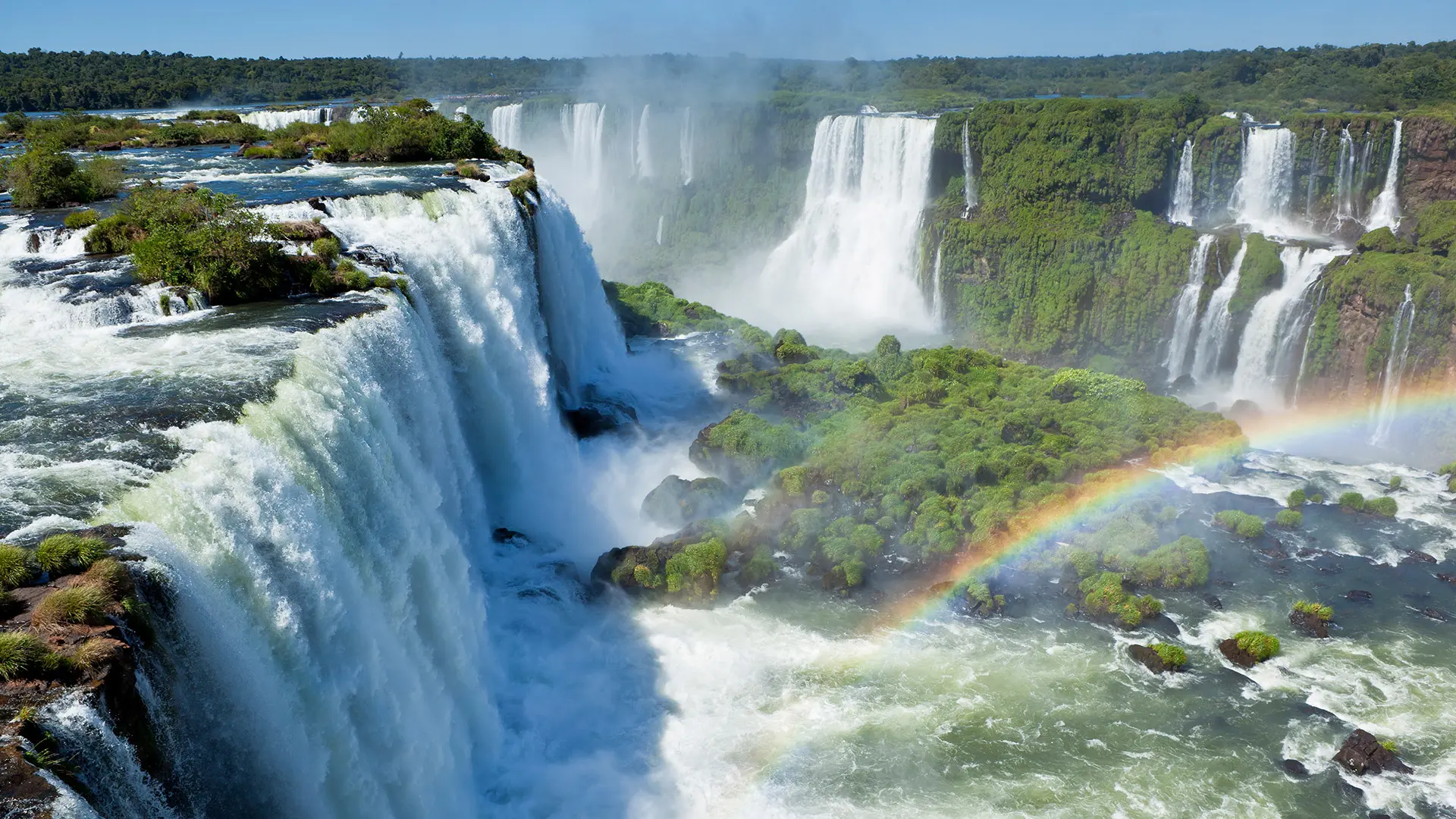
Iguazu Falls is one of South America’s most remarkable natural attractions. Located on the border between Argentina and Brazil, the waterfall system combines immense scale, dense subtropical rainforest, exceptional wildlife, and viewpoints that allow visitors to experience the falls from several perspectives.
Here are nine facts that explain what makes Iguazu Falls so special and internationally famous.
Why Is Iguazu Falls So Famous?
Iguazu Falls is famous for combining extraordinary scale, approximately 275 waterfalls, drops of up to 80 meters, and a protected subtropical rainforest filled with wildlife. The waterfall system extends for approximately 2.7 kilometers along the border between Argentina and Brazil. Both surrounding national parks are UNESCO World Heritage Sites, making Iguazu internationally important for its scenery, biodiversity, and conservation value.
Iguazu Falls at a Glance
| Fact | Key Information |
|---|---|
| Location | On the Iguazu River, between Misiones Province in Argentina and Paraná State in Brazil |
| Maximum height | Approximately 80 meters (262 feet) |
| Total width | Approximately 2.7 kilometers (1.7 miles) |
| Number of waterfalls | Traditionally described as around 275 individual waterfalls and cascades |
| Most famous section | Devil’s Throat, known as Garganta del Diablo in Spanish and Garganta do Diabo in Portuguese |
| Countries | Argentina and Brazil |
| Protected areas | Iguazú National Park in Argentina and Iguaçu National Park in Brazil |
| UNESCO status | The Argentine park was inscribed in 1984 and the Brazilian park in 1986 |
| Name origin | The name comes from Guaraní and is commonly translated as “Big Water” or “Great Water” |
| Ecosystem | Paranaense subtropical rainforest, part of the Interior Atlantic Forest |
| Wildlife | Toucans, coatis, monkeys, butterflies, caimans, tapirs, ocelots, giant anteaters and jaguars |
| International recognition | One of the New7Wonders of Nature |
| Best way to experience it | Visit both national parks: Argentina for immersive walkways and Brazil for panoramic views |
These figures describe the complete waterfall system rather than one uninterrupted drop. The number and appearance of the individual cascades can change visually according to the level of the Iguazu River.
1. Iguazu Falls Is Shared by Argentina and Brazil
The waterfall system lies along the Iguazu River, between the Argentine province of Misiones and the Brazilian state of Paraná.
Each country protects its side within a separate national park:
- Iguazú National Park in Argentina.
- Iguaçu National Park in Brazil.
Although the parks protect the same natural attraction, they have independent entrances, tickets, walking circuits, and visitor services.
The Argentine side offers a longer and more immersive visit, with walkways above and beside several waterfalls. The Brazilian side has a shorter main circuit and provides broader panoramic views of the complete system.
Visiting both parks is the best way to appreciate the destination from every angle. See more about Iguazu Falls Brazil and Iguazu Falls Argentina here.
2. The System Has Around 275 Waterfalls
Iguazu Falls is not a single waterfall. It is a vast system traditionally described as comprising approximately 275 individual waterfalls and cascades distributed along the Iguazu River.
Its appearance changes according to the river level. During periods of high water, some individual drops appear to merge into larger curtains. When the level is lower, the separate channels, rocky formations, and forested islands become easier to distinguish.
This constantly changing landscape means the falls can look noticeably different from one visit to another.
3. Iguazu Falls Stretches for Almost Three Kilometers
The waterfall system extends for approximately 2.7 kilometers, making it one of the widest and most spectacular waterfall formations in the world. Some sections reach around 80 meters in height.
Much of its visual impact comes from the combination of numerous cascades, rapids, forested islands, and permanent clouds of mist rather than from one uninterrupted drop.
The Brazilian viewpoints are particularly effective for appreciating this width, while the Argentine walkways allow visitors to explore individual sections at closer range.
4. Iguazú National Park Is a UNESCO World Heritage Site
Iguazú National Park on the Argentine side was established in 1934 and covers approximately 67,700 hectares. UNESCO inscribed it as a World Heritage Site in 1984 in recognition of its exceptional scenery and biodiversity.
The neighboring Iguaçu National Park in Brazil received its own UNESCO designation in 1986. Together, the two protected areas preserve one of the most significant remaining sections of the Interior Atlantic Forest.
The destination is therefore important not only because of its waterfalls, but also because of the threatened subtropical ecosystem that surrounds them.
5. It Is One of the New7Wonders of Nature
Iguazu Falls was selected as one of the New7Wonders of Nature through an international public-voting campaign.
The preliminary results were announced in November 2011, and Iguazu Falls was later officially confirmed as one of the winners. Argentina and Brazil shared the candidacy, reflecting the cross-border nature of the destination.
This recognition is separate from its UNESCO World Heritage status. UNESCO evaluates sites according to natural and cultural heritage criteria, while New7Wonders was an independent global voting initiative.
6. The Name Iguazú Means “Big Water”
The name Iguazú comes from Guaraní and is commonly translated as “Big Water.”
It is generally associated with the words y, meaning water, and guasu, meaning big or great. The name accurately reflects the extraordinary scale of the river and waterfall system.
Guaraní culture has deep historical roots in the region, long predating the creation of the national parks and the development of Iguazu Falls as an international tourist destination.
7. The Surrounding Forest Has Exceptional Biodiversity
The waterfalls are surrounded by the Selva Paranense, a subtropical rainforest that forms part of the Interior Atlantic Forest.
The protected environment supports approximately 2,000 plant species, around 400 bird species, and a wide variety of mammals, reptiles, amphibians, fish, and invertebrates.
Animals that visitors may encounter near the public areas include:
- Toucans.
- Coatis.
- Monkeys.
- Butterflies.
- Tegus.
- Caimans.
- Turtles.
The wider forest is also home to tapirs, ocelots, giant anteaters, and jaguars, although these larger and more elusive animals are rarely seen along the tourist circuits.
One of the species most closely associated with the falls is the great dusky swift. These birds can fly through the mist and nest on wet rock walls behind the falling water.
Visitors should never touch or feed wildlife. Feeding animals changes their natural behavior and can lead to bites, scratches, and conflicts with people.
8. Devil’s Throat Is Its Most Powerful Section
Devil’s Throat, known in Spanish as Garganta del Diablo and in Portuguese as Garganta do Diabo, is the most concentrated and dramatic section of Iguazu Falls.
Several channels of the upper Iguazu River converge before dropping into a deep, semicircular chasm. The force of the water produces enormous clouds of mist and a continuous roar that can be heard before reaching the viewpoint.
On the Argentine side, visitors reach the Devil’s Throat balcony by taking the ecological train and following a long, flat walkway across the upper river. The final platform stands directly above the main drop, creating a much closer and more immersive experience than a conventional panoramic viewpoint.
The volume of water changes considerably throughout the year. After heavy rainfall, the falls may become more powerful, but the additional mist can also reduce visibility.
9. You Can Experience the Falls From Several Perspectives
Several experiences are offered to explore Iguazu Falls from different perspectives.
On the Argentine side, visitors can walk along the Upper and Lower circuits, travel through the forest aboard the ecological train, and approach Devil’s Throat from above.
The Brazilian side provides the most complete panoramic view of the waterfall system from across the river. Its main walkway gradually reveals the scale of the falls before reaching a platform surrounded by spray.
Additional experiences may include:
- Boat rides near the lower cascades.
- Helicopter flights from the Brazilian side.
- Birdwatching and rainforest activities.
- Full moon visits on selected nights.
- Guided tours combining both national parks.
Each experience reveals a different aspect of the destination. The walkways show the details and force of individual waterfalls, while the panoramic viewpoints reveal the scale of the complete system.
Iguazu Falls Compared With Niagara Falls and Victoria Falls
Iguazu, Niagara, and Victoria are frequently compared, but each is impressive for a different reason. Measurements are not perfectly equivalent because the three destinations have different geological formations and consist of different numbers of drops.
| Waterfall | Approximate width | Approximate height | Structure | Natural setting |
|---|---|---|---|---|
| Iguazu Falls | 2.7 km | Up to 80 m | Approximately 275 waterfalls and cascades | Subtropical Atlantic Forest between Argentina and Brazil |
| Niagara Falls | Horseshoe Falls: approximately 670 m | Horseshoe Falls: approximately 57 m | Three principal falls with an exceptionally concentrated flow | Niagara River between Canada and the United States |
| Victoria Falls | Approximately 1.7 km | Average drop of about 100 m, reaching 108 m at its deepest point | A broad, nearly continuous curtain during periods of high flow | Zambezi River between Zambia and Zimbabwe |
Is Iguazu Falls Bigger Than Niagara Falls?
Iguazu Falls is considerably wider than Niagara’s principal Horseshoe Falls and reaches a greater maximum height. Iguazu also consists of hundreds of individual cascades spread across islands, channels, and forested cliffs.
Niagara is more concentrated and is particularly famous for the immense volume of water passing over its relatively compact crest. Iguazu feels more extensive and exploratory, while Niagara presents much of its power within a smaller area.
Is Iguazu Falls Bigger Than Victoria Falls?
Iguazu Falls is wider as a complete waterfall system, extending for approximately 2.7 kilometers compared with Victoria Falls’ width of about 1.7 kilometers. Victoria Falls, however, has a greater vertical drop, reaching approximately 108 meters at its deepest point.
Their structures are also different. Victoria Falls can form an enormous, almost continuous curtain of falling water during periods of high flow. Iguazu is divided into numerous individual waterfalls, rapids, islands, and channels, creating a more varied landscape that visitors can explore from multiple viewpoints.
Which Waterfall Is the Most Impressive?
There is no objective winner because each waterfall offers a different experience:
- Iguazu Falls stands out for its width, hundreds of cascades, rainforest biodiversity, and the possibility of experiencing the falls from two countries and many different walkways.
- Niagara Falls is renowned for its concentrated power, enormous flow, accessibility, and dramatic urban setting between Canada and the United States.
- Victoria Falls is famous for its height and for forming one of the world’s largest curtains of falling water when the Zambezi River is at high flow.
What makes Iguazu particularly distinctive is the combination of scale and immersion. Visitors do not simply observe the waterfall system from one viewpoint: they can walk above the river, approach individual cascades, stand close to Devil’s Throat, explore the surrounding rainforest, and see the complete panorama from the Brazilian side.
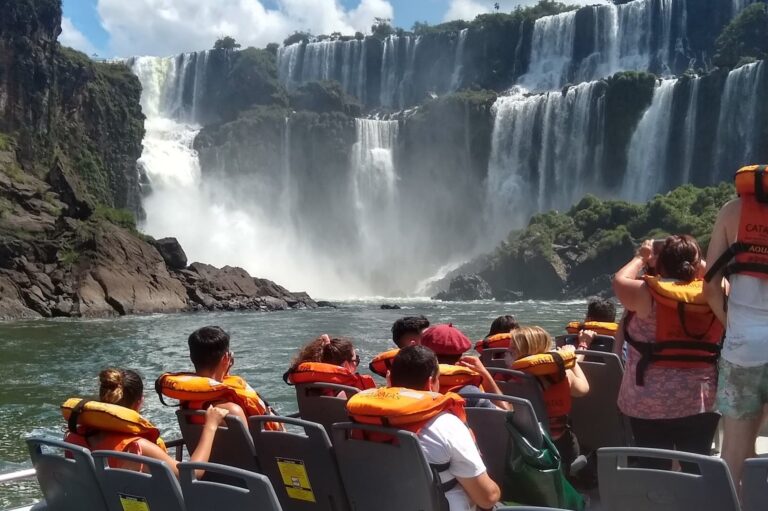
3 Day Tour to Iguazu Falls From Buenos Aires
Experience the awe of Iguazu Falls on a 3-day tour from Buenos Aires. Book now for an unforgettable adventure!
- Traditional
From Price: USD190
Why Is Iguazu Falls So Special?
Iguazu Falls stands out because of the combination of its size, number of cascades, rainforest setting, biodiversity, and variety of viewpoints.
It is not only a spectacular waterfall destination. It is also part of an extensive protected ecosystem shared by two countries and recognized internationally for both its natural beauty and conservation value.
For the most complete experience, visitors should explore the Argentine and Brazilian sides. Each offers a distinct perspective, and together they reveal why Iguazu Falls is considered one of the world’s most extraordinary natural attractions.
3 Day Tour to Iguazu Falls From Buenos Aires
Experience the awe of Iguazu Falls on a 3-day tour from Buenos Aires. Book now for an unforgettable adventure!
- Traditional
From Price: USD190
