

Iguazú Falls may be the most famous attraction in the region, but the waterfalls are only one part of a much larger—and increasingly vulnerable—natural system. Surrounding them is the Upper Paraná Atlantic Forest, known in Argentina as the Selva Paranaense or Selva Misionera. This subtropical forest once stretched continuously across large areas of Argentina, Brazil and Paraguay.
Today, Iguazú and Iguaçu National Parks protect one of the most important remaining blocks of that forest. Yet protection inside the parks does not eliminate the pressures developing around their borders. Forest clearing, agricultural expansion, illegal extraction, roads, urban development, poaching, invasive species, extreme weather and poorly connected forest fragments all affect the long-term health of the ecosystem.
At the same time, recent satellite monitoring, reforestation programs, wildlife surveys and cross-border conservation projects show that environmental decline is not inevitable. Some indicators have improved, especially on the Brazilian side, although the recovery remains fragile.
One single amazing destination, three different countries!
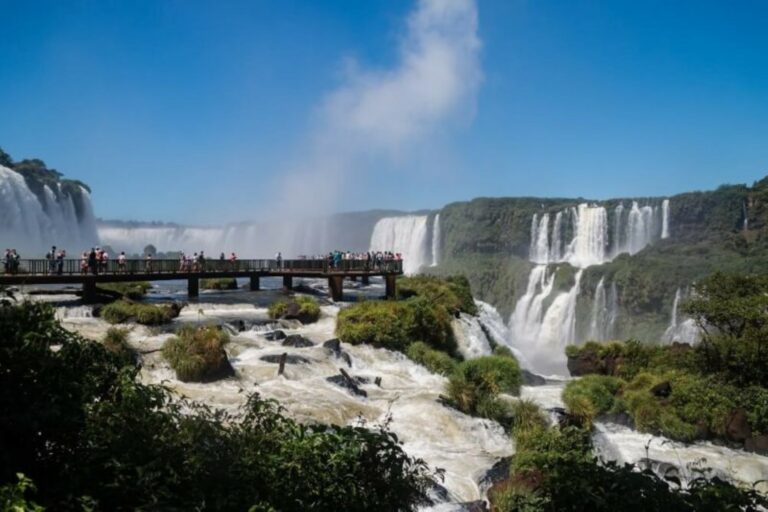
The forest surrounding Iguazú Falls is part of the Atlantic Forest biome, one of the world’s most biologically diverse and threatened ecosystems.
Unlike the Amazon, the Atlantic Forest is not a single unbroken tropical wilderness. It follows Brazil’s Atlantic side and extends inland into eastern Paraguay and the Argentine province of Misiones. The inland portion around Iguazú is generally called the Upper Paraná Atlantic Forest.
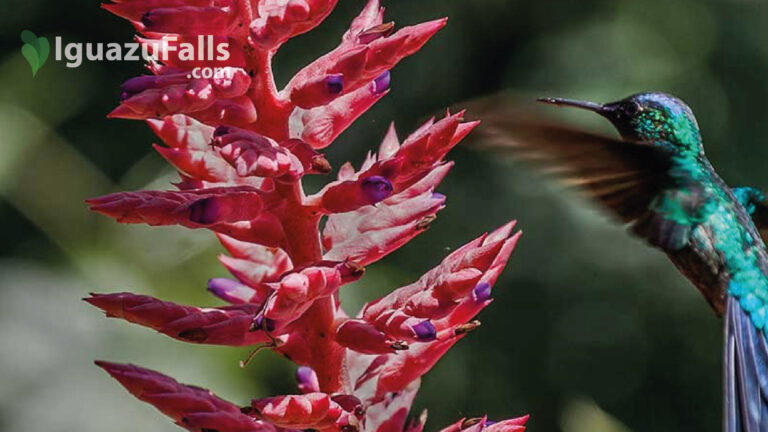
This forest has several layers. Tall trees form a closed canopy, while palms, tree ferns, bamboo, vines, orchids, bromeliads and shade-tolerant plants occupy the humid understory. The region supports jaguars, pumas, ocelots, tapirs, peccaries, monkeys, toucans, parrots, butterflies and hundreds of other species.
Misiones contains an extraordinarily large share of Argentina’s biodiversity. An Argentine government conservation program estimates that around half of all species and subspecies recorded in the country occur in this province. It also identifies fragmentation, isolation and degradation of forest patches as the region’s principal conservation threats. Argentina’s Paraná Forest Corridor
The protected forests on the two sides of the falls are especially important. Argentina’s Iguazú National Park protects more than 67,000 hectares, while Brazil’s Iguaçu National Park covers approximately 170,000 hectares. Together they form a large transboundary refuge, but even this combined protected area cannot function in complete isolation from the surrounding landscape.
When discussing environmental problems in Misiones, the Spanish term desmonte usually refers to the removal of native vegetation to change how the land is used. It should not be confused with routine removal of weeds or vegetation maintenance around buildings and trails.
Complete clearance is the most visible form of destruction, but forest degradation can occur in several ways:
A landscape can therefore still appear green while having lost much of its ecological quality. Pine or eucalyptus plantations, agricultural fields and secondary vegetation may look forested from a distance, but they cannot fully replace a mature native ecosystem.
DISCOVER A WONDERFUL PLACE TO ENJOY BIRDWATCHING. BE READY WITH YOUR BINOCULARS.

The creation of the Misiones Green Corridor in 2000 was intended to preserve connections between Iguazú National Park, provincial parks, private reserves and other forest areas. The corridor covers approximately 1.1 million hectares, or close to 37% of Misiones.
However, a study published by the University of Buenos Aires’ Faculty of Agronomy in 2025 found that almost 130,000 hectares of native forest were lost inside the Green Corridor between 1990 and 2020. This represented approximately 13% of its original forest area.
The average size of the remaining forest patches decreased from 285 to 215 hectares. The number of individual patches doubled, while the average distance between them increased from 94 to 246 meters. Areas that were cleared were mainly converted into annual and perennial crops, commercial plantations and pasture. University of Buenos Aires – Green Corridor study
These figures describe the Green Corridor as a whole, not Iguazú National Park itself. The core forest within the national park remains strongly protected. The most serious deforestation pressure is found outside formally protected areas and in the corridors that should connect them.
This distinction is essential. The immediate landscape seen by visitors at the waterfalls remains densely forested, but the ecological health of the park depends on what happens many kilometers beyond its tourist circuits.
Losing a section of forest is damaging, but dividing the remaining forest into isolated islands creates additional problems.
Jaguars, tapirs, peccaries and other large mammals need extensive territories. When forest patches become separated by farms, roads or urban areas, animals must cross exposed landscapes. This increases the risk of road accidents, poaching and conflict with livestock owners.
Small, isolated animal populations have fewer opportunities to reproduce with individuals from other areas. Over time, reduced genetic diversity can make populations less resilient to disease and environmental change.
Many Atlantic Forest trees depend on birds and mammals to carry their seeds. When animals cannot move between forest fragments, the forest’s ability to regenerate is reduced.
A small forest patch has proportionally more exposed edges than a large continuous forest. Along those edges, temperatures are higher, humidity is lower and wind penetrates more easily. This changes the vegetation and increases vulnerability to invasive species and fire.
Roads and clearings can facilitate illegal hunting, timber extraction and the removal of valuable plants such as the juçara palm, whose heart has historically been harvested illegally.
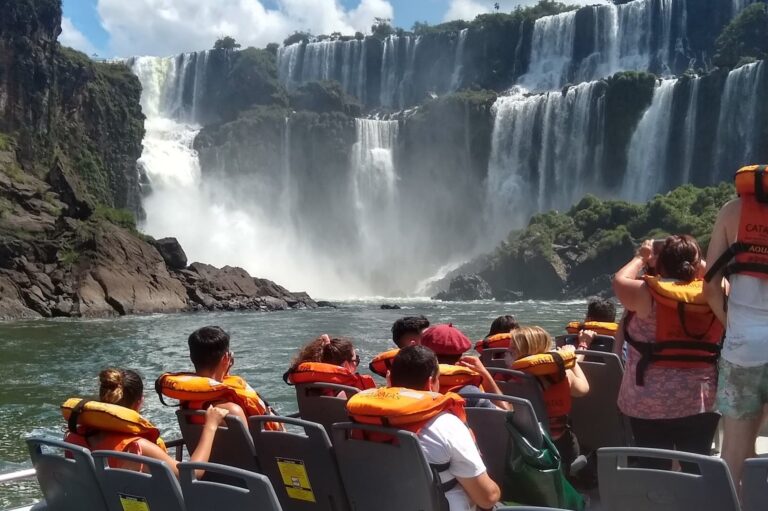
Experience the awe of Iguazu Falls on a 3-day tour from Buenos Aires. Book now for an unforgettable adventure!
From Price: USD190
Agriculture is one of the principal causes of forest conversion around the Upper Paraná Atlantic Forest.
Misiones is an important producer of yerba mate, tea, tobacco, citrus fruits and timber. Brazil and Paraguay also have extensive areas of soybeans, maize, pasture and commercial tree plantations.
These activities support regional economies and rural communities, so the conservation challenge cannot be addressed simply by opposing all agricultural production. The central question is where and how production takes place.
Some of the most effective conservation programs now work directly with farmers. They encourage agroforestry, restoration of stream banks, recovery of degraded fields, preservation of forest strips and production methods that reduce pressure on native vegetation.
Growing yerba mate beneath native trees, for example, can maintain more ecological functions than completely clearing land for an intensive monoculture. It is not identical to natural forest, but it can create a more permeable landscape through which wildlife and plant species can move.
Illegal extraction remains a concern in the wider Atlantic Forest, although recent assessments indicate that tree cutting and palm-heart extraction are no longer considered major threats inside Iguazú National Park itself.
Poaching is a more persistent problem. Hunters may target peccaries, deer, pacas and other animals. Removing these species affects predators such as jaguars, which depend on abundant natural prey.
When prey becomes scarce or forest boundaries approach cattle farms, jaguars may attack livestock. This can lead to retaliatory killing.
Conservation programs now respond to this problem by helping farmers protect their animals, documenting incidents and working to change the perception of jaguars in rural communities. The goal is to prevent conflict rather than simply reacting after an animal has been killed.
Unveiling the Wonders of Argentina: Explore Buenos Aires and Iguazu Falls on a 6-Night Journey

Roads are among the most significant sources of forest fragmentation.
On the Argentine side, National Route 101 passes through a sensitive forest environment. Wildlife crossings, speed controls and monitoring have been introduced to reduce collisions. Nevertheless, roads continue to create noise, pollution, edge effects and access points for illegal activities.
Puerto Iguazú and Foz do Iguaçu are both growing tourism cities. Housing, hotels, commercial areas and other infrastructure place additional pressure on nearby forest fragments.
Foz do Iguaçu’s Municipal Plan for the Conservation and Recovery of the Atlantic Forest identifies extensive agriculture, livestock, illegal logging and urban expansion as principal sources of environmental pressure. It defines 18 priority areas around Itaipu, central Foz do Iguaçu and the surroundings of Iguaçu National Park. Foz do Iguaçu Atlantic Forest Plan
Urban forest fragments can still be valuable. They protect streams, reduce temperatures, store carbon and provide stepping stones for birds and smaller animals. But these areas require deliberate protection before they are absorbed by development.
Tourism provides a strong economic reason to preserve Iguazú Falls and its forest. Entrance fees, tourism businesses and international recognition help finance conservation and create employment connected to nature.
However, tourism also produces environmental pressure.
Large visitor numbers require roads, trains, walkways, restaurants, hotels, waste-management systems and other facilities. According to the IUCN, Iguazú National Park recorded more than 1.5 million visitors in both 2019 and 2023. Peak periods can exceed the capacity of existing infrastructure.
Visitors may also affect wildlife by feeding animals, leaving waste, making excessive noise or approaching animals for photographs. Coatis are particularly affected by human food. Feeding them changes their behavior, increases aggression and exposes both animals and visitors to injury and disease.
Responsible tourism therefore depends on concentrating visitors in well-managed areas, limiting expansion into sensitive forest, controlling waste and educating travelers.
Enjoy a unique 3-night birdwatching tour in rainforest lodge
Deforestation is not the only threat. The Iguazú ecosystem is increasingly affected by changing rainfall and temperature patterns.
The IUCN considers climate change a high-level threat to the parks. Increased temperatures, exceptional floods, droughts and changing seasonal rainfall can affect forest structure, aquatic habitats, amphibians and other sensitive species.
During severe floods, walkways may have to close and sections can be damaged by the power of the river. During droughts, the volume of the falls can decline dramatically, while drier vegetation becomes more vulnerable to fire.
Forest loss can intensify these effects. Healthy forests absorb rainfall, stabilize soil, protect streams and gradually release water into rivers. Cleared or degraded land produces faster runoff, more erosion and less stable local water systems.
The Iguazú River begins in Brazil and passes through a heavily modified basin before reaching the national parks. Hydroelectric dams upstream affect the timing and variability of river flows.
The Baixo Iguaçu Hydroelectric Plant, located downstream from the Brazilian park, has also required extensive environmental monitoring and mitigation programs.
A 2025 IUCN assessment noted that the required minimum flow at the falls was being maintained as of June 2024. Nevertheless, it warned that the cumulative effects of dams and climate change require continued binational monitoring.
Hydroelectric power has lower direct carbon emissions than fossil-fuel generation, but dams can still alter aquatic ecosystems, sediment transport, fish movement and flood patterns. Their environmental effects must therefore be considered beyond the amount of electricity produced.
Invasive plants and animals are another less visible problem.
The Argentine park has identified more than 100 non-native plant species, in addition to exotic fish. These species can compete with native vegetation, alter food webs and change aquatic environments.
Invasive plants often spread more easily along roads, disturbed forest edges and cleared land. Once established, removing them can be expensive and labor-intensive.
Prevention is generally more effective than eradication. This requires monitoring, rapid response and careful management of ornamental plants, soil movement, tourism facilities and waterways.
Visit Three Beautiful Destinations in 9 Nights

The jaguar is one of the best indicators of the overall condition of the Iguazú forest.
During the 1990s and early 2000s, jaguar numbers in the region fell dramatically because of hunting, prey loss, habitat fragmentation and retaliatory killing. Coordinated conservation then produced an important recovery.
A joint Argentina–Brazil survey estimated 93 jaguars in the Green Corridor in 2022, compared with approximately 40 in 2005. However, the latest binational results released in 2025 estimated an average population of 84 animals, with a possible range of 64 to 110.
The lesson is clear: saving jaguars requires more than protecting the interior of two national parks. It requires maintaining prey populations, preventing hunting and reconnecting forest throughout Misiones, Paraná and eastern Paraguay.
Several restoration efforts are now moving beyond isolated tree-planting campaigns.
A restoration plan developed during 2024 and 2025 identified approximately 20,000 hectares affected by unauthorized deforestation and forest fires inside the Misiones Green Corridor.
The plan prioritizes areas that can reconnect forest fragments, protect watersheds and support rural economies. Its landscape-restoration approach recognizes that ecological recovery and local livelihoods must be planned together.
Between 2008 and 2024, Fundación Vida Silvestre Argentina worked with more than 150 rural families to restore over 500 hectares in Misiones, planting more than 220,000 native trees.
A new phase includes 31 additional families and another 124 hectares of restoration. The project also supports agroforestry, beekeeping, horticulture, livestock management and more sustainable yerba mate production.
These figures are small compared with the total area lost, but the location of restoration can be as important as its size. A relatively narrow forest strip can reconnect two large habitats, protect a stream or provide wildlife with a safer route across farmland.
The Brazilian state of Paraná has reported a major decline in Atlantic Forest clearing.
According to the state government and the Atlantic Forest Deforestation Alert System, the area cleared in Paraná fell from 3,298 hectares in the 2020–2021 period to 411 hectares in 2024–2025—a reduction of 87.5%.
Authorities attribute part of this improvement to satellite imagery, geographic intelligence and monitoring systems that issue nearly daily alerts, allowing inspectors to respond more quickly.
This is encouraging, but 411 hectares of additional loss is not insignificant in an already fragmented biome. Lower annual deforestation also does not automatically restore ecological connections lost during previous decades.
Brazil has also been restoring forest around the Baixo Iguaçu hydroelectric reservoir and the boundaries of Iguaçu National Park.
The IUCN reports that approximately 223 hectares were restored between May 2022 and February 2024. The broader initiative seeks to restore 1,700 hectares while connecting native forest fragments and increasing monitoring of hunting, fishing and illegal extraction.
Embark on an Epic Journey: 9 Nights of Adventure, Natural Wonders, and Cultural Marvels in Argentina!

Nature does not recognize international borders. A jaguar may move between Argentina and Brazil, while rivers and migratory birds connect all three Triple Frontier countries.
For this reason, Argentina, Brazil and Paraguay created the Trinational Atlantic Forest Restoration Network. It brings together government agencies, conservation organizations, researchers, Indigenous representatives, farmers and businesses.
In July 2024, 64 participants representing 43 institutions met in Foz do Iguaçu to evaluate restoration efforts and establish regional priorities. The network now involves more than 70 organizations and forms part of an Atlantic Forest restoration initiative recognized by the United Nations as a World Restoration Flagship.
Itaipu Binacional has also reported restoring more than 2,500 hectares in Paraguay through its conservation programs. These projects are especially relevant because forest near the Paraná River can help create connections between reserves and protect water quality.
The challenge is to turn meetings and individual projects into a continuous, coordinated landscape strategy with compatible monitoring across all three countries.
Experience the awe of Iguazu Falls on a 3-day tour from Buenos Aires. Book now for an unforgettable adventure!
From Price: USD190
Recent progress shows that better enforcement and restoration can work, but several priorities remain.
Restoration cannot compensate for the continued destruction of mature native forest. A newly planted area may take decades to recover some of the structure and biodiversity of an old forest.
Conservation efforts should prioritize land that connects Iguazú and Iguaçu National Parks with other protected areas. Without corridors, even large parks can become ecological islands.
Farmers and Indigenous communities must be included in planning and decision-making. Conservation programs are more durable when they also improve livelihoods, land security and local access to technical assistance.
Illegal hunting, wildlife trafficking and timber extraction can move across national boundaries. Argentina, Brazil and Paraguay need coordinated patrols, information-sharing and compatible monitoring.
Parks and tourist facilities need plans for more frequent floods, droughts, heat and fire. Protecting watersheds and restoring riparian forest should be central to climate adaptation.
Successful restoration should be measured by tree survival, water quality, returning wildlife and improved connectivity—not merely by the number of seedlings placed in the ground.
Enjoy a wonderful 4-night tour to visit Iguazu Falls and discover the atlantic rainforest
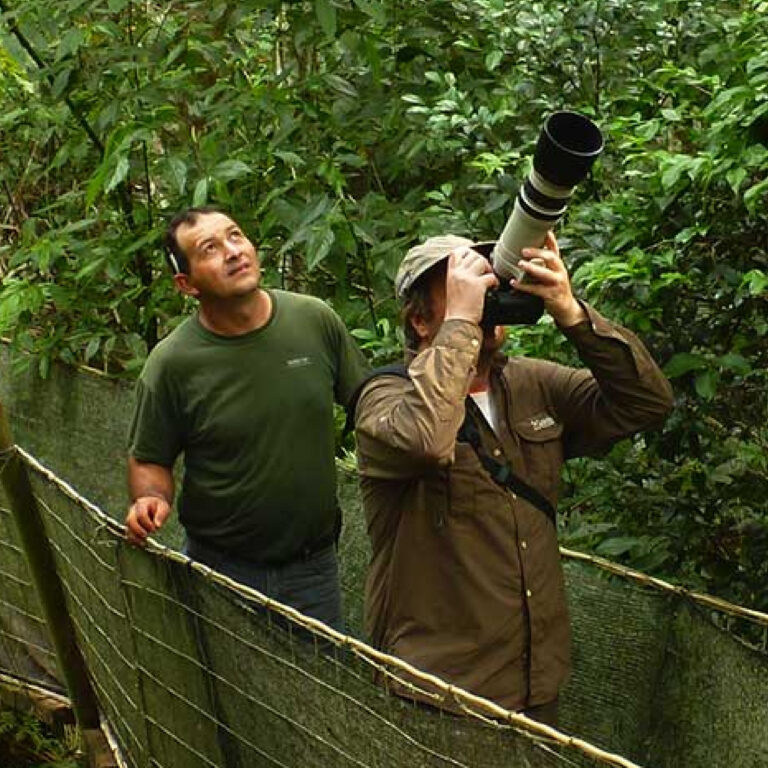
Travelers cannot solve the region’s environmental problems alone, but responsible behavior matters.
Visitors should:
Tourism can be a powerful conservation tool when visitors understand that the surrounding forest is not merely a backdrop. It is the living system that protects the rivers, wildlife and landscapes they have traveled to see.
Experience Argentina’s Icons with Comfort and Style

The Upper Paraná Atlantic Forest remains under serious pressure. Decades of clearing have reduced its area, divided the surviving forest into smaller fragments and placed species such as the jaguar at risk.
Yet the Iguazú region also demonstrates what sustained conservation can achieve. National parks protect a major binational forest block. Jaguar populations recovered from near-local extinction. Satellite systems are identifying clearing more rapidly. Farmers are participating in agroforestry and restoration. Argentina, Brazil and Paraguay are beginning to coordinate their efforts across borders.
The latest figures are neither a reason for complacency nor a story of inevitable environmental collapse. They show a forest at a critical point.
Protecting Iguazú now means looking beyond the waterfalls. The future of the region depends on preserving native forest outside the parks, reconnecting isolated fragments, supporting rural communities and treating the entire Triple Frontier as one shared ecosystem.
Experience the awe of Iguazu Falls on a 3-day tour from Buenos Aires. Book now for an unforgettable adventure!
From Price: USD190

Experience the wonder of Iguazu Falls on a private 2 day tour from Buenos Aires. Easily reserve accommodations and optional activities. Book now!
From Price: USD150
