
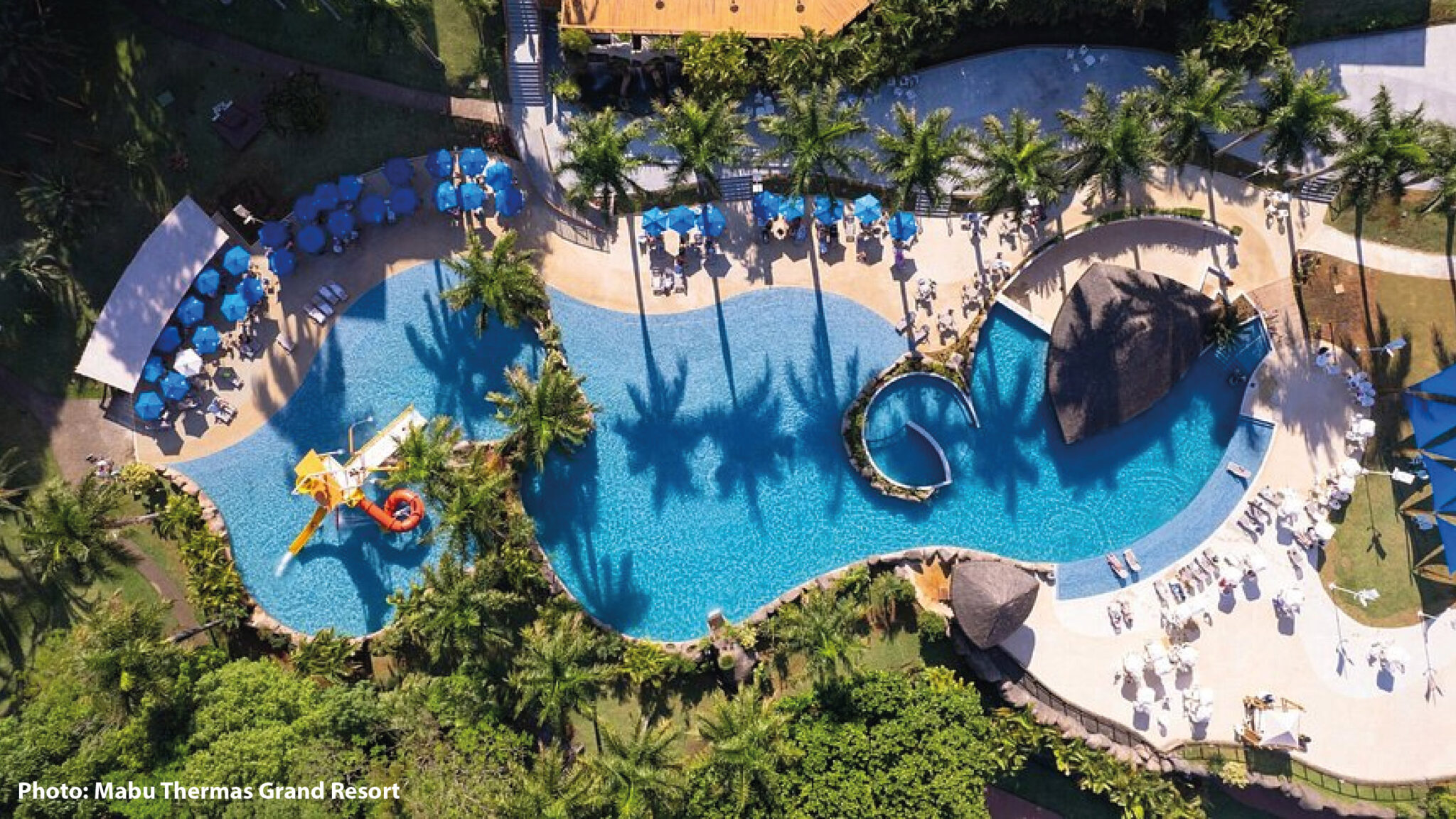
Iguazu Falls is famous for thunderous cascades, subtropical rainforest and extraordinary wildlife. Yet the wider destination offers another, quieter relationship with water. Beyond the national parks, visitors can find thermal pools, aquatic resorts and wellness experiences supplied by underground water associated with the vast Guarani Aquifer.
These experiences provide an appealing contrast to a demanding day at the waterfalls. After walking through humid forest trails, climbing stairways and approaching the mist of the cascades, travelers can spend several hours relaxing in warm water surrounded by tropical vegetation.
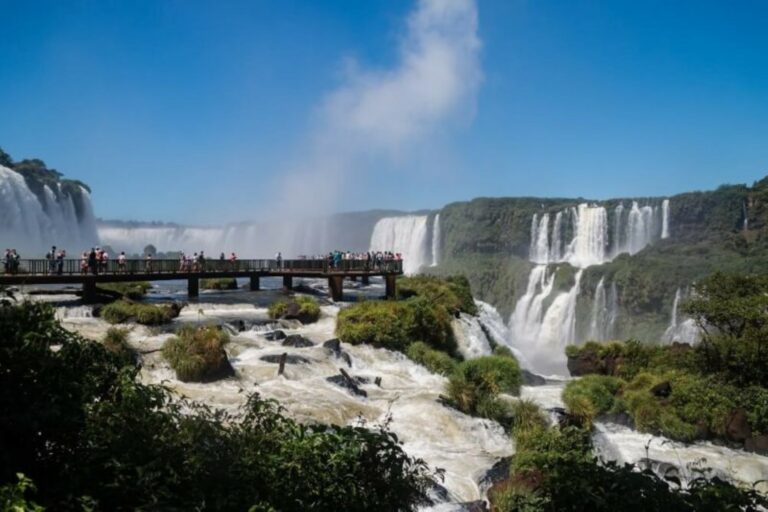
However, it is important to understand exactly what “thermal waters in Iguazu” means. The falls themselves are not hot springs, and visitors cannot bathe in the waterfalls inside Iguazú National Park or Iguaçu National Park. Thermal bathing takes place in developed facilities elsewhere in the region, particularly around Foz do Iguaçu on the Brazilian side.
The water flowing over Iguazu Falls is surface water carried by the Iguazu River. It travels across the basalt landscape of southern Brazil before descending through a system of approximately 275 waterfalls along the border between Argentina and Brazil.
The thermal waters used by resorts and recreational facilities have a different origin. They are groundwater extracted from underground geological formations, often associated with the Guarani Aquifer System.
This distinction matters. The waterfalls are part of a protected natural ecosystem, while thermal pools are managed recreational or wellness environments outside the national parks. Both experiences involve water, but their geological origins, temperatures and tourism uses are entirely different.
Iguazú National Park in Argentina and Iguaçu National Park in Brazil protect one of the most important remnants of the Atlantic Forest as well as the waterfall system itself. The Argentine park was inscribed as a UNESCO World Heritage Site in 1984, followed by the Brazilian park in 1986.
One single amazing destination, three different countries!
The Guarani Aquifer System is an enormous transboundary underground reservoir extending beneath parts of Argentina, Brazil, Paraguay and Uruguay. Its water is stored primarily within layers of ancient sandstone, in many places confined beneath thick basalt formations.
The aquifer is used principally as a source of water for communities, agriculture and industry. In certain locations, its naturally warm groundwater also supports thermal tourism. According to the Organization of American States, temperatures within different sectors of the aquifer may range from approximately 33°C to 65°C. These figures describe the aquifer as a whole; the temperature delivered to an individual pool depends on the well, location and facility. The Organization of American States identifies tourism among the aquifer’s established uses.
The warmth of this groundwater is related primarily to depth. As water circulates through deep geological formations, it is heated by the Earth’s natural geothermal gradient. Wells can then bring it to the surface, where its temperature may be regulated before it enters recreational pools.
This means that Iguazu’s thermal experience is not based on volcanic activity. It comes from an immense groundwater system shaped by the geological history of the Paraná Basin.
Foz do Iguaçu is the most convenient base for travelers who want to combine the waterfalls with a thermal-water experience. The city is close to the Brazilian entrance of Iguaçu National Park and has resorts and aquatic attractions supplied by warm groundwater.
One of the best-known examples is Mabu Thermas Grand Resort. The property is located between central Foz do Iguaçu and the Brazilian side of the falls, approximately 12 kilometers from the national park. Its facilities include thermal pools and recreational areas, making it particularly suitable for families and groups. Travel Weekly’s property overview confirms its location near the falls.
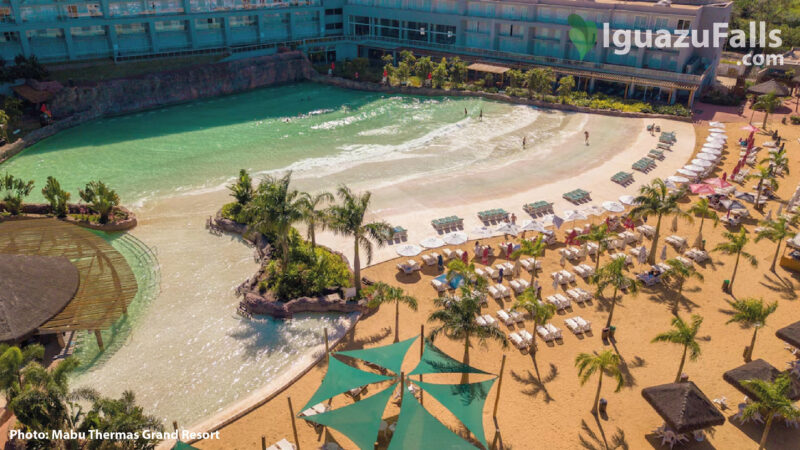
The adjoining Blue Park is designed more as a family water park than as a traditional therapeutic spa. Its principal attraction is an artificial thermal beach with waves, accompanied by slides, children’s areas and other recreational facilities. When its first phase opened, the Municipality of Foz do Iguaçu described it as the largest water park in southern Brazil. Foz do Iguaçu municipal information provides background on the project.
These facilities are appropriate for travelers looking for entertainment and warm-water recreation. Visitors seeking silence, massage treatments or an adults-oriented wellness atmosphere should instead compare the spas and heated pools offered by individual hotels.
Day admission, operating days and access policies may change according to season and private events. Travelers should therefore confirm whether a reservation or resort stay is required before visiting.
One single amazing destination, three different countries!
Puerto Iguazú, on the Argentine side, has numerous hotels with swimming pools, jacuzzis, spas and hydrotherapy services. Some are set within the forested area of Selva Iryapú, providing an attractive natural atmosphere.
Nevertheless, a heated hotel pool is not necessarily a natural thermal pool. Water can be warmed mechanically, and the presence of a spa does not automatically mean that the establishment uses geothermal groundwater.
Travelers who specifically want natural thermal water should ask the property several direct questions:
This prevents confusion between authentic thermal water, ordinary heated pools and hydrotherapy circuits.
Travelers continuing south through Misiones can visit Termas de la Selva near Oberá. This is not immediately beside Iguazu Falls: the journey from Puerto Iguazú generally requires more than three hours by road. It is therefore better treated as a separate stop on a longer tour of Misiones rather than as a short excursion after visiting the falls.
The complex occupies a green setting with native vegetation, yerba mate plantations and the characteristic red soil of Misiones. According to the Ruta de la Yerba Mate, its facilities include three thermal pools whose temperatures generally range between 38°C and 42°C, although conditions may vary. Ruta de la Yerba Mate also lists showers, changing facilities and basic visitor services.
Termas de la Selva offers a different experience from the large aquatic complexes of Foz do Iguaçu. Its appeal lies in the combination of warm pools, vegetation and the rural landscape of central Misiones. A visit can also be connected with Oberá’s multicultural heritage, local food traditions and yerba mate tourism.
A thermal-water experience around Iguazu is especially pleasant after an active day. Visiting the Argentine side of the waterfalls can involve several hours of walking between stations, forest paths and elevated walkways. The Brazilian circuit is shorter, but heat and humidity can still be tiring.
Warm pools offer a slower rhythm. The soundscape changes from roaring water and busy viewpoints to birds, rustling leaves and gentle movement in the pools. Depending on the property, visitors may also find hydromassage stations, children’s areas, saunas, relaxation rooms or massage services.
The experience varies considerably between locations:
Choosing the right facility depends on whether the traveler wants relaxation, wellness, family recreation or a complete resort stay.
Thermal facilities can be enjoyed throughout the year, but the character of the experience changes with the seasons.
During the austral summer, from December through March, Iguazu is normally hot and very humid. Warm thermal pools may be more enjoyable early in the morning, late in the afternoon or after sunset. Families may prefer aquatic facilities that also provide shaded areas and pools maintained at cooler temperatures.
Autumn and winter can be especially attractive for thermal bathing. Although Iguazu remains subtropical, cold fronts occasionally produce cool mornings and evenings. Entering a warm outdoor pool while the surrounding rainforest is cool or misty can be one of the most memorable ways to experience the region.
Spring offers a balance of warm weather, active wildlife and generally comfortable conditions. Nevertheless, the region receives rainfall throughout the year, so visitors should remain flexible.
One single amazing destination, three different countries!
A thermal experience works best as a complement rather than a replacement for the waterfalls. A comfortable itinerary might include:
Day one: Visit the Argentine side of Iguazú National Park, allowing most of the day for its principal circuits.
Day two: Cross to Brazil, explore the panoramic walkway in Iguaçu National Park and visit another attraction in Foz do Iguaçu.
Day three: Reserve a morning or afternoon for thermal pools, a spa or a family aquatic park.
Travelers continuing through Misiones could add Oberá and Termas de la Selva later in the journey. This longer route can include yerba mate plantations, cultural attractions and other forest landscapes.
International visitors should remember that traveling between Puerto Iguazú and Foz do Iguaçu requires crossing an international border. Required documents depend on nationality, and waiting times can vary. It is wise to leave sufficient time and verify current entry requirements before departure.
The Guarani Aquifer is not simply a tourism resource. It is an essential freshwater reserve shared by four countries and used by millions of people. Its protection requires monitoring extraction, preventing contamination and managing recharge areas responsibly.
Tourism facilities can contribute by controlling water consumption, treating wastewater, monitoring wells and avoiding unnecessary discharge. Visitors can also make responsible choices by following pool rules, using showers efficiently and supporting businesses that publish clear environmental policies.
Warm groundwater may appear abundant, but aquifers operate on geological and hydrological timescales. Sustainable management is necessary to preserve water quality and availability for future generations.
Thermal bathing is generally associated with rest and recreation, but visitors should avoid treating it as a cure for medical conditions unless advised by a qualified professional. Very warm water can cause fatigue, dizziness or dehydration, particularly in Iguazu’s humid climate.
Visitors should follow the facility’s recommended immersion times, drink water regularly and supervise children closely. Anyone with a medical condition, limited mobility or sensitivity to heat should consult an appropriate healthcare professional and speak with facility staff before entering high-temperature pools.
Iguazu Falls represents water at its most powerful: vast, loud and constantly moving. The region’s thermal pools offer the opposite experience—warmth, stillness and time to recover.
Together, these two forms of water can create a remarkably balanced journey. The national parks provide adventure, biodiversity and one of the planet’s greatest natural spectacles. The thermal facilities of the wider region provide rest and an opportunity to appreciate the geological world hidden beneath the rainforest.
For travelers who plan carefully and understand the distinction between the waterfalls and the underground aquifer, thermal waters can become an excellent final chapter to an Iguazu itinerary.
DISCOVER A WONDERFUL PLACE TO ENJOY BIRDWATCHING. BE READY WITH YOUR BINOCULARS.

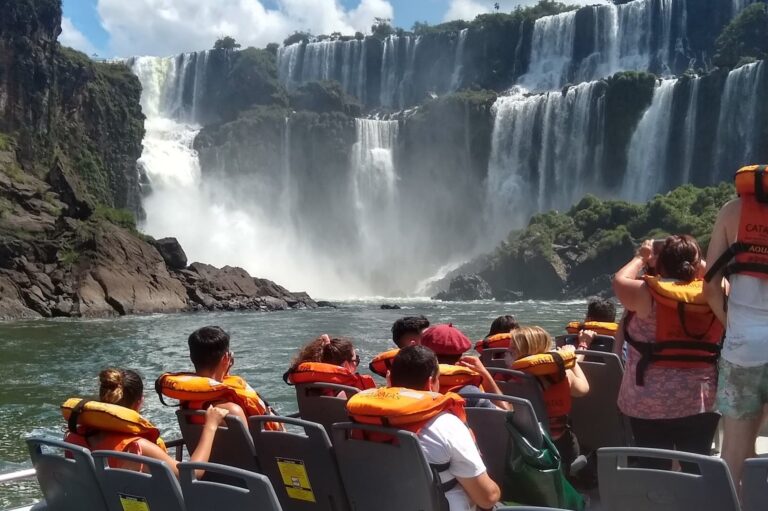
Experience the awe of Iguazu Falls on a 3-day tour from Buenos Aires. Book now for an unforgettable adventure!
From Price: USD150
