
Iguazu Falls looks as though it were designed for the cinema. Its immense curtain of water, subtropical rainforest, rocky islands and almost permanent clouds of mist can represent adventure, danger, spiritual transformation or an entirely imaginary world.
Over the decades, filmmakers from the United States, Europe, Latin America and Asia have used the falls in historical dramas, action movies, documentaries, romantic films and television series.
Not every production was filmed in the same way. Some actors and crews worked on location inside the national parks. Others used aerial photography, second-unit footage, miniature models, studio sets or digital effects. In several movies, the real Iguazu landscape was transformed into a fictional waterfall located thousands of kilometres away.

Experience the wonder of Iguazu Falls on a private 2 day tour from Buenos Aires. Easily reserve accommodations and optional activities. Book now!
From Price: USD150
Iguazu offers filmmakers more than a single waterfall. Depending on the river level, the system contains approximately 275 separate cascades distributed across nearly three kilometres.
This variety allows cinematographers to capture:
The Argentine side provides close perspectives from different heights, while the Brazilian side offers the broadest panoramic views. Aerial photography can combine both into an apparently endless natural world.
]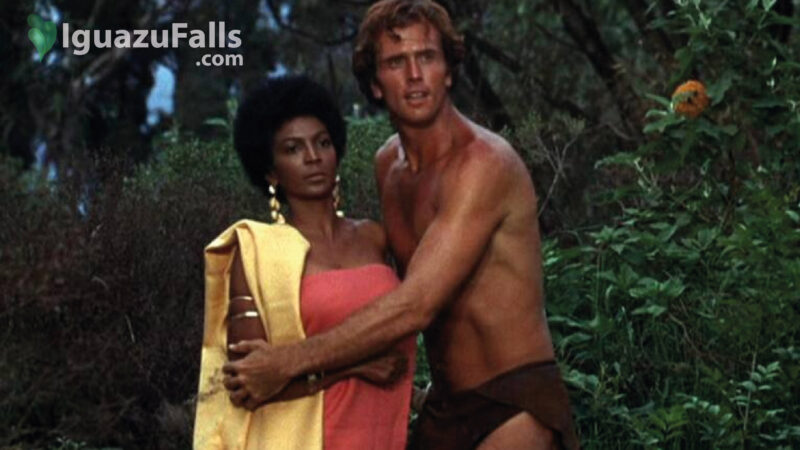
The American television series Tarzan, starring Ron Ely, was among the earliest internationally distributed productions to feature Iguazu Falls.
The series ran on NBC for two seasons and followed a more educated version of Tarzan who returned to the jungle after becoming disillusioned with civilization.
Several early episodes were filmed in Brazil before production moved to Mexico. Iguazu Falls appeared prominently in the opening sequence, where the landscape helped establish the scale and wild character of Tarzan’s fictional African environment.
The waterfall was not presented as a destination in Argentina or Brazil. Instead, it became part of an imaginary African jungle. This was an early example of Iguazu functioning as a cinematic double for another part of the world.
Although the series is less familiar to younger audiences today, it helped introduce images of Iguazu to millions of television viewers during the 1960s.
One single amazing destination, three different countries!
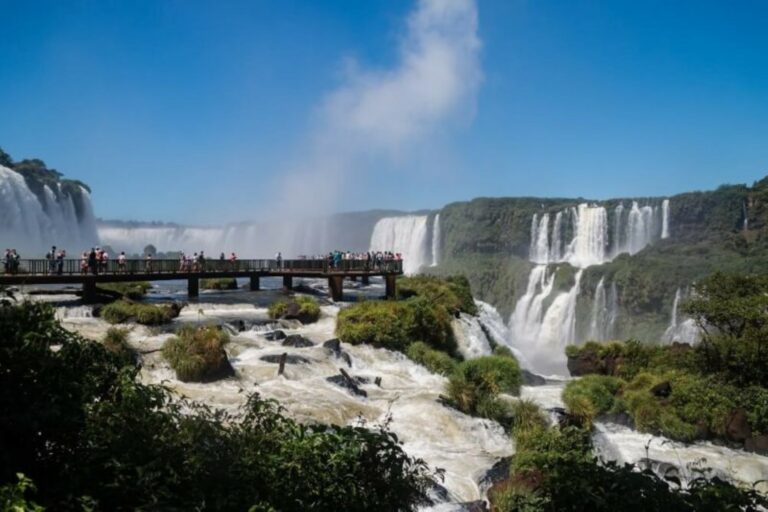
One of Iguazu’s most famous appearances came in Moonraker, the eleventh James Bond movie and the fourth starring Roger Moore.
In the film, Bond pilots a speedboat while being pursued along what is supposedly a river in the Amazon basin. As the boat approaches a massive waterfall, he escapes using a concealed hang glider while his pursuer continues toward the edge.
The waterfall is unmistakably Iguazu, even though the story places it in a different part of Brazil.
The production’s second unit filmed the real waterfalls, but completing the action sequence required several techniques.
The filmmakers reportedly considered sending an unmanned boat over the edge. The boat became trapped on rocks near the precipice, and attempts to retrieve it proved difficult and dangerous. The final fall was therefore completed with miniature work at Pinewood Studios.
The result combines:
Moonraker demonstrates how cinema can use a recognizable natural location while completely changing its geography. In the movie, the falls form part of an imaginary Amazonian route, even though Iguazu is situated far to the south on the border of Argentina and Brazil.
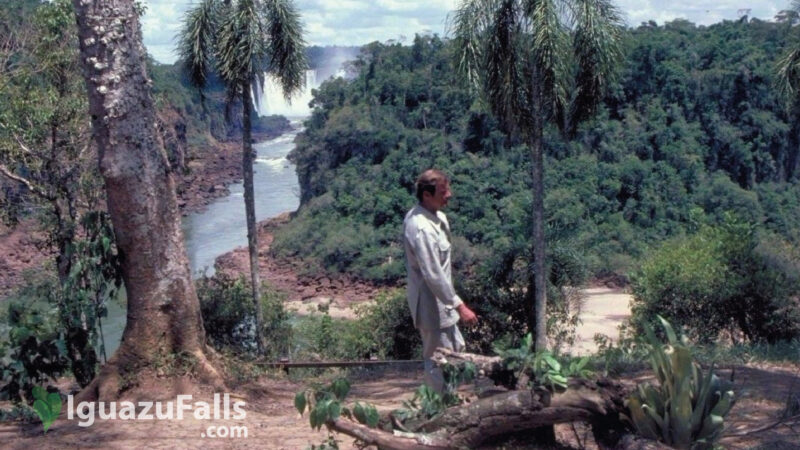
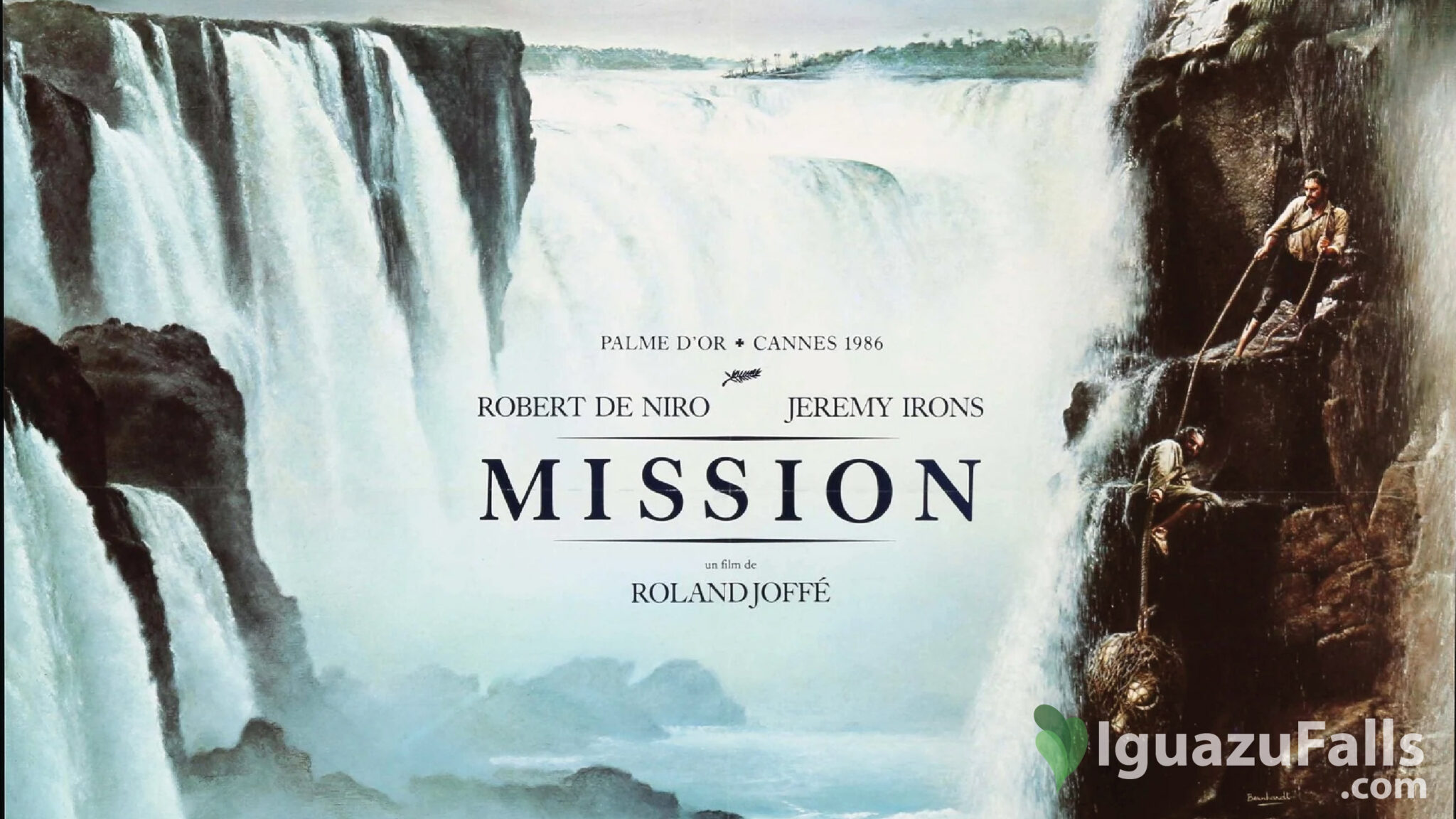
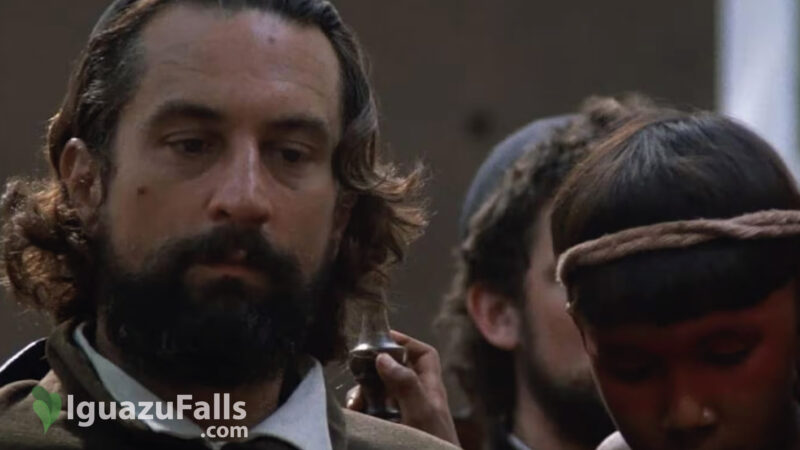
No international movie is more closely connected with Iguazu Falls than The Mission.
Directed by Roland Joffé and starring Robert De Niro, Jeremy Irons, Ray McAnally, Aidan Quinn and Liam Neeson, the historical drama tells a fictionalized story inspired by the Jesuit missions and the experiences of Guaraní communities during the eighteenth century.
The waterfalls are central to the film’s visual and spiritual identity.
At the beginning of the movie, a missionary is tied to a wooden cross by an Indigenous community and sent down the river. The cross passes over the waterfalls, immediately establishing the power and danger of the landscape.
Father Gabriel, played by Jeremy Irons, later climbs through the forest and approaches the Guaraní while playing his oboe. The combination of music, mist, forest and falling water creates one of the film’s most memorable sequences.
Another famous scene shows Rodrigo Mendoza, played by Robert De Niro, carrying a heavy bundle containing his armour and weapons through the jungle and up the rocky terrain.
The physical struggle represents his attempt to seek forgiveness after a violent personal tragedy. Iguazu’s difficult landscape is used not simply as scenery but as a symbol of suffering and transformation.
The production filmed in and around Iguazu, including areas close to the waterfalls and the surrounding rainforest. Other parts of the movie were produced in Colombia and at reconstructed mission sites.
Filming near such powerful water presented enormous logistical challenges. Equipment had to be protected from moisture, while cast and crew worked around slippery rocks, intense spray and difficult terrain.
The movie won the Palme d’Or at the Cannes Film Festival and received seven Academy Award nominations. Chris Menges won the Oscar for Best Cinematography, while Ennio Morricone’s soundtrack became one of the most celebrated scores in film history.
More than any other production, The Mission established Iguazu Falls as an internationally recognizable cinematic landscape.
Directed by Ron Fricke, Baraka is a non-narrative documentary without conventional characters, dialogue or voice-over.
The film was shot at 152 locations in 24 countries and explores relationships between nature, spirituality, human civilization and technology. Iguazu Falls appears as one of its great natural landscapes.
Unlike an action or historical movie, Baraka does not attempt to transform Iguazu into another place. The camera concentrates on movement, scale and the contrast between water and rock.
The production was filmed in the 70mm Todd-AO format, creating exceptionally detailed images. Its footage included locations on both the Argentine and Brazilian sides of the falls.
The film is particularly interesting for travellers and photographers because it presents Iguazu as a visual and meditative experience rather than a background for a fictional adventure.
Wong Kar-wai’s Happy Together is one of the most important films in modern Hong Kong cinema.
Starring Tony Leung Chiu-wai and Leslie Cheung, it follows a couple who travel from Hong Kong to Argentina hoping to repair their troubled relationship. Their intention is to reach Iguazu Falls together, but emotional conflict repeatedly interrupts the journey.
Most of the story unfolds in Buenos Aires. Nevertheless, Iguazu remains present throughout the film as an image, destination and symbol.
A rotating lamp decorated with an image of Iguazu Falls becomes one of the movie’s central visual objects. It represents the journey the couple planned but could not complete together.
When one of the characters finally reaches the real falls alone, the landscape expresses both freedom and loss. Iguazu is no longer simply a tourist destination; it becomes the physical representation of a relationship that could not survive.
The film’s unusual blue and green waterfall images, combined with Christopher Doyle’s cinematography, give Iguazu an almost dreamlike quality.
Wong Kar-wai won Best Director at the 1997 Cannes Film Festival. The movie is now considered a landmark of LGBTQ+ and Asian cinema, and Iguazu Falls remains one of its most recognizable images.
One single amazing destination, three different countries!
Iguazu Falls also appeared in the American comedy Mr. Magoo, starring Leslie Nielsen.
Inspired by the classic animated character, the movie follows the extremely short-sighted Quincy Magoo as he becomes involved in a criminal adventure. The waterfall landscape is incorporated into the film’s exaggerated action and comedy.
Unlike The Mission or Happy Together, the movie does not explore the cultural or symbolic significance of Iguazu. The falls function primarily as a spectacular setting for physical comedy and danger.
Although Mr. Magoo received a mixed critical response, its international distribution added another Hollywood production to Iguazu’s screen history.
Michael Mann’s film adaptation of Miami Vice, starring Colin Farrell and Jamie Foxx, used locations across the Americas, including Miami, the Caribbean, Uruguay, Paraguay and the Iguazu region.
Footage was produced at Iguazu Falls on both the Argentine and Brazilian sides. The landscape forms part of the movie’s wider South American geography, characterized by international borders, aircraft, rivers and criminal networks.
Iguazu does not dominate the story as it does in The Mission. Its appearance is more atmospheric, helping establish the enormous geographic scale of the characters’ operations.
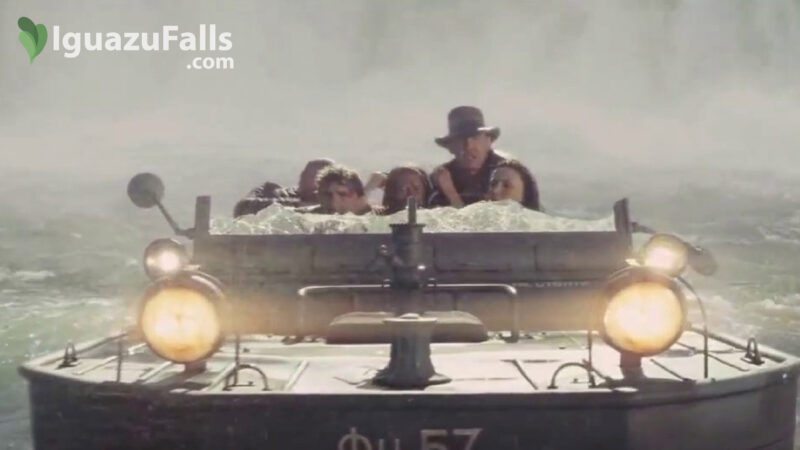
Iguazu returned to blockbuster cinema in the fourth Indiana Jones movie, starring Harrison Ford.
During the story’s South American section, Indiana Jones and his companions escape through the jungle in an amphibious vehicle. They enter a river and descend a spectacular sequence of waterfalls before continuing toward the lost city of Akator.
The sequence presents Iguazu as part of the Peruvian Amazon, although the real waterfalls are located between Argentina and Brazil.
The waterfall sequence combines broad images of Iguazu with actors, controlled sets and extensive visual effects. The principal cast did not physically descend the real falls.
Different shots were assembled to create a fictional chain of drops suitable for the adventure. The real geography was altered, and the vehicle’s falls were created under controlled production conditions.
Argentina’s official tourism promotion identifies Iguazu as the landscape used for the waterfall scenes.
The final result captures the visual scale of Iguazu while creating a physically impossible journey through it.
The Chilean drama A Fantastic Woman, directed by Sebastián Lelio and starring Daniela Vega, also uses Iguazu Falls as an important emotional destination.
The story follows Marina, a transgender woman confronting grief, discrimination and exclusion following the death of her partner, Orlando.
A trip to Iguazu represents a dream connected to the couple’s relationship. Images of the waterfalls reinforce the themes of memory, interrupted plans and emotional survival.
The film won the Academy Award for Best Foreign Language Film in 2018, becoming one of the most internationally acclaimed Latin American productions to feature Iguazu.
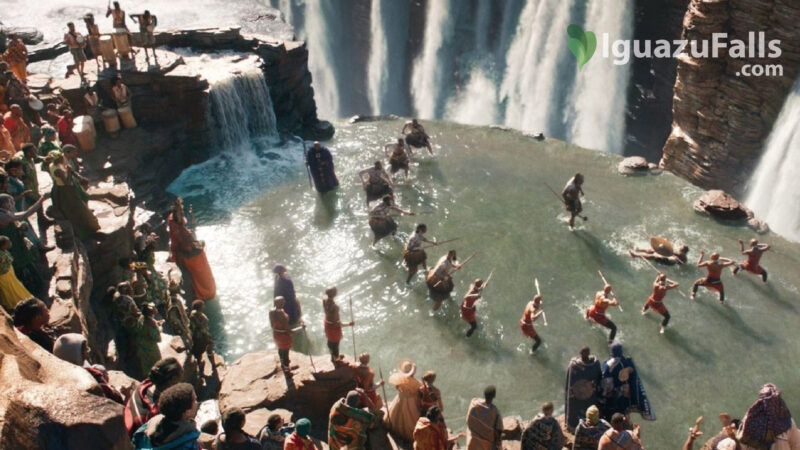
Marvel Studios’ Black Panther introduced Iguazu Falls to another enormous worldwide audience.
The movie’s Warrior Falls is the ceremonial location where challenges for the throne of Wakanda take place. However, the finished environment is not a direct representation of one real waterfall.
Warrior Falls combined several sources:
Iguazu contributed to the scale and water imagery, while the close-up ceremonial scenes were filmed on a controlled set. The final location is a fictional composite rather than a digitally renamed version of Iguazu.
This is an important distinction: the actors were not performing the ritual scenes beside the real Devil’s Throat. The movie used real natural references to build the imaginary geography of Wakanda.
Several additional films, attractions and screen projects have incorporated Iguazu imagery.
Disney’s flight-simulation attraction Soarin’ Around the World includes an aerial journey over major international landscapes, including Iguazu Falls.
It is not a conventional movie or television series, but its large-format projection has introduced millions of theme-park visitors to the waterfall system.
Iguazu imagery has also been associated with an action sequence in the second modern Teenage Mutant Ninja Turtles film.
As with many effects-heavy productions, the final scene combines natural landscape photography with digitally constructed action. It should not be understood as the actors—or animated characters—having been physically filmed on the waterfall itself.
The celebrated family film Paddington 2 briefly incorporates waterfall imagery into its imaginative world. Iguazu functions as a spectacular visual reference rather than as a principal location where the main cast worked for an extended shoot.
Experience Argentina’s Icons with Comfort and Style

Not in the same sense.
Productions connected with Iguazu can be divided into three broad categories.
These productions sent crews to capture substantial material at the destination:
In these cases, specialist crews recorded the waterfalls while the principal actors worked elsewhere:
Some productions use Iguazu as one element within a digitally created environment. The final landscape may combine several real locations and constructed sets.
This distinction explains why a movie can genuinely feature Iguazu without its stars having filmed dangerous scenes beside the real waterfalls.
Experience the wonder of Iguazu Falls on a private 2 day tour from Buenos Aires. Easily reserve accommodations and optional activities. Book now!
From Price: USD150
Visitors can recognize many of the landscapes seen in the movies, but the scenery does not always match the final screen image.
Views from the Argentine and Brazilian parks reveal the same waterfall system that dominates the movie. San Martín Island and nearby cascades were particularly important to its visual identity, although visitor access and circuits can change because of river conditions.
The broad views used in the James Bond movie are most closely associated with the Brazilian side, where visitors can see an extensive section of the waterfall system from across the gorge.
The movie’s final waterfall imagery captures the overwhelming motion of Iguazu rather than one easily replicated tourist photograph. Visitors can nevertheless recognize the same combination of cascades, islands, mist and subtropical forest.
There is no real route where a vehicle can safely descend the chain of waterfalls shown in the movie. The sequence is a cinematic construction combining real landscape imagery with effects.
DISCOVER A WONDERFUL PLACE TO ENJOY BIRDWATCHING. BE READY WITH YOUR BINOCULARS.

Today, Iguazu Falls is protected by Iguazú National Park in Argentina and Iguaçu National Park in Brazil. Both are UNESCO World Heritage properties.
Professional productions require authorization from the relevant park authorities. Depending on the project, requirements may include:
The waterfalls are not an ordinary outdoor set. River levels can change quickly, walkways may close and equipment must operate without damaging the rainforest or disrupting visitors.

Enjoy a city tour in Puerto Iguazu, to visit differnt areas and views of the river, and the famous triple frontier landmark
From Price: USD75
Each major production presented a different version of Iguazu.
In Tarzan, it became fictional Africa. In Moonraker, it moved into the Amazon basin. In The Mission, it represented the spiritual and political conflicts of colonial South America. In Happy Together, it became a dream of reconciliation. In Indiana Jones, it was transformed into an impossible adventure route. In Black Panther, it helped create the fictional kingdom of Wakanda.
These films do not always represent Iguazu accurately, but they have made its landscape recognizable around the world.
For many international travellers, the first encounter with the falls did not take place in Argentina or Brazil. It happened in a cinema, on television or through a movie playing at home.
Buenos Aires, Iguazu, & Rio de Janeiro: A Triad of South American Splendor

The Mission is the movie most strongly associated with Iguazu Falls. The landscape plays an essential role in its story, cinematography and spiritual atmosphere.
Real images of Iguazu were used in the waterfall sequence, but the actors did not descend the actual falls. The finished scene combines location photography, controlled filming and visual effects.
Iguazu contributed visual material and inspiration to Warrior Falls, but the ceremonial scenes were created using a large studio set and digital effects. The fictional location combines several influences.
Iguazu appears in Moonraker from 1979, starring Roger Moore as James Bond.
Wong Kar-wai’s Happy Together is the best-known Asian production connected with Iguazu. The falls are central to the film’s emotional and visual language.
Yes. Iguazu appeared in the opening imagery of the NBC Tarzan series starring Ron Ely, and some of the early production was filmed in Brazil.
Iguazu Falls does not need a constructed set or dramatic lighting to appear cinematic. The scale of the water, dense forest and constant movement already create a landscape larger than most fictional worlds.
That is why the same destination can convincingly represent the Amazon, Africa, eighteenth-century South America, an emotional dream or the futuristic kingdom of Wakanda.
From classic television and James Bond to award-winning dramas and Marvel blockbusters, Iguazu has become more than a filming location. It is one of cinema’s most recognizable natural stars.
One single amazing destination, three different countries!
