
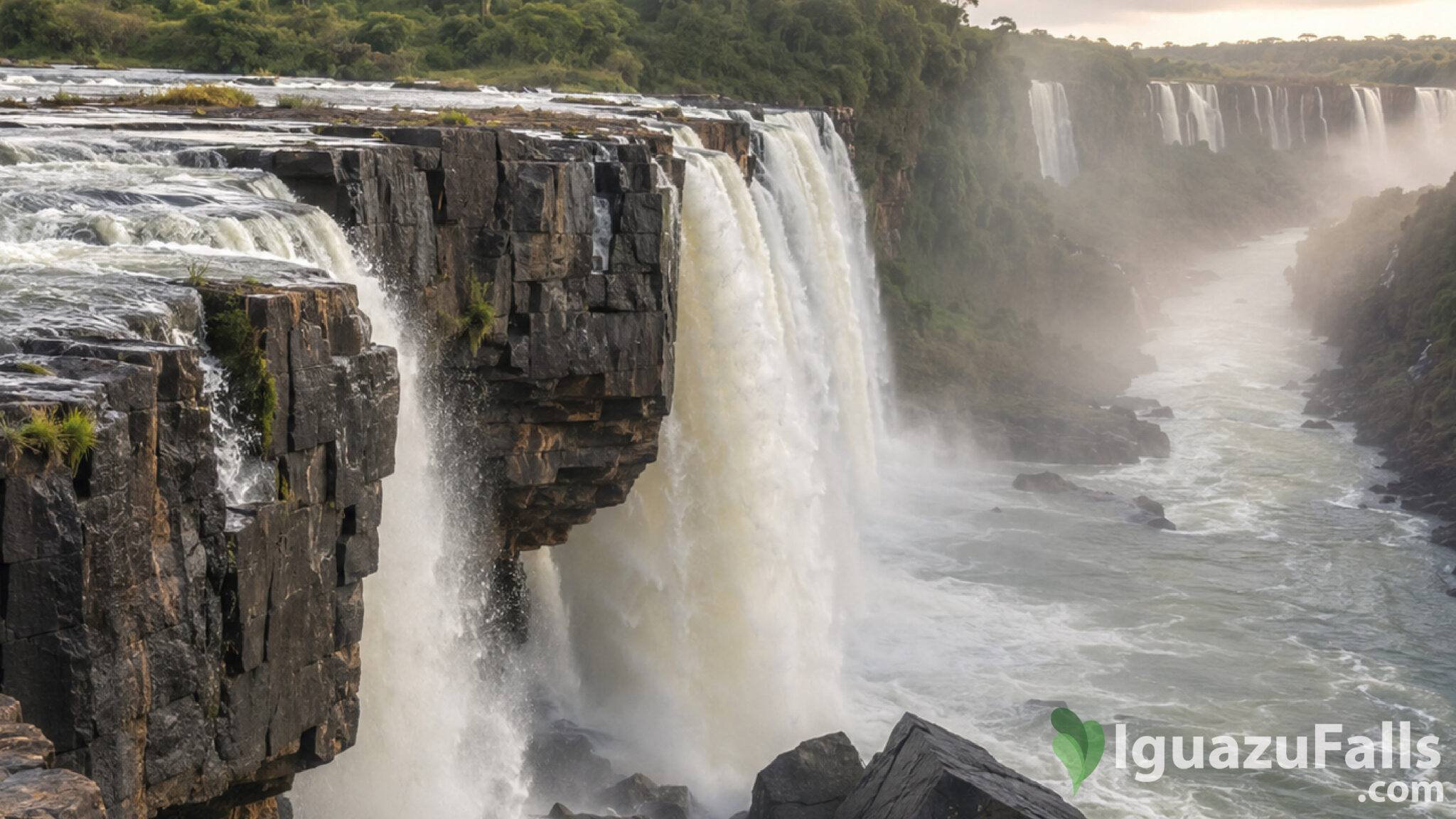
Iguazu Falls may appear permanent, but the waterfall system is constantly changing. Every second, flowing water enters fractures, removes material and weakens the enormous basalt cliffs.
Over geological time, this process causes the edge of the waterfalls to retreat—or “move”—upstream.
Estimates suggest that Iguazu Falls has been retreating at an average rate of approximately 1.4 to 2.1 centimeters per year. That is far too slow to observe during a vacation, or even over an entire human lifetime. However, multiplied across hundreds of thousands of years, this tiny annual movement has created the enormous canyon below the falls.
Yes, although the expression can be misleading.
The entire waterfall does not slide backward as a single structure. Instead, small sections of the cliff are gradually eroded, undercut and broken away. Each collapse moves part of the waterfall’s edge slightly farther upstream.
Geologists call this process headward erosion, headcut retreat or regressive erosion.
The movement is:
The river continues flowing downstream while the physical location of the waterfall’s edge gradually migrates in the opposite direction.
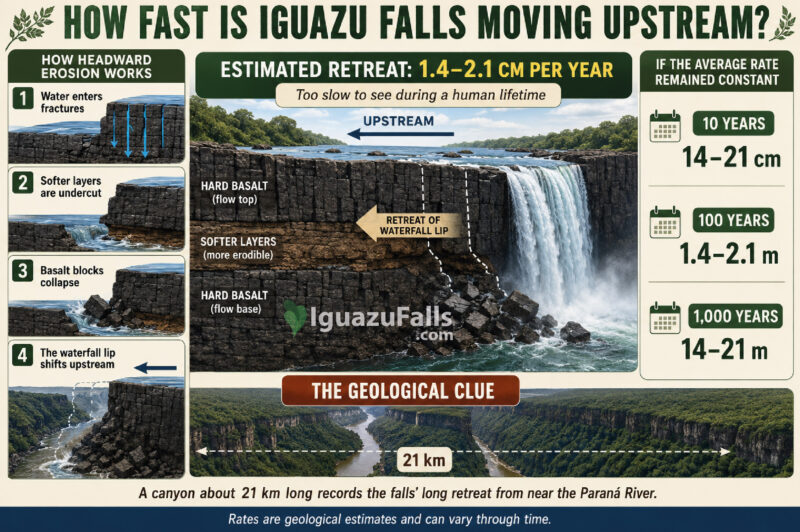
The estimated long-term retreat rate is approximately 1.4–2.1 centimeters per year.
The Geological Institute of Paraná explains that this movement is imperceptible at a human scale but is recorded by the canyon extending downstream from Devil’s Throat. Its official geological interpretation describes Iguazu as a major example of regressive erosion.
If the estimated average remained constant, the movement would equal approximately:
| Period | Estimated retreat |
|---|---|
| 1 year | 1.4–2.1 cm |
| 10 years | 14–21 cm |
| 50 years | 70–105 cm |
| 100 years | 1.4–2.1 m |
| 1,000 years | 14–21 m |
| 10,000 years | 140–210 m |
These are simplified projections. Erosion does not proceed at an identical speed every year.
Scientists cannot simply place a marker beside Devil’s Throat and wait several million years. Instead, they study:
Published geological interpretations commonly place the average retreat at around 1.4–2.1 centimeters annually, but the rate may have varied considerably through time.
One single amazing destination, three different countries!
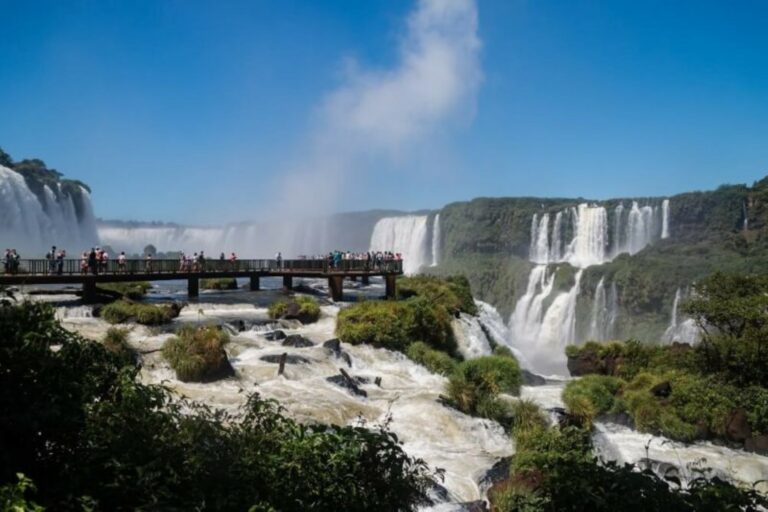
The process occurs through repeated cycles of erosion and collapse.
The rocks at Iguazu Falls contain natural joints and fractures. Water enters these openings under considerable pressure, particularly during periods of high river flow.
Sediment carried by the river can also strike and scrape the rock.
Iguazu is formed by several ancient basalt lava flows rather than one uniform mass of rock.
The upper portions of some flows are more resistant, while other layers or contacts between separate flows erode more easily. Water gradually removes material from beneath the harder rock, forming an overhang.
This difference in resistance helps explain the stepped profile of many Iguazu cascades.
As the weaker material underneath disappears, the heavier basalt above loses support.
Eventually, large blocks can detach along existing fractures and fall into the turbulent water below. The collapse may be sudden, even though the preparation took decades or centuries.
After a block collapses, the waterfall lip is positioned slightly farther back. Water begins attacking the newly exposed rock, and the cycle starts again.
The annual average may be measured in centimeters, but much of the actual movement probably occurs through occasional collapses rather than smooth, continuous retreat.

Experience the wonder of Iguazu Falls on a private 2 day tour from Buenos Aires. Easily reserve accommodations and optional activities. Book now!
From Price: USD150
The strongest visual evidence of Iguazu’s migration is the canyon downstream from Devil’s Throat.
The Iguazu River flows through a narrow canyon for approximately 21 kilometers before reaching the Paraná River. According to Paraná’s geological authorities, the canyon was carved as the waterfall retreated along faults and fractures in the basalt.
Around one to 1.5 million years ago, the falls may have been situated much closer to the confluence of the Iguazu and Paraná rivers. As erosion moved the waterfall upstream, it left the canyon behind.
In other words, the canyon can be interpreted as the historical path of Iguazu Falls.
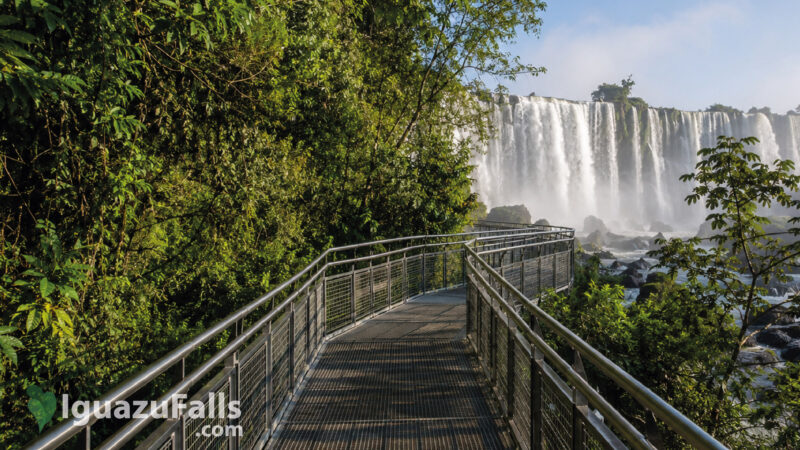
The Paraná River cut its channel more deeply than the Iguazu River. This difference in elevation created a drop close to their confluence.
Once established, the waterfall began eroding backward into the Iguazu River.
Over an immense period, the waterfall moved away from the Paraná and toward its present position on the Argentina–Brazil border.
Iguazu Falls flows over basalt produced by enormous volcanic eruptions approximately 120–130 million years ago.
These eruptions occurred as South America and Africa were separating. Successive lava flows spread across the Paraná Basin, cooled and created thick sequences of volcanic rock.
The waterfall’s characteristic steps reflect different lava flows and the contacts between them. Official geological material from Paraná identifies these layered basalt formations as the foundation of the falls and the surrounding canyon. The geological guide to Iguaçu National Park explains this volcanic origin.
Devil’s Throat concentrates a large proportion of the river’s flow within a relatively narrow channel. This produces enormous hydraulic power and intense erosion.
It might therefore seem logical that Devil’s Throat would always retreat faster than the smaller cascades. However, erosion also depends on:
Different sectors may retreat at different rates, causing the shape of the waterfall front to evolve.
Experience the wonder of Iguazu Falls on a private 2 day tour from Buenos Aires. Easily reserve accommodations and optional activities. Book now!
From Price: USD150
Floods can accelerate some erosional processes.
High water levels increase pressure, turbulence and the amount of sediment transported by the river. Floodwater may penetrate fractures, remove loose material or trigger the collapse of blocks that were already unstable.
However, it would be inaccurate to attribute a specific cliff collapse to one flood without geological evidence. The rock may have been weakening for many years before finally breaking.
Low water reduces hydraulic force temporarily, but it does not reverse the long-term process.
Weathering, temperature changes, moisture and gravity can continue weakening exposed rock. When normal or high flow returns, the river resumes its erosive work.
One single amazing destination, three different countries!
Not in real time.
At an estimated 1.4–2.1 centimeters per year, the change during a week-long visit would be microscopic. Even photographs taken several decades apart may not show an obvious difference unless a particular block collapsed.
Visitors can, however, see evidence of the process:
The movement cannot be watched, but its results surround the visitor.
Not anytime remotely close to the human future.
If erosion continues, the waterfall front will keep changing and gradually moving upstream. Over extremely long geological periods, it may encounter different rock structures or changes in river gradient that alter its form.
Individual cascades may:
But these developments occur across thousands or millions of years. Iguazu Falls is not about to vanish.

The geological retreat rate should not be interpreted as an immediate danger to visitors.
Both Iguazú National Park in Argentina and Iguaçu National Park in Brazil manage access around an active river and changing natural landscape. Walkways may occasionally be closed because of flooding, damaged infrastructure or operational safety—not because the entire waterfall suddenly moved upstream.
UNESCO notes that the Iguazu River drops approximately 80 meters across a front almost three kilometers wide, illustrating the enormous scale of the protected system. Iguazú National Park has been recognized as a World Heritage Site since 1984.
Iguazu Falls is not simply water passing over an ancient, unchanging cliff. It is an active geological system.
The basalt controls where the water falls. The river exploits fractures and weaker layers. Rock collapses alter the cliff, and the waterfall slowly advances into the plateau.
At approximately two centimeters per year, nothing seems to happen. Across a million years, an entire canyon appears.
That contrast between human time and geological time is one of the most fascinating aspects of Iguazu Falls.

Go biking to the amazing Iguazu Falls National Park Brazilian Side ,enjoying the nature, the animals, the flora.
From Price: USD35
The estimated long-term average is approximately 1.4–2.1 centimeters per year.
No. The river continues flowing downstream. It is the physical edge or lip of the waterfall that gradually retreats upstream through erosion.
Geological interpretations connect its retreat with the formation of a canyon approximately 21 kilometers long between Devil’s Throat and the Paraná River.
The basalt is approximately 120–130 million years old, but the waterfall and canyon are much younger. The retreat may have occurred over roughly the last one to two million years.
No. The 1.4–2.1-centimeter figure is a long-term geological estimate. Actual erosion varies according to water flow, floods, fractures and rock resistance.
A natural rockfall is possible in any actively eroding canyon, but it is unpredictable and uncommon from a visitor’s perspective. Access is restricted to managed walkways and authorized areas.
One single amazing destination, three different countries!
DISCOVER A WONDERFUL PLACE TO ENJOY BIRDWATCHING. BE READY WITH YOUR BINOCULARS.

