
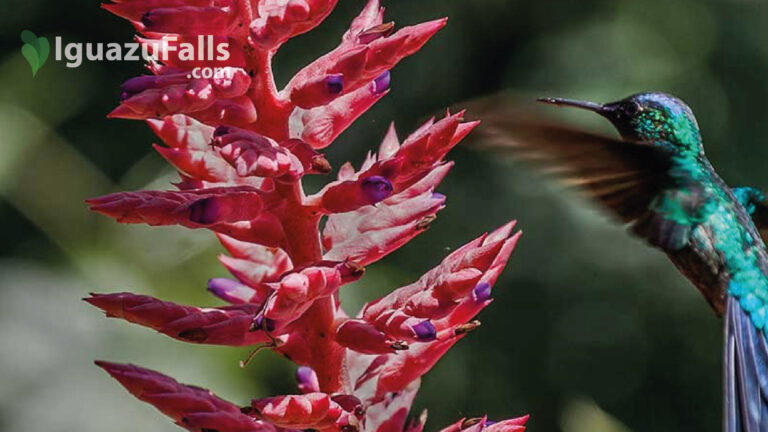
Iguazu Falls is celebrated for its immense waterfalls, colorful butterflies and toucans, but the surrounding Atlantic Forest is also an excellent destination for observing hummingbirds.
Known as picaflores in Argentina and beija-flores in Brazil, these tiny birds can be found inside both national parks, in forest clearings, hotel gardens and flowering areas around Puerto Iguazú and Foz do Iguaçu.
Some species display brilliant violet, green or golden plumage. Others are more discreet and remain within the shaded forest understory. Their rapid movements can make identification challenging, but patient visitors may observe several species during a single stay.
The Iguazu region forms part of the Upper Paraná Atlantic Forest, a humid subtropical ecosystem extending across areas of Argentina, Brazil and Paraguay.
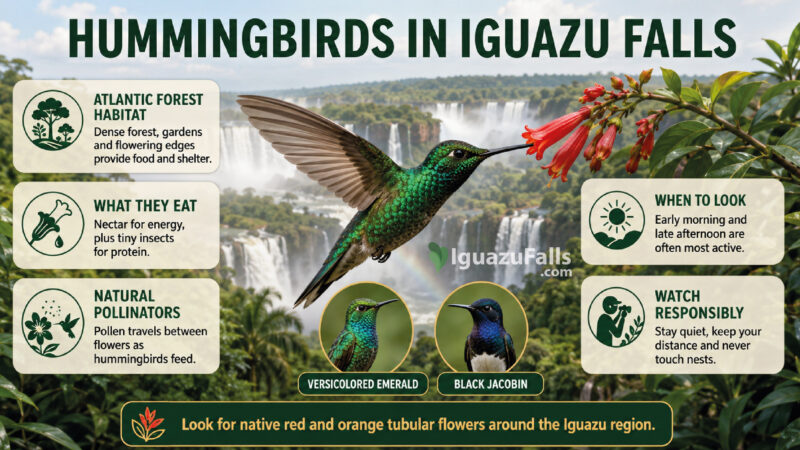
The combination of warm temperatures, abundant rainfall and diverse vegetation produces flowers throughout much of the year. These provide nectar for hummingbirds, while the forest also supplies insects, nesting material and protected perches.
The region contains more than one type of environment. Hummingbirds may use:
Each habitat attracts a slightly different group of species. Some hummingbirds prefer the shaded interior of the forest, while others are more easily seen around gardens and sunny clearings.
DISCOVER A WONDERFUL PLACE TO ENJOY BIRDWATCHING. BE READY WITH YOUR BINOCULARS.

The exact number depends on how the geographical area is defined and whether rare or accidental records are included.
The current Avibase checklist for the wider Iguazú region contains more than a dozen recorded hummingbird species, although several are considered rare or occasional. A typical visitor is more likely to encounter a smaller group of regularly observed species.
Not every recorded species can be expected during a short visit. Sightings change according to habitat, flowering cycles, weather and the observer’s experience.
Scientific name: Florisuga fusca
Spanish name: Picaflor negro
Portuguese name: Beija-flor-preto
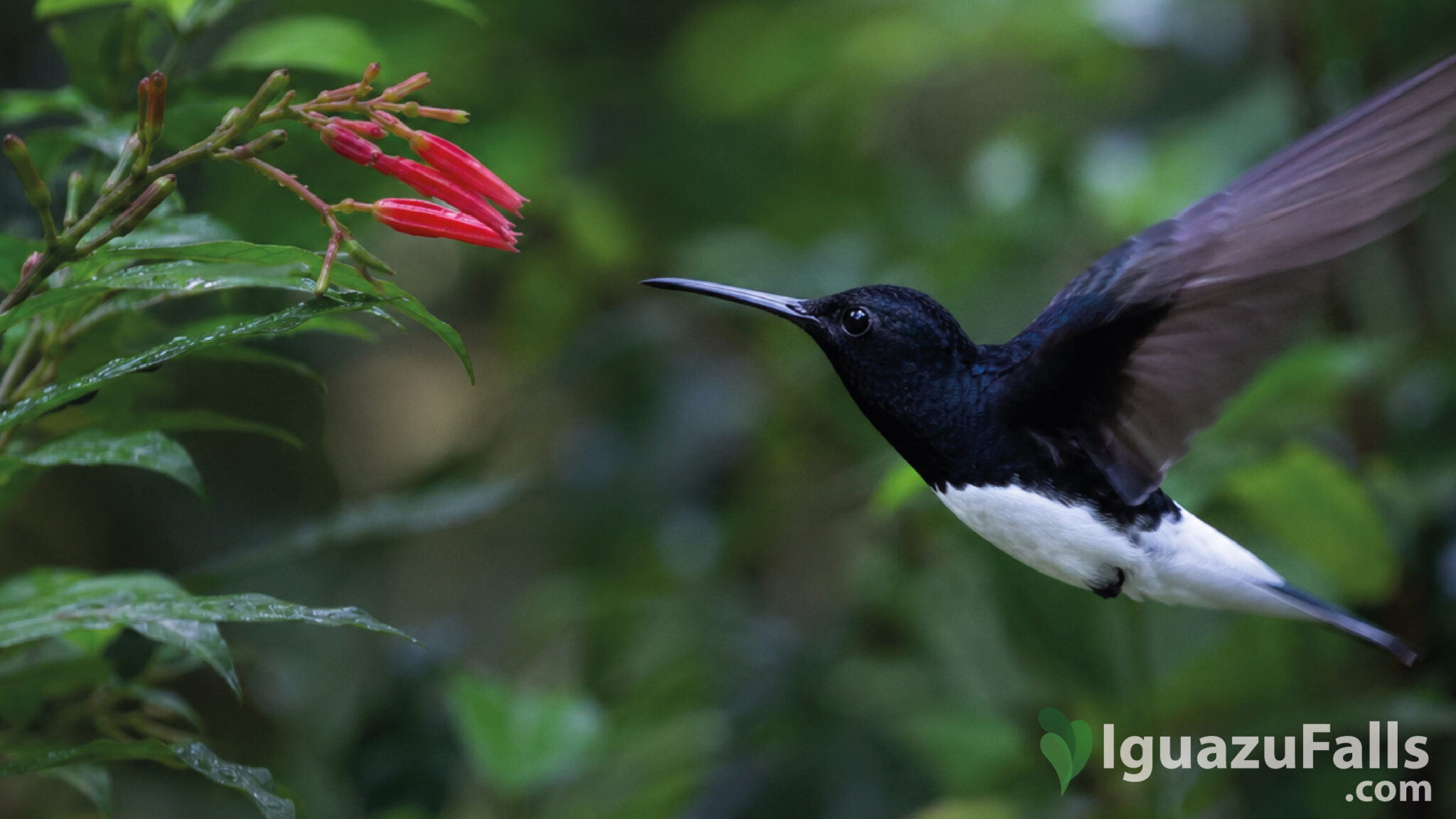
The Black Jacobin is one of the most distinctive hummingbirds in the region.
Adults appear predominantly dark, with contrasting white areas on the lower body and tail. Under favorable light, the black plumage may reveal subtle bluish or purplish reflections.
Black Jacobins may visit flowering trees, forest edges and hummingbird feeders. Their contrasting plumage makes them relatively easy to recognize when they pause.
They can behave assertively around concentrated nectar sources and may chase smaller hummingbirds away from flowers or feeders.
Scientific name: Thalurania glaucopis
Spanish name: Picaflor corona violácea
Portuguese name: Beija-flor-de-fronte-violeta
The male Violet-capped Woodnymph is one of the most colorful birds in Iguazu. It combines a brilliant violet crown with iridescent green underparts and a dark, forked tail.
Females are less intensely colored, generally displaying green upperparts and paler underparts.
This species is strongly associated with the Atlantic Forest. It may be found along shaded trails, forest edges and areas with flowering native vegetation.
Its colors can appear surprisingly dark in deep shade. When sunlight reaches its feathers at the correct angle, the violet crown and green body suddenly become much brighter.
Scientific name: Hylocharis chrysura
Spanish name: Picaflor bronceado
Portuguese name: Beija-flor-dourado
The Gilded Hummingbird has iridescent greenish plumage with warm bronze or golden tones, particularly around the tail and back.
It is one of the characteristic hummingbirds of northeastern Argentina and neighboring regions.
Gilded Hummingbirds adapt relatively well to gardens, forest borders and flowering vegetation near human activity. They are among the species visitors may observe outside the national parks as well as within the broader Iguazu ecosystem.
Scientific name: Chrysuronia versicolor
Spanish name: Picaflor de pecho azul
Portuguese name: Beija-flor-de-banda-branca
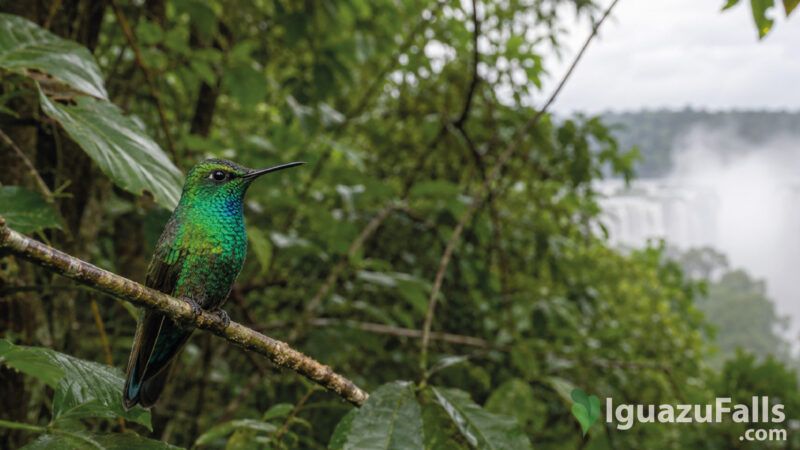
The Versicolored Emerald is a small hummingbird whose plumage changes considerably with light and viewing angle.
Green, turquoise and blue tones may become visible when the bird turns its head or body. At other times, it may look much duller.
It can appear in gardens, open woodland and forest-edge habitats. The species is one of the hummingbirds frequently associated with Puerto Iguazú’s Hummingbird Garden.
Scientific name: Chlorostilbon lucidus
Spanish name: Picaflor común
Portuguese name: Besourinho-de-bico-vermelho
Despite its English name, this species is commonly known in Argentina as the picaflor común, or common hummingbird.
Males usually show brilliant green plumage and a reddish bill with a darker tip. Females are more subdued.
This adaptable hummingbird can be found in gardens, open areas, woodland edges and vegetation around towns. It is often easier to see than the species restricted to the forest interior.
Scientific name: Phaethornis eurynome
Spanish name: Ermitaño escamado
Portuguese name: Rabo-branco-de-garganta-rajada
The Scale-throated Hermit looks very different from the compact, jewel-like hummingbirds commonly seen at feeders.
It has a longer, curved bill, elongated tail feathers and streaked or scaled markings around the throat. Its earthy coloration provides camouflage within the forest.
This is primarily a forest hummingbird. It tends to feed along established routes, visiting a sequence of flowers rather than defending one concentrated feeding territory.
Visitors have a better chance of seeing it on quiet forest trails than in busy visitor areas.
Scientific name: Phaethornis pretrei
Spanish name: Ermitaño canela
Portuguese name: Rabo-branco-acanelado
The Planalto Hermit is another long-billed hummingbird recorded in the Iguazu region.
It has brownish and cinnamon-colored plumage, a pale facial stripe and long central tail feathers. Like other hermits, it may move quickly through shaded vegetation and stop only briefly at flowers.
Search along forest edges, less crowded trails and places containing tubular flowers. Its discreet colors can make it difficult to detect unless it calls or moves across an open space.
Scientific name: Anthracothorax nigricollis
Spanish name: Picaflor garganta negra
Portuguese name: Beija-flor-de-veste-preta
The Black-throated Mango is larger and more powerfully built than many of Iguazu’s emerald hummingbirds.
Males have a dark central stripe extending along the throat and chest, bordered by iridescent green. Females have pale underparts with a dark stripe down the center.
This species is more likely around open woodland, flowering trees and clearings than within the darkest forest interior.
Scientific name: Thalurania furcata
The Fork-tailed Woodnymph is closely related to the Violet-capped Woodnymph. Males display intense green and violet tones with a deeply forked tail.
The species has been recorded in the Iguazu area, although identifying it requires care because of its similarity to related hummingbirds and the complexity of regional distribution.
Do not rely on color alone. Photographs showing the crown, chest and tail shape are useful when distinguishing woodnymph species.
Scientific name: Eupetomena macroura
Portuguese name: Beija-flor-tesoura
The Swallow-tailed Hummingbird is one of South America’s most striking hummingbirds. It is relatively large, with a deeply forked blue-black tail and shimmering green, blue and violet plumage.
It is listed as rare or accidental in the broader Iguazú checklist, so visitors should not expect to see one during every trip.
When present, it is more likely around flowering trees, gardens and open areas than in dense forest. Its size and long tail make it unmistakable in flight.
Scientific name: Leucochloris albicollis
Spanish name: Picaflor garganta blanca
Portuguese name: Beija-flor-de-papo-branco
The White-throated Hummingbird has green upperparts, a clearly white throat and pale underparts. Its appearance is less flamboyant than some tropical species, but it is an attractive Atlantic Forest bird.
It may occur along forest margins and in gardens containing suitable nectar-producing plants.
Enjoy a unique 3-night birdwatching tour in rainforest lodge
Additional species appearing on regional checklists include:
Some are rare, occasional or accidental in Iguazu. Their inclusion in a regional checklist does not mean that travelers are likely to see them.
Birdwatchers should treat unusual sightings carefully and attempt to obtain clear photographs or field notes.

Experience the wonder of Iguazu Falls on a private 2 day tour from Buenos Aires. Easily reserve accommodations and optional activities. Book now!
From Price: USD150
The Jardín de los Picaflores, or Hummingbird Garden, is one of the easiest places to observe hummingbirds at close range.
It is a small, privately operated garden in Puerto Iguazú rather than part of Iguazú National Park. Flowering plants, trees and feeders attract free-flying wild birds.
Visitors can remain seated while hummingbirds approach the flowers and feeders around them. Because the birds regularly visit concentrated food sources, the garden offers excellent opportunities for identification and photography.
Depending on the season and daily conditions, visitors may see species such as:
Other nectar-eating and fruit-eating birds may also visit the garden.
No. The hummingbirds are wild and free to enter or leave. They are not kept inside cages or enclosed exhibits.
Opening hours, admission fees and reservation procedures can change, so visitors should confirm current information before going.
Hummingbirds can be found throughout the Argentine national park, although they are less predictable than at a garden with feeders.
Good observation areas include:
The Green Trail passes through vegetation between the main visitor areas. Early in the day, before pedestrian activity increases, it can provide opportunities to hear and observe small forest birds.
The forest surrounding the Lower Circuit contains flowering plants and shaded vegetation. Quieter stretches between the major waterfall viewpoints may be more productive than crowded platforms.
Hummingbirds may cross open areas or visit flowers near the forest edge. Because visitors naturally concentrate on the waterfalls, small birds frequently pass unnoticed.
The Macuco Trail enters a quieter section of the forest and can be rewarding for birdwatchers.
Hummingbird sightings are not guaranteed, but the trail offers better opportunities for forest species than the most heavily visited circuits. Check accessibility and closing times before beginning the walk.
Experience Argentina’s Icons with Comfort and Style

The Brazilian national park protects an extensive area of Atlantic Forest.
Along the main waterfall trail, look for hummingbirds near forest openings and flowering vegetation rather than on the exposed platforms closest to the water.
Quieter nature experiences and forest trails can offer better birdwatching conditions than the busiest panoramic areas.
Gardens and landscaped vegetation around official buildings can attract hummingbirds, especially when native flowers are blooming.
However, visitors should remain within authorized areas and never enter restricted vegetation to follow a bird.
Many hotels around Puerto Iguazú and Foz do Iguaçu maintain tropical gardens containing flowering shrubs and trees.
Properties surrounded by forest may attract hummingbirds naturally. Guests can often observe them during breakfast or from balconies, gardens and swimming-pool areas.
A hotel garden is particularly useful for travelers who do not have time for a specialized birding excursion.
Experience the awe of Iguazu Falls on a 3-day tour from Buenos Aires. Book now for an unforgettable adventure!
From Price: USD150
Hummingbirds occur in the Iguazu region throughout the year, but their visibility changes with flowering cycles and weather.
The most productive periods are usually:
Hummingbirds feed repeatedly throughout the day because their flight requires enormous energy. Nevertheless, heat and heavy visitor activity can make them less visible around midday.
Spring and summer generally bring abundant flowers, nesting activity and high insect availability.
Autumn and winter can also be rewarding. When natural nectar becomes less evenly distributed, birds may visit flowering gardens and managed feeding areas more predictably.
There is no single month that guarantees the greatest number of species.
Hummingbirds are strongly associated with nectar, but they do not live on sugar alone.
Their diet includes:
Nectar provides rapid energy, while insects and other small invertebrates supply protein, fats and nutrients.
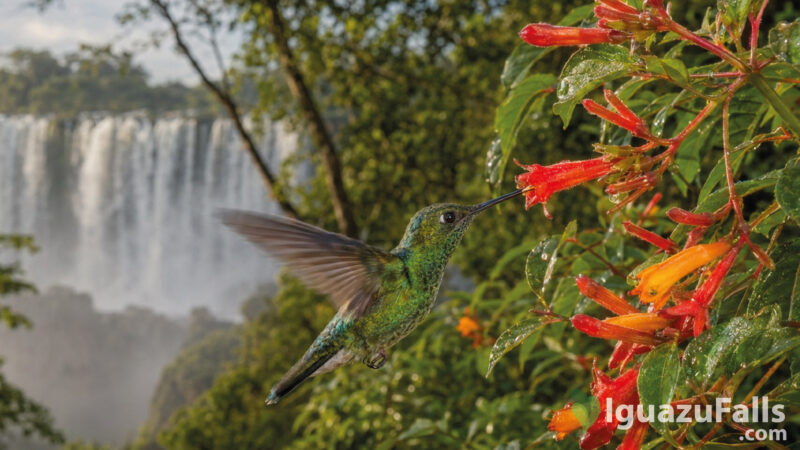
The bird inserts its bill into a flower and extends a specialized tongue to collect nectar. While feeding, pollen may attach to the bill, face or feathers.
When the bird visits another flower, some pollen is transferred, allowing pollination to occur.
Enjoy a unique 3-night birdwatching tour in rainforest lodge
Hummingbirds are not merely beautiful animals. They perform an essential ecological function as pollinators.
Many Atlantic Forest plants produce tubular flowers suited to hummingbird bills. Bright red, orange and pink flowers are especially common among bird-pollinated plants, although hummingbirds also visit flowers of other colors.
Scientific research has documented the importance of hummingbirds in pollinating Atlantic Forest bromeliads and other plant groups. One study found hummingbirds were responsible for pollinating a high proportion of the bromeliad species examined in an Atlantic Forest environment.
As hummingbirds travel between flowers, they move pollen through the landscape. This can connect plants separated by trails, rivers, clearings and forest fragments.
Protecting hummingbirds therefore supports the reproduction and genetic diversity of many native plants.
Most birds generate lift primarily during the downward wing stroke. Hummingbirds rotate their wings in a figure-eight-like movement, producing lift during both parts of the stroke.
This allows them to:
Wingbeat speed varies by species and behavior. Their characteristic humming sound is produced by the rapid movement of the wings.
The energy cost is enormous. Hummingbirds spend significant periods resting on small branches between feeding flights, even though casual observers may notice only their rapid aerial movements.
DISCOVER A WONDERFUL PLACE TO ENJOY BIRDWATCHING. BE READY WITH YOUR BINOCULARS.
Some hummingbirds defend a productive patch of flowers or a feeder. They may perch nearby and chase any bird that approaches.
These aerial confrontations are fast and noisy but usually brief.
Forest hummingbirds such as hermits may follow a repeated feeding route known as a trap-line.
Instead of defending one flower cluster, the bird visits a sequence of scattered plants and returns after the nectar has been replenished.
Hummingbirds spend more time perched than many people realize.
Look at thin, exposed branches close to flowering plants. A bird may repeatedly return to the same perch between feeding attempts.
Hummingbirds may bathe in light rain, wet leaves, shallow water or fine waterfall spray.
After bathing, they often perch and preen their feathers carefully.
Males of some species perform rapid flights, dives or repeated movements to attract females or defend territory.
These displays are most likely during breeding periods but may be difficult to interpret without experience.
Hummingbird nests are remarkably small and easily overlooked.
The female generally constructs a cup-shaped nest using materials such as:
Spider silk helps the nest stretch as the chicks grow.
Depending on the species, nests may be attached to thin branches, hidden within vegetation or placed near roots and sheltered forest structures.
Visitors should never approach, touch or attempt to improve the visibility of a nest. Repeated disturbance can cause stress and expose eggs or chicks to predators.
If you discover a nest inside a visitor area, quietly move away and inform park staff.
Experience the awe of Iguazu Falls on a 3-day tour from Buenos Aires. Book now for an unforgettable adventure!
From Price: USD150
Hummingbirds are among the most challenging birds to photograph because they are small, fast and frequently change direction.
Useful equipment includes:
A professional camera is helpful but not essential. Modern smartphones can produce good results when a bird repeatedly visits the same feeder or flower.
For a hummingbird in flight:
For a perched bird, reduce the shutter speed and ISO to improve image quality.
Instead of chasing the bird with the camera, choose one frequently visited flower and focus on that location.
Wait for the hummingbird to enter the frame. This often produces sharper and more natural images.
Flash can disturb birds and create artificial reflections on iridescent feathers. Natural light usually produces a more realistic result.
If photography rules at a private garden permit specialized lighting, it should be used responsibly and without stressing the birds.
Enjoy a unique 3-night birdwatching tour in rainforest lodge
Many hummingbird colors are structural rather than produced only by pigment.
Microscopic structures in the feathers reflect light differently according to the angle between the bird, light source and observer.
This is why a crown can appear black in one moment and brilliant violet a second later.
Position yourself so sunlight reaches the bird from behind or slightly to the side of the photographer. The correct angle can reveal colors invisible in flat or shaded light.
A hummingbird that appears exhausted or injured should be reported to park staff or a qualified wildlife professional.
Remain at a substantial distance and avoid attracting other people to the location.
Repeatedly playing recorded hummingbird calls can cause territorial stress and interfere with feeding or breeding behavior.
Do not enter vegetation or restricted areas to obtain a photograph.
The flowers are food sources and part of the protected ecosystem.
Visitors should not carry homemade nectar or attempt to attract birds. Feeding wildlife inside protected areas is regulated and should be left to authorized management practices.

Enjoy a city tour in Puerto Iguazu, to visit differnt areas and views of the river, and the famous triple frontier landmark
From Price: USD75
Properly managed feeders can provide observation opportunities, but poor hygiene can spread disease.
Responsible feeder management requires:
Visitors should not interfere with feeders at private gardens or hotels.
The protected national parks provide essential habitat, but hummingbirds still face pressures across the broader Atlantic Forest.
Agriculture, roads and urban development have eliminated or fragmented much of the original Atlantic Forest.
Forest-dependent hummingbirds are especially vulnerable when isolated habitat patches no longer contain enough flowers or nesting locations.
Replacing diverse native vegetation with lawns or ornamental plants can reduce the availability of natural nectar.
Pesticides may directly affect birds or reduce the small insects they need for protein.
Changes in temperature and rainfall can alter flowering cycles. If flowers bloom at different times, hummingbirds may have difficulty finding predictable food supplies.
Reflective glass can appear to be open sky or vegetation. Hotels and homes surrounded by gardens can reduce collisions by applying effective visual markers to windows.
Free-roaming cats can prey on small birds, particularly when they rest or feed close to the ground.
One single amazing destination, three different countries!
Yes. Birdwatching guides operate around both Puerto Iguazú and Foz do Iguaçu.
A specialized guide can help visitors:
Private early-morning tours are generally more productive than attempting serious birdwatching during a busy general sightseeing excursion.
Recommended items include:
Avoid brightly colored clothing if you plan to wait quietly near a flowering area.
They are widespread but can be difficult to observe along crowded waterfall circuits. Gardens and quiet forest edges offer better opportunities.
Yes. Argentina and Brazil share the same Atlantic Forest ecosystem, although individual sightings and species frequency vary by location.
The Jardín de los Picaflores in Puerto Iguazú is usually the easiest place for close observations and photography.
Yes. Hummingbirds occur throughout the year, but their abundance and behavior change with flowers, weather and seasonal movements.
The Violet-capped Woodnymph is a strong candidate, particularly when its violet crown and green body are illuminated by sunlight.
The Swallow-tailed Hummingbird is among the largest species recorded in the area, but it is considered uncommon or accidental locally.
No. They also eat tiny insects and spiders, which provide important protein and nutrients.
Visitors should not feed wildlife inside the national parks. At established private gardens, feeding systems are managed by the property.
Some hummingbird species make seasonal or local movements in response to flowering cycles. Others remain within the region throughout the year.
Their response varies. Birds accustomed to gardens may approach feeders near seated visitors, while forest species are generally more cautious.
Plan at least one quiet early morning away from the busiest waterfall platforms.
Visit a mixture of habitats: national park trails, hotel gardens and, if interested in close-up viewing, the Jardín de los Picaflores. Listen for rapid wingbeats and short calls, and watch exposed branches beside flowering plants.
Most importantly, slow down.
Iguazu’s hummingbirds are easy to miss when visitors focus only on reaching the next waterfall viewpoint. By pausing beside a flowering tree or shaded forest opening, you may discover one of the most delicate and colorful parts of the Atlantic Forest ecosystem.
DISCOVER A WONDERFUL PLACE TO ENJOY BIRDWATCHING. BE READY WITH YOUR BINOCULARS.
Enjoy a unique 3-night birdwatching tour in rainforest lodge
