
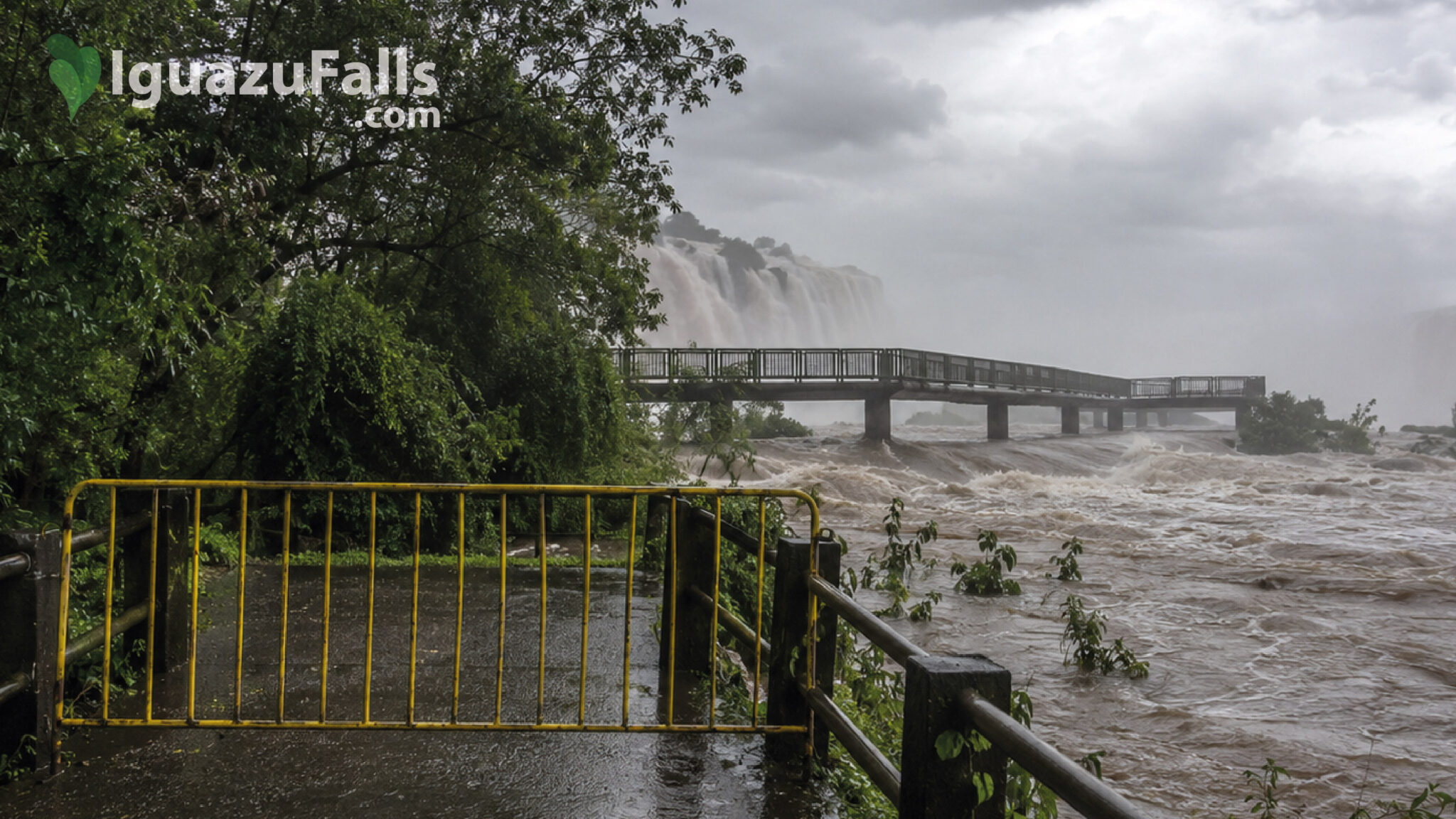
Iguazu Falls is famous for its enormous volume of water, but the river does not always behave in the same way. Its flow can change dramatically following intense rainfall in southern Brazil, where most of the Iguazu River basin is located.
During ordinary conditions, approximately 1,500 to 1,800 cubic meters of water may pass over the falls every second. During the greatest floods, however, the flow has exceeded 20,000—and in one exceptional event, more than 45,000—cubic meters per second.
These floods can transform hundreds of individual waterfalls into an almost continuous wall of brown, turbulent water. They can also damage walkways, interrupt train services and force the temporary closure of attractions on both sides of the border.
The volume visible at the waterfalls depends on rainfall across the entire Upper Iguazu River basin, not only on the weather in Puerto Iguazu or Foz do Iguaçu.
The river begins near Curitiba and travels for more than 1,000 kilometers before reaching the falls. Heavy and persistent rain upstream may take time to arrive at the national parks. Consequently, visitors can encounter extremely high water levels even when local rainfall has already stopped.
Several factors can contribute to major floods:
Although dams and reservoirs exist upstream, they cannot completely prevent extreme floods. Once reservoirs approach their operating limits, additional water must continue downstream.
One single amazing destination, three different countries!
The 1983 flood is one of the most important historical references for the Iguazu River basin. It occurred during a broader period of severe flooding that affected southern Brazil, Paraguay and northeastern Argentina.
At Iguazu Falls, the river rose far above its normal level. Historical accounts commonly place its peak flow at more than 30,000 cubic meters per second, although exact figures vary according to the monitoring point and method used.
The flood damaged tourism infrastructure and demonstrated how vulnerable early walkways could be when exposed to a combination of powerful currents and floating debris.
For many years, the 1983 event remained the benchmark against which later floods were compared. It also influenced the development of improved monitoring systems and more adaptable infrastructure.
Experience the awe of Iguazu Falls on a 3-day tour from Buenos Aires. Book now for an unforgettable adventure!
From Price: USD150
Another significant flood occurred in 1992. While it did not surpass the exceptional record later established in 2014, it caused serious damage to visitor infrastructure.
Sections of the old walkway leading toward Devil’s Throat were affected or swept away. The event reinforced the need for a new type of structure capable of responding more effectively to sudden rises in the river.
When the modern Argentine visitor system was developed between 1997 and 2001, modular construction became an important feature of the new walkways. Individual metal sections could be disconnected, displaced, recovered or replaced without necessarily losing the entire structure.
The flood of June 2014 is generally considered the largest recorded flood in the modern history of Iguazu Falls.
Following extraordinary rainfall across the Upper Iguazu basin, the flow at the waterfalls reached approximately 45,700 to 46,300 cubic meters per second. The variation between published figures reflects differences in measurement timing and monitoring locations.
That was around 25 to 30 times the river’s average flow. The usual collection of separate cascades became a vast, turbulent front of water, while the normally greenish river turned brown with sediment.
Contemporary reports identified 2014 as the highest flow officially recorded at the falls.
Both national parks activated emergency procedures. Visitor routes were closed as the water rose, particularly those extending across or close to the river.
On the Argentine side, sections of the Upper Circuit and Devil’s Throat walkway were damaged. The river carried logs, branches and other debris into platforms and railings, adding powerful impacts to the direct force of the current.
National Parks personnel and the local concessionaire inspected and repaired the affected structures before gradually reopening the circuits.
The modular design helped limit the damage. Some walkway sections were released or displaced by the flood but could later be recovered and reinstalled.
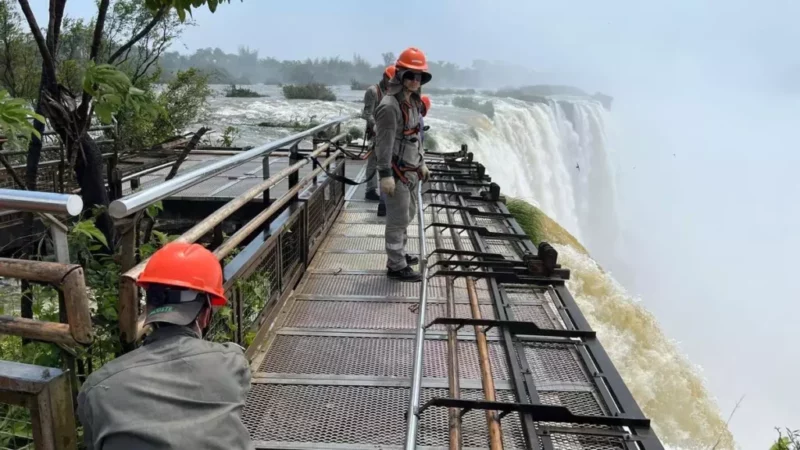
In October 2022, intense rainfall once again produced an exceptional rise in the Iguazu River.
The water volume reached approximately eleven times its normal level and was described as the second-highest flow registered within a 25-year period.
Although the event remained well below the 2014 record, it was powerful enough to damage sections of the Devil’s Throat walkway on the Argentine side.
The circuit remained closed for more than four months. Reconstruction included repairs to approximately 275 square meters of walkway and an expansion of the main viewing balcony.
Before reopening in March 2023, specialists inspected:
The inspection confirmed that visitor safety depended not only on replacing visible components but also on examining the foundations and structural system beneath them.
Only months after the repaired walkway reopened, another extreme flood reached Iguazu Falls in October 2023.
The river rose to more than 16 times its normal level, with reports placing the peak at approximately 24 million liters per second—or about 24,000 cubic meters per second. It was the highest volume recorded at the falls since the exceptional 2014 flood.
The flood severely damaged the Argentine Devil’s Throat Circuit. According to the Argentine government, approximately 90 percent of the walkways and the observation balcony were destroyed or affected.
The rising water also damaged:
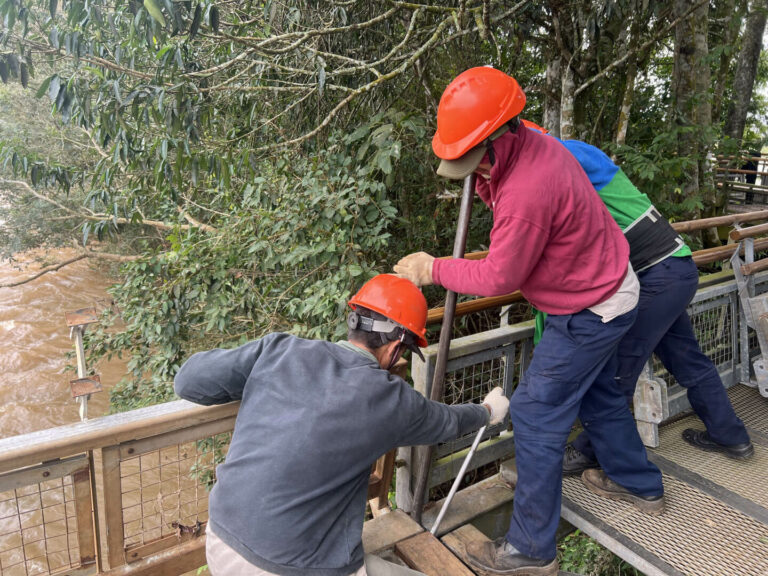
The Devil’s Throat Circuit remained closed for more than eight months while components were recovered, repaired and reconstructed.
Following technical inspections by structural and geological specialists, the walkway reopened to visitors on July 13, 2024.
| Year | Estimated peak flow | Main consequences |
|---|---|---|
| 1983 | More than 30,000 m³/s | Major regional flooding and damage to early infrastructure |
| 1992 | Estimates vary | Serious damage to older visitor walkways |
| 2014 | Approximately 45,700–46,300 m³/s | Highest modern record; circuits closed and walkways damaged |
| 2022 | Around 11 times the normal flow | Devil’s Throat walkway damaged and closed for several months |
| 2023 | Approximately 24,000 m³/s | Highest since 2014; extensive destruction of the Devil’s Throat Circuit |
The figures should be considered approximate because river flow may be reported at different monitoring stations and at different stages of the same flood.
Experience the awe of Iguazu Falls on a 3-day tour from Buenos Aires. Book now for an unforgettable adventure!
From Price: USD150
Today, park authorities monitor rainfall, upstream reservoirs and river-flow forecasts. Circuits may be closed before water reaches the walkways.
Preventive closures can affect the Devil’s Throat Circuit first because much of its walkway crosses the Upper Iguazu River. The Brazilian walkway and parts of the Argentine Upper Circuit may also close when water levels become unsafe.
Modern safety measures include:
A closure does not necessarily mean that the national parks are completely inaccessible. In many cases, some circuits remain open while the most exposed areas are temporarily restricted.
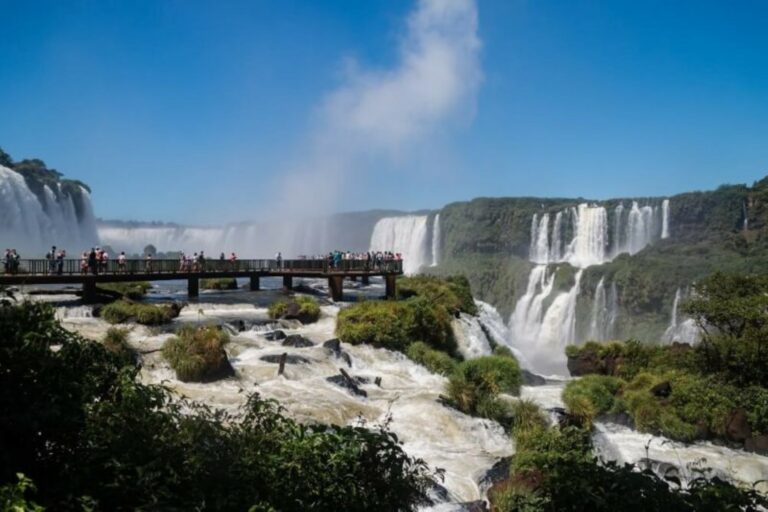
During normal conditions, visitors can distinguish many individual waterfalls separated by rocky islands and vegetation. In a major flood, these separate cascades merge into a wider and more violent curtain.
The river also changes color. Increased erosion carries soil, organic material and sediment downstream, turning the water reddish-brown.
Extremely high flow can make the waterfalls impressive, but it does not always provide the best visitor experience. Heavy mist may reduce visibility, boat excursions can be suspended and important walkways may close.
DISCOVER A WONDERFUL PLACE TO ENJOY BIRDWATCHING. BE READY WITH YOUR BINOCULARS.

Iguazu has always experienced natural fluctuations, including both floods and severe periods of low water. It is therefore difficult to attribute an individual event to a single cause.
However, the succession of significant floods in 2014, 2022 and 2023 has increased attention on changing rainfall patterns and the potential influence of climate variability. Warmer atmospheric conditions can hold more moisture, while events such as El Niño may produce unusually intense rainfall in southern South America.
Scientists and park managers continue to study these patterns because future infrastructure must be designed for conditions that may differ from historical averages.
The parks may remain partly open during elevated river conditions, but available circuits can change from one day—or even one hour—to the next.
Travelers should check official information before leaving their hotel and follow all closure notices. Barriers must never be crossed, even if a walkway appears dry. Water levels can rise rapidly, and floating debris may create risks that are not immediately visible.
The great floods of Iguazu reveal the true scale of the river behind the waterfalls. The 2014 record, the major flood of 1983 and the destructive events of 2022 and 2023 demonstrate that Iguazu is not a static attraction.
Walkways can be reconstructed, platforms can be reinforced and water levels can be monitored, but the natural power of the river remains dominant. That unpredictability is also part of what makes Iguazu Falls one of the world’s most extraordinary natural environments.

Experience the wonder of Iguazu Falls on a private 2 day tour from Buenos Aires. Easily reserve accommodations and optional activities. Book now!
From Price: USD150
Experience the awe of Iguazu Falls on a 3-day tour from Buenos Aires. Book now for an unforgettable adventure!
From Price: USD150
