

The hotels located inside the national parks at Iguazu Falls are much more than places to sleep. Their history reflects the transformation of Iguazu from a remote subtropical frontier into one of the most celebrated natural destinations in the world.
On the Argentine side, the story began with the Old Hotel Cataratas in 1922 and continued with the opening of Hotel Internacional Iguazú in 1978. That modern property later became the Sheraton Iguazú and eventually today’s Gran Meliá Iguazú.
Across the river in Brazil, Hotel das Cataratas opened in 1958. Its distinctive Portuguese-colonial architecture, pink façade and privileged position opposite the falls have made it one of South America’s most recognizable historic hotels.
Together, these buildings reveal how hospitality, conservation, architecture and tourism developed alongside the two national parks.
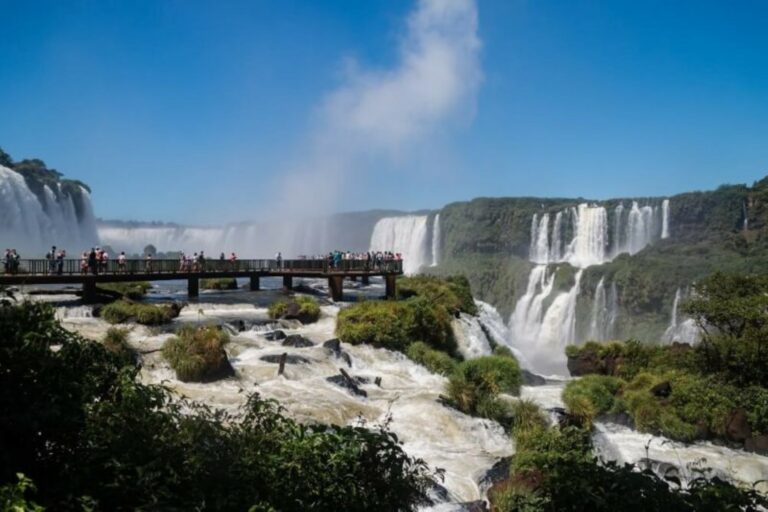
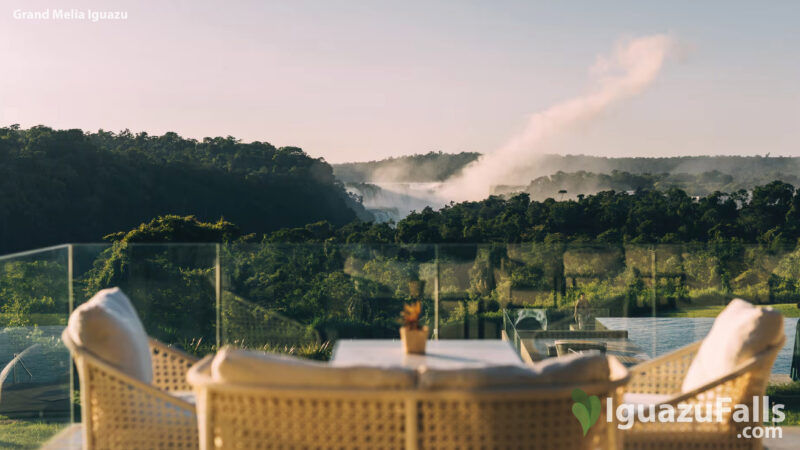
Enjoy a unique view of the Devil´s throat from the Grand Melia Iguazu hotel

Today, reaching Iguazu Falls is relatively easy. Visitors can fly into airports on either side of the border, travel along paved roads and explore the waterfalls through organized walkways and transportation systems.
At the beginning of the twentieth century, the situation was completely different.
The region was remote, densely forested and difficult to access. Travelers often arrived by river after long journeys through the Paraná and Iguazu river systems. Infrastructure was minimal, and visiting the falls was closer to an expedition than a conventional vacation.
Nevertheless, the enormous tourism potential of the waterfalls was already evident.
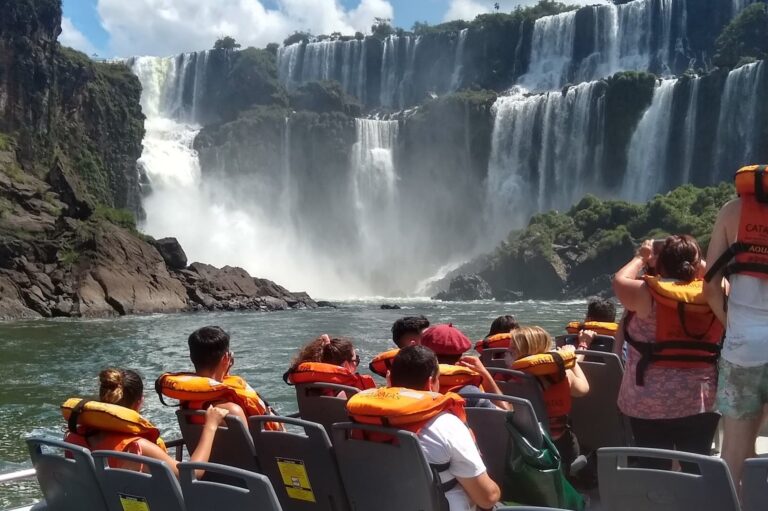
Experience the awe of Iguazu Falls on a 3-day tour from Buenos Aires. Book now for an unforgettable adventure!
From Price: USD150
Explorers, scientists, government officials and adventurous travelers began visiting the area during the late nineteenth and early twentieth centuries. Their descriptions helped introduce Iguazu Falls to a wider national and international audience.
The Argentine government gradually became interested in protecting the landscape while also making it accessible to visitors. Accommodation was essential to this plan because travelers needed somewhere to stay in a region without an established tourism industry.
This need led to the creation of the first important hotel beside the waterfalls.
One single amazing destination, three different countries!
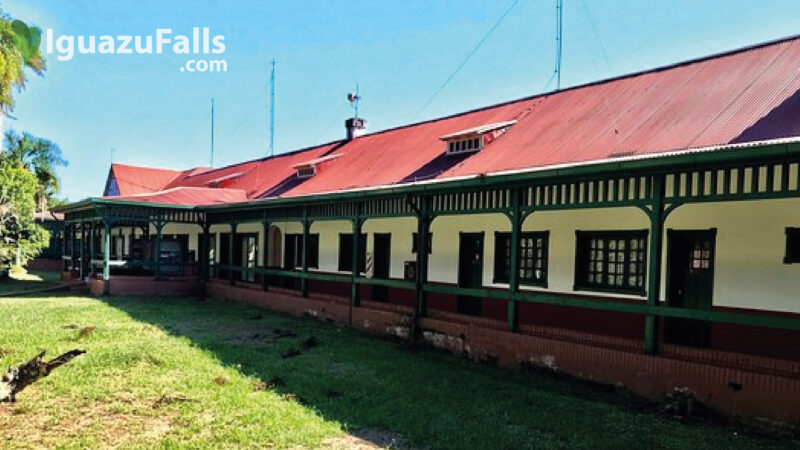
The first major hotel in the immediate Iguazu Falls area was the Hotel Cataratas, now generally known as the Viejo Hotel Cataratas, or Old Hotel Cataratas.
It was constructed in the waterfall area beginning in 1922, more than a decade before the official creation of Iguazú National Park. Argentina’s National Parks Administration recognizes the building as an important element of the park’s cultural heritage.
The original development was promoted by Olaf Hansen, who was associated with the administration of lands in the Iguazu area. Historical accounts indicate that construction took place between 1922 and 1924 under his direction.
The hotel opened in 1922 with approximately 40 rooms, as well as a dining room, bar and games room. These were notable facilities for such an isolated destination at the time.
The building had a strong European influence, particularly an English-inspired architectural appearance. Its style contrasted with the intense vegetation of the surrounding Atlantic Forest.
The Old Hotel Cataratas did not function in isolation. Operating a hotel in such a remote location required workers, food production, transportation and basic services.
A small settlement began developing around the waterfall area. It included:
In this sense, the hotel helped establish one of the earliest permanent tourism communities near the falls.
The history of the hotel is therefore closely connected with the early development of Puerto Iguazú itself.
Enjoy a unique view of the Devil´s throat from the Grand Melia Iguazu hotel
In 1928, the Argentine government acquired the land surrounding the falls. The hotel concession was subsequently associated with the Compañía Argentina de Navegación, linked to shipping entrepreneur Nicolás Mihanovich.
Government control marked an important change in the area’s history. Iguazu was no longer viewed exclusively as a distant natural attraction. It was increasingly regarded as a landscape of national importance that required protection, infrastructure and organized public access.
In 1934, Argentina created Iguazú National Park as part of the country’s emerging national park system.
The park had two interconnected objectives:
The Old Hotel Cataratas became part of this new protected landscape. It allowed visitors to remain close to the falls while national authorities developed roads, trails and public services.
Iguazú National Park was later inscribed on the UNESCO World Heritage List in 1984. UNESCO emphasizes that its conservation history extends back to the early twentieth century.

Experience the wonder of Iguazu Falls on a private 2 day tour from Buenos Aires. Easily reserve accommodations and optional activities. Book now!
From Price: USD150
As tourism increased, the original hotel required improvements.
During the late 1940s, Argentina’s National Parks Administration remodeled and expanded the property. Over time, its facilities reportedly included a swimming pool, tennis courts, a music room with a grand piano, its own power system and an agricultural area that helped supply the restaurant.
These features demonstrate how self-sufficient a remote hotel needed to be before modern roads and logistics connected Iguazu with the rest of Argentina.
Guests did not simply spend one night at the falls. Reaching Iguazu required considerable time and effort, so stays tended to be longer.
The hotel offered travelers a combination of nature, social life and organized recreation. Meals, music and evening gatherings became part of the experience because there were few alternative services outside the property.
The waterfall was the principal attraction, but the hotel itself became an important destination.
Experience Argentina’s Icons with Comfort and Style

As transportation improved and tourism expanded, the Old Hotel Cataratas became less suitable for the demands of modern international hospitality.
Eventually, it ceased operating as the principal hotel inside the park. However, the building was not forgotten or completely removed.
Different areas were adapted for institutional, educational and cultural purposes. In 2014, the restored building was presented as an interpretation center and venue for special events.
Yes. The historic building remains within the Argentine park and represents an important link with the earliest period of Iguazu tourism.
It has hosted exhibitions, environmental activities, conferences and cultural events. An official park audio-guide also includes a section dedicated specifically to the Old Hotel Cataratas.
The building should not be confused with the current Gran Meliá Iguazú. They are separate properties from different periods.
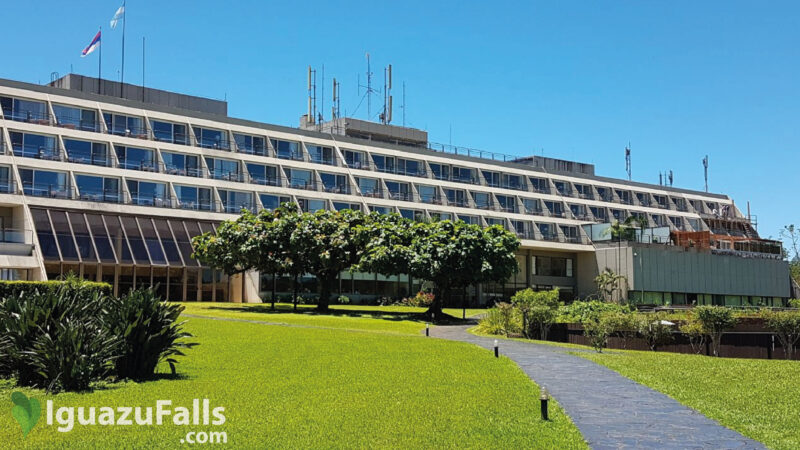
By the 1970s, Iguazu Falls was becoming a major international destination. Improved roads, commercial aviation and growing interest in nature tourism created demand for a modern hotel capable of receiving larger numbers of visitors.
Between 1976 and 1978, a new hotel and airport infrastructure were developed on the Argentine side.
The Hotel Internacional Iguazú Resort officially welcomed its first guest in August 1978.
The new hotel represented a significant change in scale and ambition. Unlike the relatively intimate Old Hotel Cataratas, Hotel Internacional Iguazú was designed as a complete international resort.
Its facilities included approximately 180 rooms, restaurants, bars, a swimming pool, tennis courts, conference facilities and commercial spaces.
The property also provided employment for around 200 people from Puerto Iguazú. At the time, the hotel and its employees had a major economic and social impact on the relatively small local community.
The hotel was designed to avoid competing visually with the waterfalls.
Its low-rise, horizontal structure followed the terrain and was surrounded by dense forest. Instead of imitating a traditional European palace, the building employed a modern resort style intended to frame views of the landscape.
The waterfalls, jungle and mist were always meant to remain the central attractions.

One of the most fascinating chapters in the hotel’s history came during the filming of The Mission, the 1986 historical drama starring Robert De Niro and Jeremy Irons.
Important scenes were filmed at Iguazu Falls and in the surrounding region. Hotel Internacional Iguazú reportedly served as an operational base and accommodation center during several months of production in 1985.
The film introduced the dramatic landscape of Iguazu to audiences around the world. Its images of immense waterfalls, rainforest and colonial-era missions helped reinforce the destination’s international identity.
Although Iguazu was already famous, The Mission gave the falls a powerful new presence in global cinema.
In the late 1990s, Starwood assumed management of the property, which became the Sheraton Internacional Iguazú.
For many international travelers, the hotel is still remembered simply as “the Sheraton Iguazú.”
During the Sheraton period, the hotel underwent renovations intended to update its rooms, restaurants and leisure facilities. A major renovation in the early 2000s included the development of a spa and other improvements.
The hotel later operated under the name Sheraton Iguazú Resort & Spa.
Its location remained its defining advantage. It was the only operational hotel inside the Argentine national park and offered direct views toward the waterfall system from selected rooms and public spaces.
Over several decades, the Sheraton hosted:
The hotel became closely identified with the Argentine experience of Iguazu Falls. Even after the brand changed, many local residents and returning visitors continued referring to the building by its former Sheraton name.
A major ownership and branding change occurred in 2017.
The property ended its association with Sheraton and joined Meliá Hotels International. It initially operated as Meliá Iguazú.
The transition was followed by an extensive renovation designed to reposition the hotel in the international luxury market.
Enjoy a unique view of the Devil´s throat from the Grand Melia Iguazu hotel
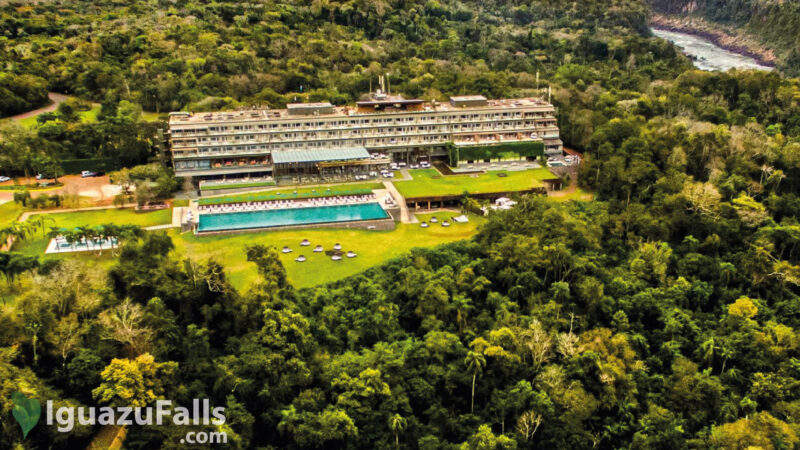
After the renovation, the property reopened under the luxury Gran Meliá brand in December 2018.
The project modernized guest rooms and public spaces while placing even greater emphasis on the hotel’s views of the waterfalls.
New or redesigned features included:
Today, Gran Meliá Iguazú presents itself as the only hotel located inside Argentina’s Iguazú National Park.
The Brazilian hotel developed along a different architectural path.
While Argentina eventually replaced its original hotel with a modern resort, Brazil preserved and expanded a grand Portuguese-colonial-style building that remains closely connected with the visual identity of the destination.
Construction of Hotel das Cataratas reportedly began in 1939.
The project was ambitious. It aimed to create a prestigious hotel directly opposite the Brazilian panorama of the waterfalls. However, World War II and the logistical difficulties of building in a remote forest region delayed its completion.
The hotel was not officially inaugurated until October 4, 1958.
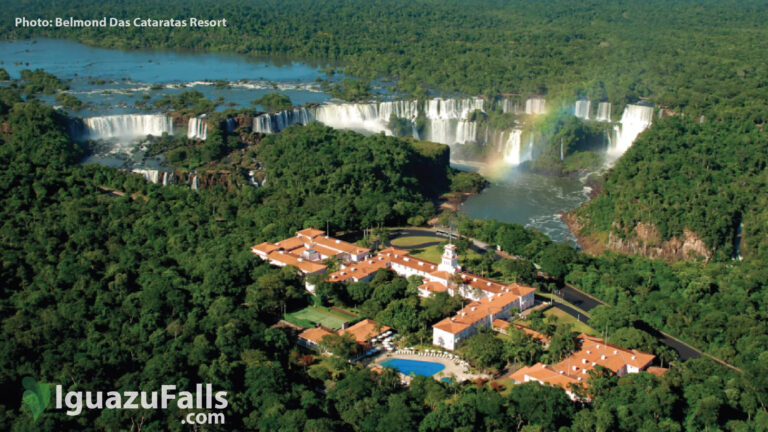
When it opened, Hotel das Cataratas reportedly had 52 rooms. Its architectural design evoked a Portuguese colonial residence, with features such as:
The building offered a striking contrast with the green Atlantic Forest, yet its relatively low profile prevented it from dominating the natural landscape.
Enjoy a wonderful exprience staying inside the park, on the brazilian side
In the 1950s, Brazil was investing in infrastructure, modernization and national tourism. Hotel das Cataratas became part of that broader effort.
The hotel gave travelers a comfortable base from which to experience a destination that was still difficult to reach. As on the Argentine side, the early property required considerable logistical independence.
Road access was limited, supplies had to be carefully organized and operating a luxury hotel inside a forest environment presented constant challenges.
As visitor numbers increased, Hotel das Cataratas was expanded.
Additional wings were reportedly added in 1971 and 1982. These expansions increased the number of rooms while maintaining the property’s recognizable colonial appearance.
Rather than replacing the original building with a completely modern structure, the hotel grew around its established architectural identity.

Brazil created Iguaçu National Park in 1939, the same year construction of the hotel reportedly began.
The Brazilian park was added to the UNESCO World Heritage List in 1986, two years after the Argentine park received the same recognition.
The two parks protect opposite sides of the same waterfall system and large areas of Atlantic Forest. UNESCO considers them complementary protected landscapes rather than isolated attractions.
Operating a hotel inside this environment requires a balance between tourism and conservation. Waste management, energy use, transportation, wildlife interaction and building maintenance must all respond to national park regulations.
In 2007, the property was acquired by Orient-Express Hotels.
The company began an extensive renovation program, reportedly costing approximately US$20 million. The work was completed around 2010.
The renovation sought to modernize the property without removing its historic character.
The project included improvements to:
Preserving the character of the original building was essential. The pink façade, tiled roof and colonial appearance had already become part of the visual memory of Iguazu Falls.

In 2014, Orient-Express Hotels changed its corporate brand to Belmond.
The Brazilian property consequently became Belmond Hotel das Cataratas, and today its official name is Hotel das Cataratas, A Belmond Hotel.
It remains the only hotel inside Iguaçu National Park on the Brazilian side.
The hotel now combines its mid-twentieth-century architecture with contemporary luxury services.
Its historic character continues to be one of its principal attractions. Guests are not simply staying close to Iguazu Falls; they are staying in a building that has formed part of the Brazilian park’s tourism history since the 1950s.
Enjoy a wonderful exprience staying inside the park, on the brazilian side
The two current hotels occupy equally privileged positions, but they represent different periods and architectural philosophies.
Gran Meliá expresses the modern resort tradition of the late twentieth century. Its horizontal architecture, large windows, terraces and infinity pool are designed to direct attention toward the falls.
Its story is one of transformation:
Hotel das Cataratas represents the tradition of the grand historic destination hotel.
Its identity has remained connected to:
Its story emphasizes architectural continuity and restoration rather than complete reinvention.
One single amazing destination, three different countries!
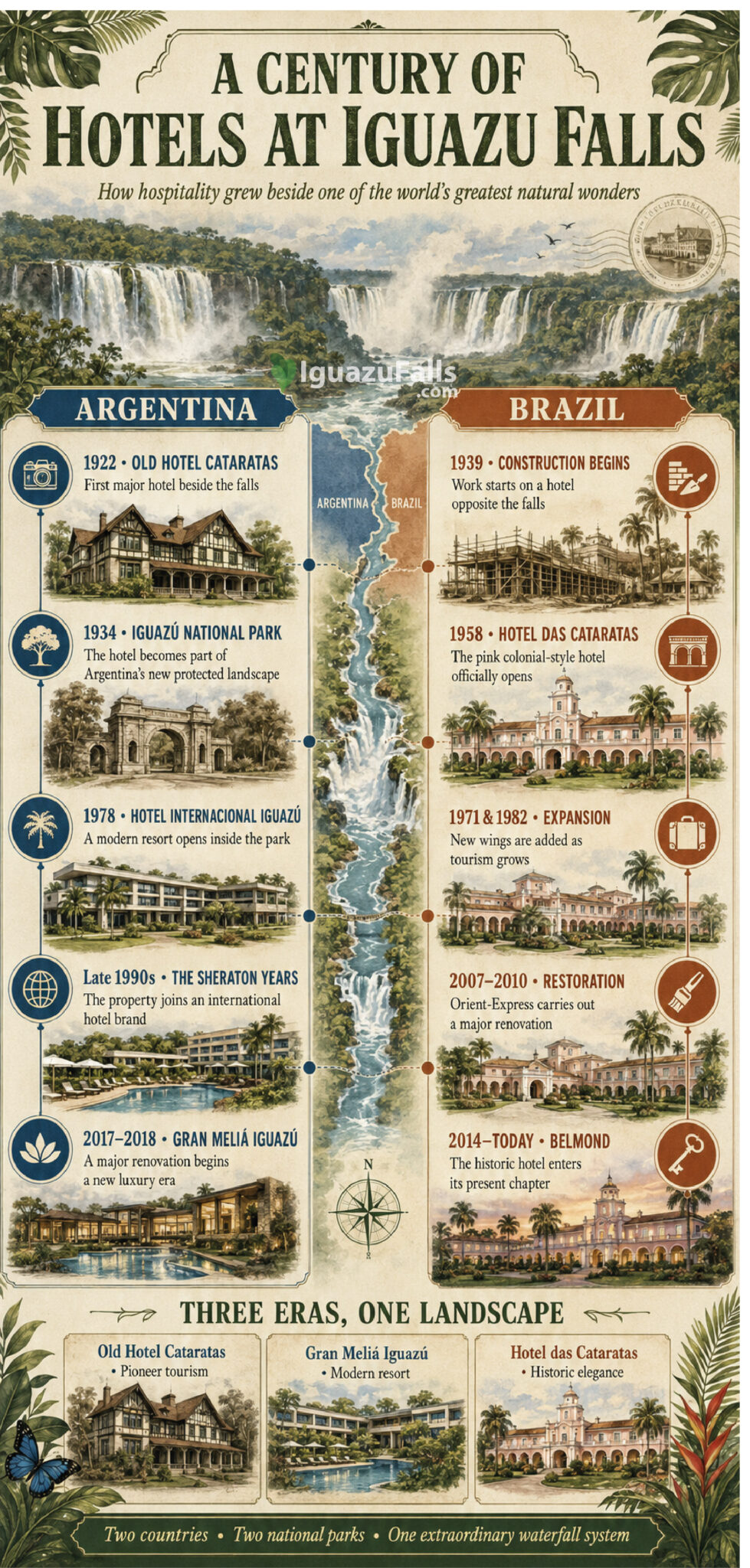
The first important hotel beside the falls opens on the Argentine side with around 40 rooms and essential visitor services.
The Argentine government takes greater control of the waterfall area and its tourism development.
The Old Hotel Cataratas becomes part of Argentina’s new national park system.
Construction of Hotel das Cataratas reportedly begins during the same period.
Argentina’s National Parks Administration renovates and improves the historic property.
The Brazilian hotel is officially inaugurated on October 4 with approximately 52 rooms.
An additional accommodation wing is added.
Argentina inaugurates a modern international resort inside the national park.
A further wing increases the hotel’s accommodation capacity.
The park receives World Heritage status.
Hotel Internacional Iguazú serves as an important base during the production period.
The Brazilian side joins the World Heritage List.
Hotel Internacional Iguazú becomes Sheraton Internacional Iguazú.
A major restoration and modernization program begins.
The corporate rebranding produces today’s Belmond identity.
The restored Argentine building becomes an interpretation and special-events venue.
Meliá assumes operation of the hotel.
The renovated property reopens under Meliá’s luxury brand.
Both hotels were developed during periods when national parks were expected not only to protect nature but also to encourage public enjoyment, tourism and regional development.
At the time, transportation was difficult and there were few accommodation options nearby. A hotel inside the protected area was considered necessary for making the waterfalls accessible to travelers.
Modern conservation policies are generally more restrictive about building major accommodations inside national parks. For that reason, the existing hotels occupy highly unusual and historically valuable positions that would be difficult to reproduce today.

The hotels helped generate employment and encouraged investment in:
They also helped transform Puerto Iguazú and Foz do Iguaçu from relatively isolated frontier settlements into internationally recognized tourism cities.
Generations of local residents have worked at the hotels, supplied them or provided services to their guests. Their history therefore belongs not only to international tourism but also to the communities surrounding the parks.
Iguazu Falls is primarily a natural attraction, but its tourism infrastructure has also become historically significant.
The Old Hotel Cataratas illustrates the pioneering phase of tourism during the 1920s. Gran Meliá represents the arrival of large-scale international hospitality in the 1970s and its evolution into a contemporary luxury resort. Hotel das Cataratas preserves the atmosphere of a grand mid-twentieth-century destination hotel.
Together, they demonstrate how different generations interpreted the relationship between architecture and nature.
Experience Argentina’s Icons with Comfort and Style
The Old Hotel Cataratas on the Argentine side was the earliest major hotel in the waterfall area. It opened in 1922, before Iguazú National Park was officially created.
No. It no longer operates as a conventional hotel. The historic building has been restored and adapted for interpretation, cultural activities and special events.
The present Gran Meliá building opened in 1978 as Hotel Internacional Iguazú.
Yes. The property operated under the Sheraton brand for many years before joining Meliá in 2017. It became Gran Meliá Iguazú following an extensive renovation in 2018.
Construction reportedly began in 1939, but the hotel was not officially inaugurated until October 4, 1958.
Its pink-and-white exterior forms part of its Portuguese-colonial-inspired architectural identity. The color has become one of the hotel’s most recognizable features.
There is one operational hotel inside each park: Gran Meliá Iguazú in Argentina and Hotel das Cataratas in Brazil.
Hotel das Cataratas is older than the current Gran Meliá building. However, Argentina’s Old Hotel Cataratas predates both of them.
The history of accommodation at Iguazu Falls spans more than a century.
It began with a pioneering hotel constructed in the forest when reaching the falls was still an adventure. It continued with Brazil’s elegant colonial-style Hotel das Cataratas and Argentina’s ambitious Hotel Internacional Iguazú. Later came international brands, major renovations and a new era of luxury travel.
Yet the essential attraction has never changed.
Every version of these hotels has attempted to give travelers something rare: the opportunity to wake up surrounded by the Atlantic Forest, hear the distant thunder of the water and experience Iguazu Falls as more than a short daytime visit.
The hotels are therefore not merely located inside the national parks. They form part of the human history of Iguazu itself.
Enjoy a wonderful exprience staying inside the park, on the brazilian side
Enjoy a unique view of the Devil´s throat from the Grand Melia Iguazu hotel
