

The Ibera Wetlands are a magnificent location in the Argentine Mesopotamia region, perfectly combinable with your visit to the Iguazu Falls. Allow me to introduce you to this natural attraction that you can add to your itinerary in the region.
The Ibera Wetlands constitute one of the largest freshwater wetland ecosystems in South America. Encompassing over 13,000 square kilometers, these wetlands are renowned for their biodiversity, hosting a myriad of wildlife, including caimans, capybaras, and over 350 bird species. Visitors can navigate through marshes, lagoons, and grasslands by boat or on guided wildlife excursions, immersing themselves in this natural sanctuary of extraordinary beauty and ecological significance. The Ibera Wetlands provide a unique opportunity to witness pristine wilderness and encounter a diverse array of flora and fauna in their natural habitat.
The approximate center of this system is located at coordinates 28°36′00″S 57°49′0″W. In Argentina, it covers around 12,000 km², which is part of a much larger system estimated to encompass approximately 45,000 km².
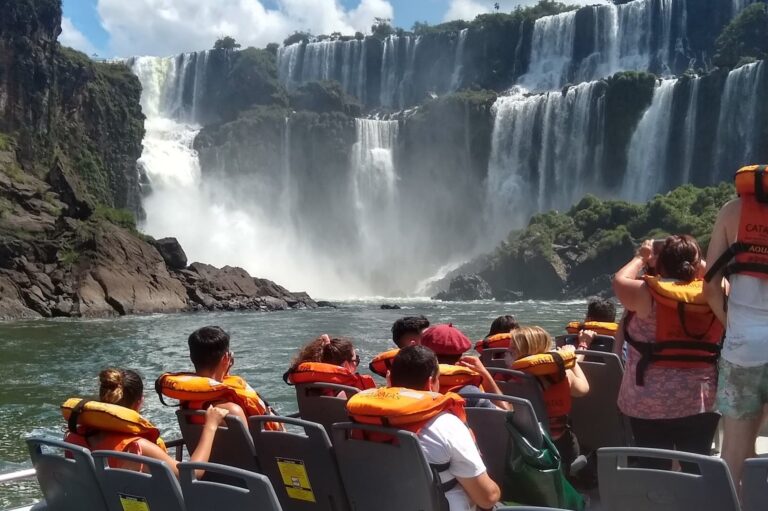
Experience the awe of Iguazu Falls on a 3-day tour from Buenos Aires. Book now for an unforgettable adventure!
From Price: USD190
The Ibera Wetlands are located in northeastern Argentina, primarily in the provinces of Corrientes and parts of Entre Ríos. They cover a vast area of over 13,000 square kilometers, making them one of the largest freshwater wetland ecosystems in South America.
The distances from the Ibera Wetlands to various important cities in the area are approximate and can vary depending on the specific starting and ending points within the wetlands:
From Ibera Wetlands to Posadas: The distance is approximately 250 kilometers (155 miles) to the southeast. This journey usually takes around 3.5 to 4 hours by car.
From Ibera Wetlands to Iguazu Falls: The distance is approximately 450 kilometers (280 miles) to the northeast. Traveling by car typically takes around 6 to 7 hours.
From Ibera Wetlands to Corrientes: The distance is roughly 320 kilometers (200 miles) to the east. It usually takes about 4.5 to 5 hours to drive.
From Ibera Wetlands to Resistencia: The distance is approximately 450 kilometers (280 miles) to the southeast. Travel time by car is around 6 to 7 hours.
These distances and travel times are estimates and can vary depending on factors such as road conditions, traffic, and the specific route taken. It’s advisable to consult a map or a navigation app for more precise information based on your starting point within the Ibera Wetlands.

The largest species include the marsh deer (Blastoceros dichotomous, known as guazú puku in Guarani) and the pampas deer (Ozotocerus bezoarticus, known as guazú ti’í in Guarani). The marsh deer, an excellent swimmer, roams throughout the region, residing in flooded areas for extended periods, making it difficult to spot except from boats. The smaller pampas deer is restricted to the mainland area. Both species are considered endangered and are listed in Appendix I of the Convention on International Trade in Endangered Species of Wild Fauna and Flora (CITES), which strictly prohibits their hunting and trade.
Difficult to observe due to their shy habits and also strictly protected by CITES, the maned wolf (Chrysocyon brachiurus), a large native canid, the river otter (Lontra longicaudis, a relative of the otter), and the Geoffroy’s cat (Oncifelis geoffroyi). Conversely, the capybara (Hydrochoerus hydrochaeris) is easily found nowadays. It is an amphibious herbivorous rodent weighing over 70 kg as an adult, measuring approximately 1 meter long and 60 cm tall. Its appearance resembles that of a giant guinea pig, sturdy and tailless. With a solid trunk, thick head, wide and split snout, small eyes, undeveloped ears, and deeply cleft upper lip. Short-legged with four toes on the front legs and 3 toes on the hind legs, connected by a small webbed membrane. Its coat is dense, short, and rough. The general color is light gray.
Yacaré in the Ibera Wetlands.
Reptile species include the ubiquitous black caiman (Caiman yacare) and broad-snouted caiman (Caiman latirostris). Both occasionally exceed two meters in length, although large specimens are scarce due to intense poaching before the establishment of the park. Both species have repopulated easily and are currently easy to spot. Several snake species, including the highly venomous lancehead pit viper (Bothrops alternatus), rattlesnake (Crotalus durissus terrificus), and coral snake (Micrurus pyrrhocryptus), as well as harmless water cobra (Hydrodynastes gigas, known as ñacaniná in Guarani), false fer-de-lance (Pseudotomodon trigonattus), and the constrictor anaconda (Eunectes notaeus) complement the landscape, along with numerous amphibian species of all sizes.

Giant Anteater.
The giant anteater (Myrmecophaga tridactyla) naturally existed in the area until 1965 but was exterminated by humans; it has recently been reintroduced.
The tapir (Tapirus terrestris), collared peccary (Pecari tajacu), and giant otter (Pteronura brasiliensis) have also been reintroduced.
In 2016, the medium-sized feline called the ocelot (Leopardus pardalis) reappeared.

Experience the wonder of Iguazu Falls on a private 2 day tour from Buenos Aires. Easily reserve accommodations and optional activities. Book now!
From Price: USD130
Jaguar or “American tiger” (Yaguareté)
Regarding the jaguar or “tiger” (Panthera onca), this top American predator was exterminated in the 1960s in the province of Corrientes (where it is emblematic) as it was classified as a “plague”; however, since 2015, the reintroduction plan for the “tiger” or “jaguar” in the Ibera Wetlands has been active, using specimens in captivity whose offspring would return to the wild in the “wetlands,” “marshes,” and wetlands of the Ibera, thus controlling, as it is a focal superpredator, ecologically, the reproduction of other fauna. In May 2015, the first female “tiger” or jaguar, named “Tobuna,” was reintroduced into its natural habitat in the Ibera. The area is notable for its ornithological richness. The presence of around 300 bird species, from over 50 families, has been recorded. Among the rare species or those with some degree of vulnerability are the greater rhea (Rhea americana), the black-and-white monjita (Xolmis dominicanus), the yellow cardinal (Gubernatrix cristata), the red-and-green macaw (Ara chloropterus), and the bare-throated bellbird (Procnias nudicollis). The crested caracara (Caracara plancus), the red-crested cardinal (Paroaria coronata), and the black-fronted piping guan (Pipile jacutinga) have been reintroduced. In total, it is estimated (as of 2015) that there are about 800 species of macroscopic fauna in the Ibera area.

If you’ve chosen to explore the Ibera Wetlands, you’re undoubtedly a nature enthusiast. Encompassing an area of 13,000 square kilometers, this remarkable place comprises swamps, lagoons, lakes, and bogs teeming with diverse wildlife, making it a paradise for nature lovers. Expect to encounter alligators, deer, giant otters, capybaras, anacondas, monkeys, and over 350 bird species.
For independent exploration, consider renting a kayak to paddle through the marshes, though you may not encounter as much wildlife. Alternatively, opt for a guided boat excursion lasting approximately 1.5 to 2 hours, where you’ll marvel at a plethora of animals up close and capture unique photographs. Self-guided trails are also available to explore the provincial reserve.
Another captivating option is to embark on a horseback riding tour through the forests and swamps. These tours, led by local guides, cater to both novice and experienced riders and offer a serene experience, especially during sunset.
Birdwatching enthusiasts will be delighted by the Wetlands’ 350 bird species, observable from September to April. Professional birding tours are available to explore designated circuits and spot various bird species such as Ñandu, Red-winged, Spotted, Maca Gris, and many more.
Trekking trails provide an opportunity to immerse oneself in the Wetlands’ nature under the guidance of expert guides, respecting the fauna while discovering the native forest.
Boat navigation remains one of the best ways to explore the area and witness its fauna. Early morning boat trips unveil picturesque landscapes, aquatic vegetation, and the wetlands’ true inhabitants, including capybaras, marsh deer, otters, caimans, and various aquatic birds, offering an unforgettable adventure in the wetlands.

Enhance your visit to Iguaçu National Park in Brazil and experience a breathtaking sunset at Iguazu Falls with a delightful drink in hand.
From Price: USD139
As you can observe in the following image, there are various entrances to the Ibera Wetlands, with some being more significant than others. Let’s delve into details about the main entrances to access the Ibera Wetlands:

The Uguay Gate:
Situated 82 km from Mercedes and 32 km from Colonia Carlos Pellegrini by RP40, the Uguay Gate offers access to a remote area where approximately 20 families reside within the Iberá Natural Reserve. The gate provides opportunities for navigation through the Fernandez Lagoon, flora and fauna sighting, nature trail walks, horseback riding, and visits to artisans. “Posada Uguay,” the local inn, serves as the gateway to the Guazu-Cuare reserve, where guests can experience the authentic essence of Iberá.
The Rio Corriente Gate:
Conveniently located 180 km from Corrientes City, the Rio Corriente Gate is accessible via RN12 and RN123. Visitors can enjoy boat rides and indulge in “mate” sessions on the banks of the Corriente River. While no stores are available at the gate, nearby Chavarría offers dining options and rotisseries.
The Carambola Gate:
Situated 190 km from Corrientes and 207 km from Ituzaingó by RN12 and RP118, the Carambola Gate requires traversing 27 km of gravel and dirt roads from Concepción de Yaguareté Corá. This gate features a recently opened campground with barbecue areas, though visitors must bring their own supplies.
The San Nicolas Gate:
Located 163 km from Corrientes city by RP5, the San Nicolas Gate involves a 27 km journey along sand and dirt roads from San Miguel. It offers camping facilities with barbecue areas and hot water showers, making it ideal for overnight stays. Visitors can partake in activities such as canoeing, kayak excursions, bird watching, horseback riding, trekking, and visits to artisans in San Miguel.
The Cambyretá Gate:
Found 230 km from Corrientes, the Cambyretá Gate is accessible via RN12, 15 km from Ituzaingó, and 8 km from Villa Olivari. It features a camping area, barbecue facilities, and hot showers, with Ituzaingó providing various services such as guided tours and transfers. Activities include hiking and bird watching.
The Galarza Gate:
Situated 318 km from Corrientes, the Galarza Gate offers navigation through estuaries and lagoons, bird watching, flora and fauna exploration, walks, night safaris, and visits to herbal establishments and Jesuit ruins. It provides ecotourism accommodations and English and Portuguese interpretation services.
The Laguna Ibera Gate:
Located 120 km from Mercedes, the Laguna Ibera Gate serves as the entrance to Colonia Carlos Pellegrini on RP40. It offers activities such as kayak or boat rides, hiking, horseback riding, car rides, bird watching, night safaris, and visits to artisans, complemented by diverse gastronomic options in Pellegrini.
These gateways provide diverse opportunities for visitors to experience the wonders of the Ibera Wetlands.
Absolutely! Of course, it requires careful planning and consideration of travel logistics. Both destinations offer incredible natural beauty and wildlife experiences, making them worthwhile additions to any travel itinerary in Argentina. We´re ready to arrange a good program for you, but check below our suggested tour to combine Iguazu Falls and Iberá Wetlands in an amazing tour in the Argentinian Northeast
Click on the image below and check our suggested program. It includes also Buenos Aires in a wonderful 9-night tour, but we can offer Iguazu + Ibera only. Just let´s know!

Photo: Thanks to Posada Aguape in Ibera!
