
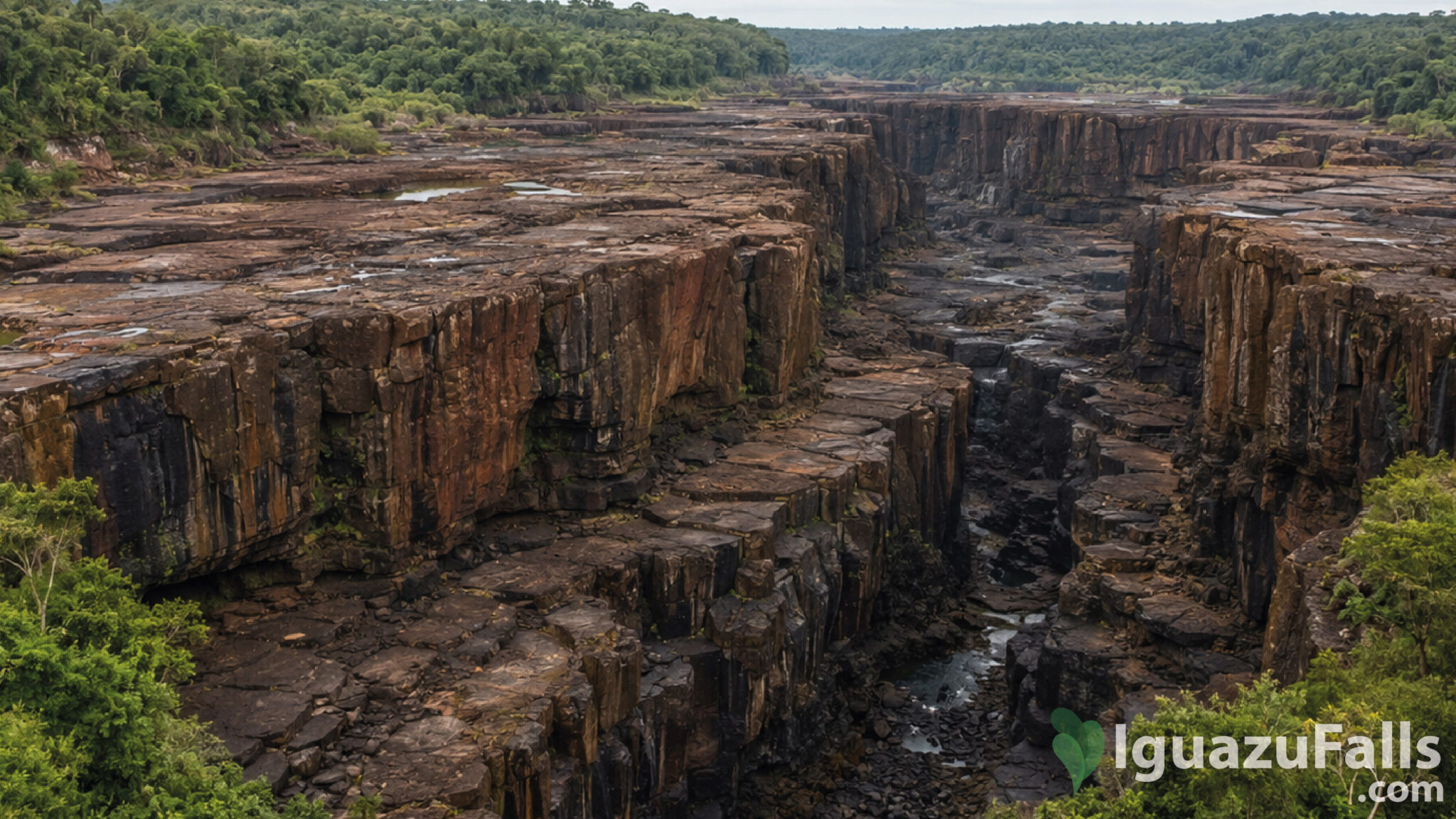
Iguazu Falls is famous for its enormous volume of water, drifting mist and continuous roar. But imagine the impossible for a moment: what would the landscape look like if all that water suddenly disappeared?
Instead of a conventional waterfall, visitors would see an immense geological amphitheater formed by dark basalt terraces, deep fractures, rocky islands and channels sculpted over thousands of years. The result would be less colorful and dynamic—but scientifically fascinating.
This is a hypothetical visualization, not a prediction. Iguazu has experienced periods of unusually low water, but an entirely dry waterfall system would require an extreme interruption of the Iguazu River.
The water does not simply fall from one smooth cliff. Beneath the cascades is a complicated landscape composed of ancient volcanic rock.
The falls extend across almost three kilometers, while the river drops approximately 80 meters through a succession of cataracts. UNESCO describes Iguazu as one of the world’s most visually and acoustically remarkable natural sites.
Without water, that enormous curtain would be replaced by a vast system of exposed ledges, canyons and river channels.
The foundation of Iguazu Falls consists largely of basalt created by enormous volcanic eruptions between approximately 120 and 130 million years ago.
Successive lava flows cooled and hardened in layers. The contacts between these layers created weaker sections that were progressively eroded by the river, producing the characteristic stepped appearance of the waterfalls. The Geotourism and Geoconservation program of Paraná explains that Iguazu’s different levels are directly connected to the structure of these basalt flows.
Without water, the divisions between the ancient lava layers would become much easier to recognize.
Visitors would also notice extensive cracks running through the basalt. Some would form straight walls, while others would divide the exposed riverbed into large angular blocks.
From a distance, parts of the canyon might resemble an abandoned stone city. These formations, however, would be entirely natural.
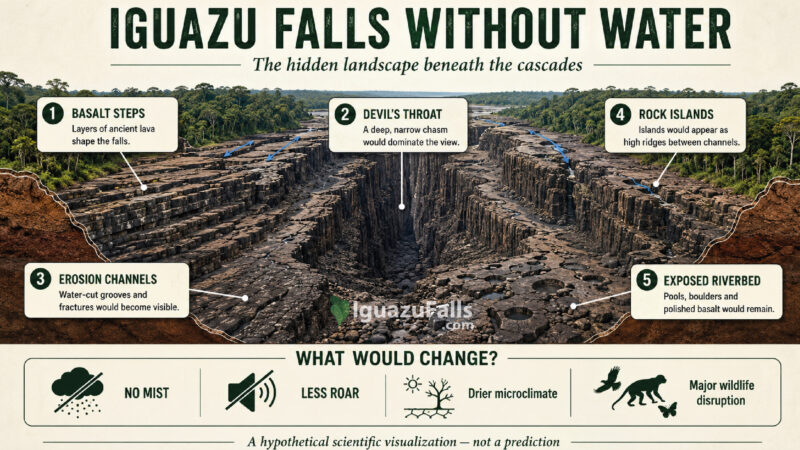
Devil’s Throat would probably remain the most dramatic section of Iguazu Falls—even without its water.
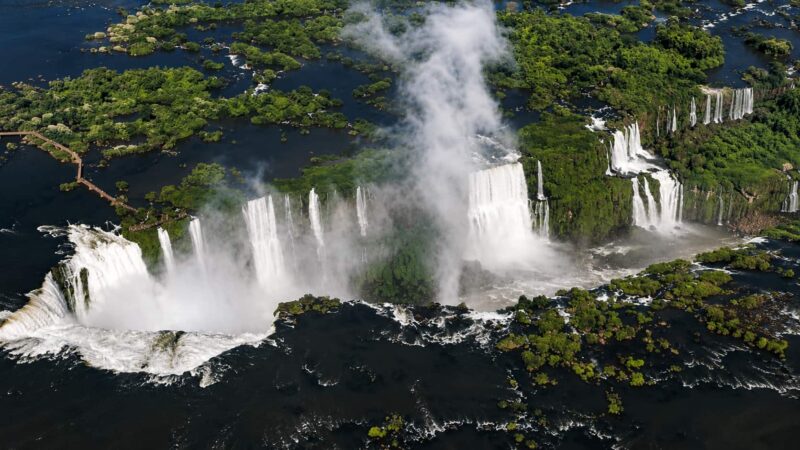
Today, the river enters Devil’s Throat from several directions before plunging into a narrow canyon. Spray frequently hides the bottom, adding to the impression that the water is falling into an enormous abyss.
Without the cascades and mist, the complete structure of the canyon would become visible. Visitors would see nearly vertical basalt walls descending into a shadowy channel filled with rocks, residual pools and water-polished surfaces.
It might look more like an enormous volcanic ravine than a waterfall.
The absence of turbulent water could reveal:
Some of these formations are permanently hidden beneath foam, spray and powerful currents.

Experience the wonder of Iguazu Falls on a private 2 day tour from Buenos Aires. Easily reserve accommodations and optional activities. Book now!
From Price: USD150
The many islands that divide the Iguazu River into separate cascades would remain—but their appearance would change substantially.
Instead of looking like green islands surrounded by water, they would resemble elevated forest-covered ridges rising above a network of dry channels. Their bases would become visible, showing how the river divided itself before reaching the edge of the falls.
Some islands might appear much larger because sections normally submerged by the river would be exposed.
Experience Argentina’s Icons with Comfort and Style

Two of Iguazu’s most recognizable characteristics would disappear almost immediately.
Millions of droplets are created when the river strikes the rocks below the falls. Without falling water, this mist would vanish.
The air around Devil’s Throat would become clearer and probably feel warmer and less humid. Rainbows produced by sunlight passing through the spray would also disappear.
The roar of Iguazu can be heard well before some viewpoints come into sight. Without water, the dominant sounds would be wind, insects, birds and perhaps water dripping into the remaining pools.
For anyone familiar with the falls, the silence might be even more surprising than the exposed rocks.

Go biking to the amazing Iguazu Falls National Park Brazilian Side ,enjoying the nature, the animals, the flora.
From Price: USD35
The consequences would extend well beyond the appearance of the waterfalls.
Fish, aquatic insects and other organisms depend on the river and its currents. A complete interruption would fragment or eliminate many of these habitats.
Residual pools could temporarily preserve some species, but they would become warmer, smaller and increasingly isolated.
Plants growing near the waterfalls benefit from permanently humid conditions. Mosses, ferns and other moisture-loving vegetation could dry out if the spray disappeared for an extended period.
The change would not instantly destroy the surrounding Atlantic Forest, but the local microclimate around the canyon would become significantly drier.
Birds, mammals and insects use the river for food, drinking water and movement through the forest. A prolonged disappearance of the river would force many animals to move elsewhere.
Great dusky swifts—which are famous for flying around and nesting close to the cascades—would be among the animals most directly affected by such a dramatic transformation.
Yes—but for entirely different reasons.
The attraction would no longer be the power and movement of the water. Instead, visitors would be looking at the geological structure responsible for creating the waterfalls.
The exposed landscape would help explain:
Iguazu would temporarily resemble an enormous open-air geology museum.
A smart, great-value way to see Iguazu Falls in two nights. Stay at a confirmed 3-star hotel, join shared group tours to both the Brazilian and Argentine sides, and enjoy shared transfers from and to IGR or IGU.
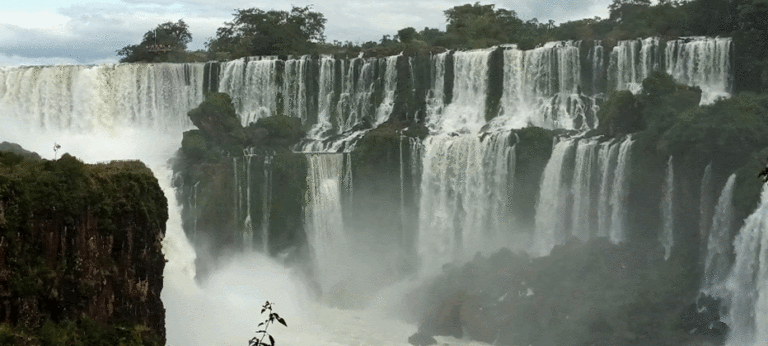
A total absence of water is extraordinarily unlikely under normal conditions.
The volume of the Iguazu River changes according to rainfall throughout its basin. Drought can reduce the number and strength of the cascades, while periods of intense rain can transform them into a nearly continuous wall of water.
However, low flow is not the same as no flow. Completely exposing the entire riverbed would require an exceptional and prolonged interruption affecting the whole river system.
If the river disappeared permanently, the initial rocky landscape would gradually evolve.
Plants would begin colonizing channels and cracks. Soil would accumulate in protected areas, larger pools would evaporate and sections of the riverbed could eventually become covered by forest.
Without constant erosion, the cliffs would change more slowly. Iguazu might eventually become a forested canyon containing dry basalt terraces—the geological memory of a waterfall that no longer existed.
Fortunately, this is speculation rather than the expected future of the national parks.
Unveiling the Wonders of Argentina: Explore Buenos Aires and Iguazu Falls on a 6-Night Journey

Imagining Iguazu Falls without water reveals that the spectacle depends on two inseparable elements:
The basalt provides the architecture. The water provides the movement, sound, mist and life.
Without the river, Iguazu would remain an extraordinary geological formation—but it would no longer be the living natural wonder recognized around the world.
No complete modern drying of the entire waterfall system is normally documented. Exceptionally low river levels have reduced many cascades to narrow streams, but some water continued flowing through the main channels.
The cliffs consist predominantly of basalt produced by enormous ancient lava flows. Different basalt layers and fractures helped determine the stepped shape of the falls.
Yes. Devil’s Throat is a physical canyon carved into the basalt. The water makes it spectacular, but the deep chasm would remain visible if the river disappeared.
Almost certainly not. The terrain would contain unstable rocks, deep cavities, sudden drops and residual channels. It would also remain inside strictly protected national parks.
No. Even severe drought usually leaves water flowing through the principal channels. The completely dry landscape shown here is a hypothetical scientific visualization.
Experience the wonder of Iguazu Falls on a private 2 day tour from Buenos Aires. Easily reserve accommodations and optional activities. Book now!
From Price: USD150
Experience the awe of Iguazu Falls on a 3-day tour from Buenos Aires. Book now for an unforgettable adventure!
From Price: USD150
