
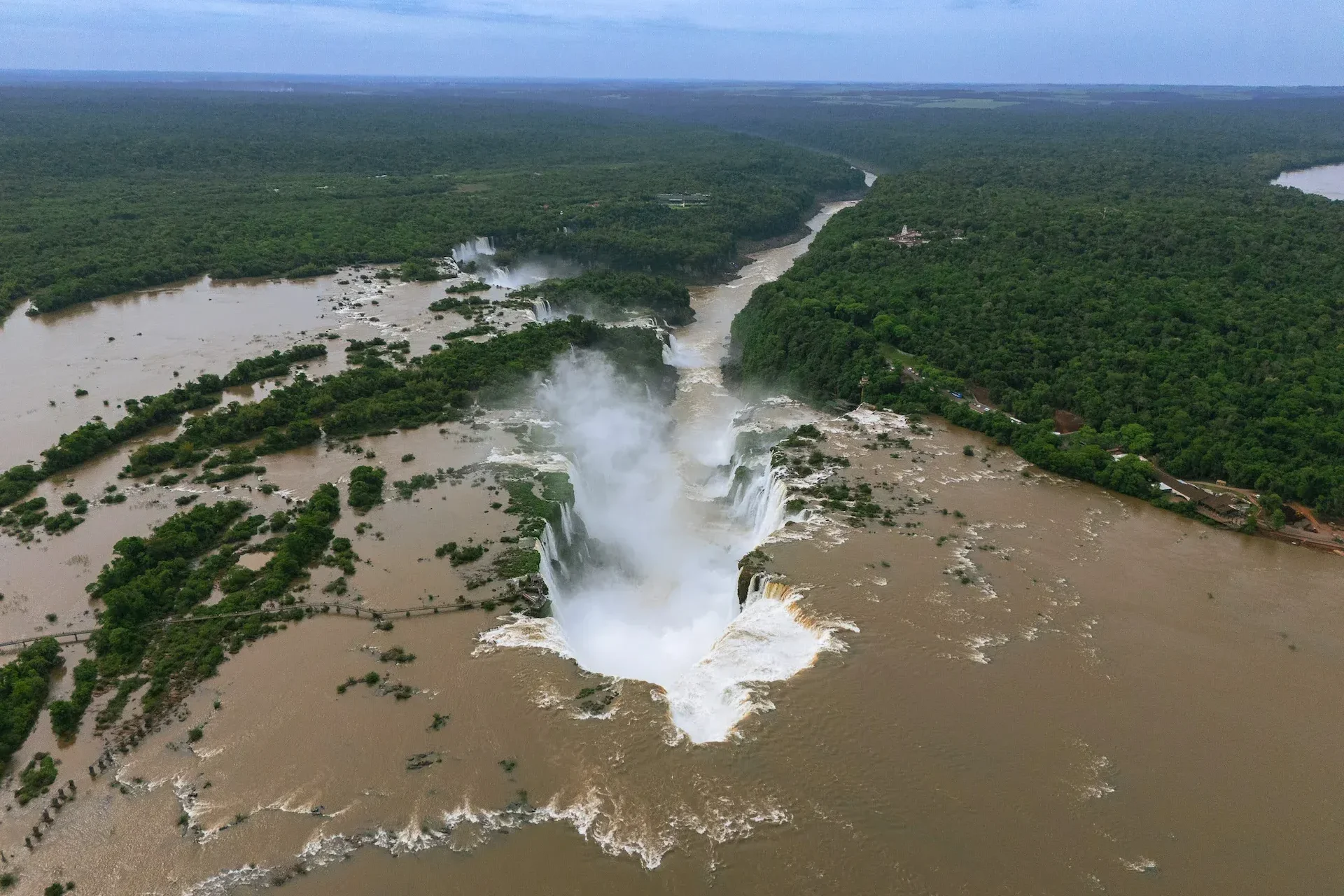
When travelers see photographs or videos of Iguazu Falls, one question often comes to mind: Why are Iguazu Falls waters brown?
The short answer is that the Iguazu River carries suspended soil, clay, sand, and organic material, especially after heavy rainfall. These natural sediments give the water its characteristic brown, reddish, or ochre appearance.
The color is not necessarily a sign of pollution. It is mainly the visible result of erosion, rainfall, river currents, and the distinctive red soils found throughout the region.
The brown color of Iguazu Falls comes primarily from tiny particles suspended in the water. As the Iguazu River travels across southern Brazil toward the border with Argentina, it collects soil, clay, minerals, leaves, and other natural materials from its vast drainage basin.
During periods of rain, runoff carries more of these particles into streams and tributaries, which then flow into the Iguazu River. The stronger the rain and the higher the river, the more sediment the water is generally able to transport.
When this sediment-filled water plunges over the falls, the turbulence mixes the particles throughout the river. That is why the water can look particularly dark, reddish-brown, or muddy during high-flow periods.
DISCOVER A WONDERFUL PLACE TO ENJOY BIRDWATCHING. BE READY WITH YOUR BINOCULARS.

The area surrounding Iguazu Falls is famous for its deep red soil. This color is largely associated with iron-rich minerals produced by the long-term weathering of volcanic rocks.
The falls themselves developed over layers of basalt connected to the ancient volcanic geology of the Paraná Plateau. Over millions of years, the warm and humid climate contributed to the chemical weathering of these rocks.
Iron compounds in the soil oxidize when exposed to air and moisture. This process is similar to the formation of rust and helps produce the region’s intense red and orange tones.
When rain falls on exposed ground, roads, riverbanks, agricultural land, and other surfaces within the watershed, it can wash small quantities of red soil into nearby waterways.
These fine particles remain suspended in the river rather than sinking immediately. Once mixed into the water, they create the earthy brown and reddish tones commonly seen at Iguazu Falls.
The visual effect can be especially striking in aerial photographs, where the reddish river contrasts with the deep green Atlantic Forest surrounding the waterfalls.
A smart, great-value way to see Iguazu Falls in two nights. Stay at a confirmed 3-star hotel, join shared group tours to both the Brazilian and Argentine sides, and enjoy shared transfers from and to IGR or IGU.
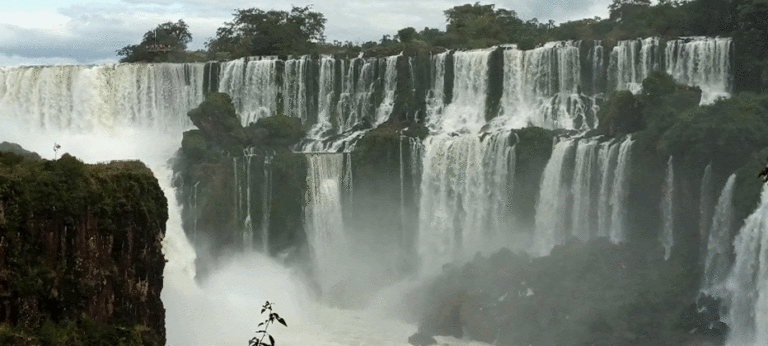
Rainfall is one of the most important factors affecting both the color and power of Iguazu Falls.
After heavy rain in the upper Iguazu River basin:
Importantly, the rain responsible for these changes may have fallen far upstream. The weather at the national parks can be sunny while increased water and sediment from earlier storms are still traveling down the river.
A fast-moving river can carry more sediment than a slow-moving one. During periods of exceptionally high flow, the Iguazu River gains enough energy to transport greater quantities of clay, silt, sand, branches, and organic debris.
This can turn the falls from a relatively light brown or greenish color into a powerful reddish-brown cascade.
The National Water Institute of Argentina monitors major fluctuations in the river’s discharge at the falls, which are strongly connected to climatic conditions and rainfall across the basin.
Experience the awe of Iguazu Falls on a 3-day tour from Buenos Aires. Book now for an unforgettable adventure!
From Price: USD150
Brown water does not automatically mean dirty or polluted water.
The color of a river can be influenced by several natural elements, including:
Water can look clear and still contain invisible contaminants. Conversely, water can look muddy while its visible color is largely caused by natural sediment. Appearance alone is therefore not a reliable measurement of water quality.
Like any large watershed, the Iguazu River is affected by both natural processes and human activity upstream. However, the famous brown appearance of the falls is fundamentally linked to sediment transport, erosion, and the region’s soil.
Visitors should not interpret the reddish-brown color as evidence that something is wrong with the waterfalls.
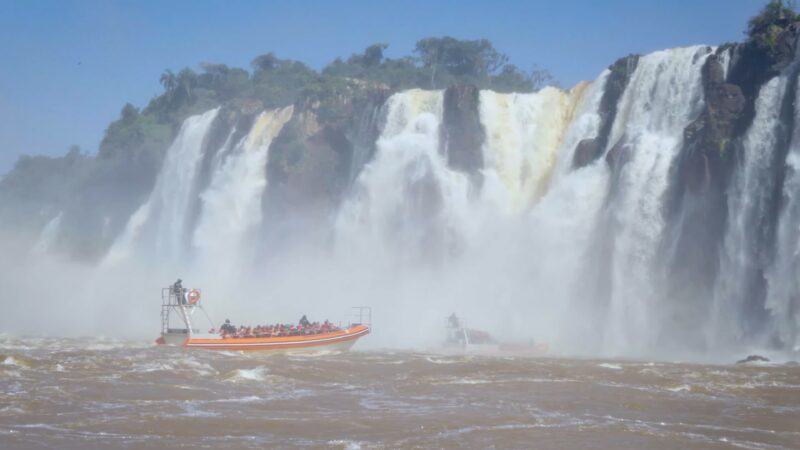
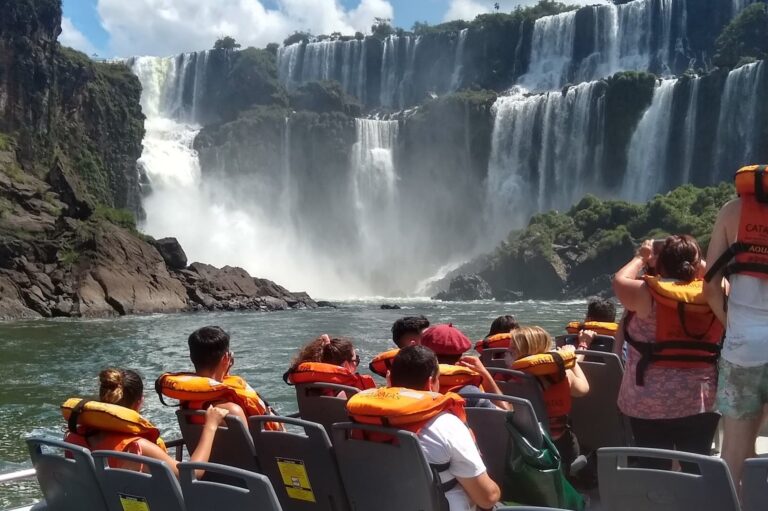
No. The color of Iguazu Falls changes constantly.
Depending on the season, recent rainfall, river level, sunlight, and observation point, the water may appear:
Under lower-flow conditions, less sediment may be suspended in the river, allowing the water to look clearer or slightly greener. During high water, the stronger current often carries more sediment and produces deeper brown tones.
There is no single permanent color for Iguazu Falls.
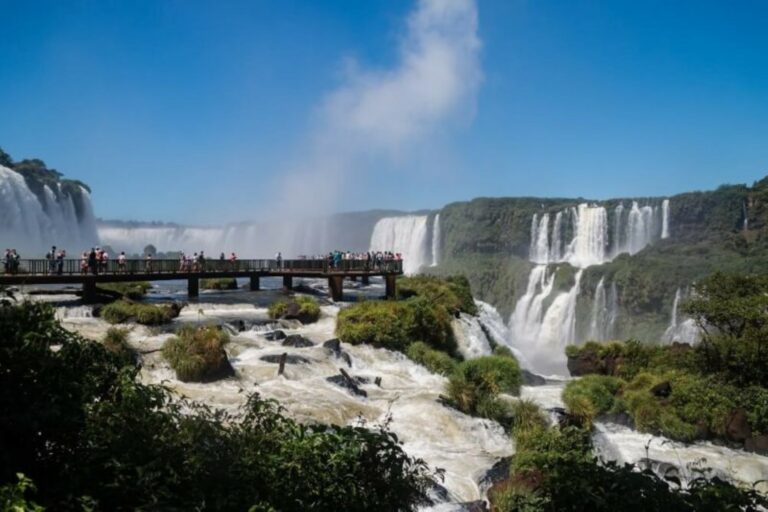
Although the Iguazu River may be brown, much of the falling water can appear white. This happens because the enormous impact of the cascades traps air inside the water.
The result is foam, mist, spray, and millions of tiny bubbles that reflect sunlight. From a distance, these aerated sections appear white even though the river flowing toward the edge may look brown.
This is particularly noticeable at Devil’s Throat, where an immense volume of water crashes into a narrow canyon and produces a permanent cloud of mist.
Experience the awe of Iguazu Falls on a 3-day tour from Buenos Aires. Book now for an unforgettable adventure!
From Price: USD150
For most visitors, the color adds to the dramatic character of the landscape.
The combination of reddish water, white spray, dark basalt cliffs, and dense green forest creates one of the most distinctive natural scenes in South America. The contrast is especially intense after rain, when the river becomes more powerful.
Clear or blue water is not an essential feature of a spectacular waterfall. Iguazu Falls is impressive because of its scale, width, geological structure, surrounding forest, and extraordinary volume of water.
The waterfall system extends across almost three kilometers and includes numerous individual cascades, with water dropping as much as approximately 80 meters in some sections. It is protected by Iguazú National Park in Argentina and Iguaçu National Park in Brazil, both recognized as UNESCO World Heritage properties.
One single amazing destination, three different countries!
During relatively dry periods, visitors may notice:
Lower flow can reveal details in the geological structure that are hidden when the river is high.
At normal levels, the waterfalls usually offer a balance between volume and visibility. The river remains powerful, but many individual cascades, islands, and rock formations can still be distinguished.
The water commonly has a light or medium brown tone, depending on recent rainfall.
After intense rain across the basin, the river can become much wider, faster, and darker. Some individual cascades may merge into enormous curtains of water.
During these periods, visitors may experience:
High water can be extraordinary to witness, but extremely elevated levels may affect park operations.
Several hydroelectric facilities operate along the Iguazu River basin, and their management can influence short-term variations in water levels and discharge. However, dams are not the original reason the river is brown.
The river naturally transports sediment from its watershed. Rainfall, runoff, erosion, soil composition, and current strength remain the main factors behind the visible color.
Hydroelectric operations may modify the timing of water movement, but they do not create the region’s red soil or the natural sediment carried by the river.
The Argentine and Brazilian viewpoints overlook the same river and the same waterfall system, so the underlying water color is essentially the same.
However, it may appear different because of:
On the Brazilian side, visitors generally enjoy broad panoramic views, making the contrast between the brown river and green forest particularly visible.
On the Argentine side, the trails bring visitors much closer to the cascades. From this perspective, the water may appear whiter because of the foam and spray.
Buenos Aires, Iguazu, & Rio de Janeiro: A Triad of South American Splendor

Iguazu Falls does not have a perfectly predictable “brown-water season” or “clear-water season.” Rain can occur throughout the year, and conditions within the extensive upstream basin matter more than the weather on a single day.
Nevertheless, wetter periods are more likely to produce higher water levels and increased sediment transport. During drier spells, the river may carry less suspended material and appear lighter.
Travelers should remember that Iguazu Falls is a dynamic natural environment. Its appearance may change dramatically in only a few days.
It is difficult to predict the exact color weeks or months in advance. Recent rainfall and river discharge are more useful than broad seasonal averages.
Before visiting, travelers can check:
Even these sources cannot guarantee a particular color, since sunlight and viewing conditions can alter how the water appears in person and in photographs.
Brown or reddish water can be excellent for photography because it creates strong color contrast with the surrounding rainforest.
To capture the natural colors effectively:
Cloudy weather can also be useful because it reduces harsh highlights in the white water and allows more detail to remain visible.
An amazing adventure program to enjoy Iguazu Falls with some extreme activities

Rain washes soil, clay, and organic material into the Iguazu River and its tributaries. Stronger currents then carry these suspended particles toward the falls, giving the water a darker brown or reddish appearance.
The brown color alone does not indicate pollution. It is primarily caused by natural sediment and organic material. Water quality requires scientific testing and cannot be determined simply by looking at its color.
The reddish tone comes mainly from fine particles of iron-rich soil suspended in the river. The region’s characteristic red earth developed through the weathering of basaltic rocks in a warm, humid climate.
Iguazu Falls is not normally known for bright blue water. Under lower-flow conditions and certain lighting, parts of the river may look greenish or gray-blue, but brown, ochre, white, and reddish tones are more typical.
Yes. Brown or reddish water is completely normal and is part of the natural appearance of the Iguazu River.
The river may appear clearer after an extended period with less rainfall, when runoff and sediment transport are reduced. However, exact conditions cannot be guaranteed for any particular date.
Swimming is not permitted in the waterfall area. The river has extremely powerful currents, sudden changes in depth, submerged rocks, and dangerous drop-offs. Visitors must remain within authorized trails, platforms, and designated visitor areas.

A wonderful adventure activity including kayak and trekking
From Price: USD69
The color of Iguazu Falls tells the story of an entire landscape.
Rain falls across the river basin, moves through forests and human-modified areas, loosens tiny particles of earth, and carries them into tributaries. Those tributaries feed the Iguazu River, which transports the sediment downstream until the water reaches the basalt cliffs of the waterfall system.
There, the river plunges into a spectacular canyon, mixing brown sediment, white foam, sunlight, and mist.
Rather than diminishing the beauty of the destination, the brown water reveals that Iguazu Falls is a living and constantly changing natural system.
Iguazu Falls waters are brown because the Iguazu River carries suspended clay, silt, minerals, organic matter, and iron-rich red soil from its upstream basin. Rainfall and erosion increase the amount of sediment in the river, particularly during high-water periods.
The color is natural, varies throughout the year, and does not by itself indicate pollution. It is one of the defining visual characteristics of Iguazu Falls—and part of what makes every visit different.

Experience the wonder of Iguazu Falls on a private 2 day tour from Buenos Aires. Easily reserve accommodations and optional activities. Book now!
From Price: USD150
Experience the awe of Iguazu Falls on a 3-day tour from Buenos Aires. Book now for an unforgettable adventure!
From Price: USD150
