
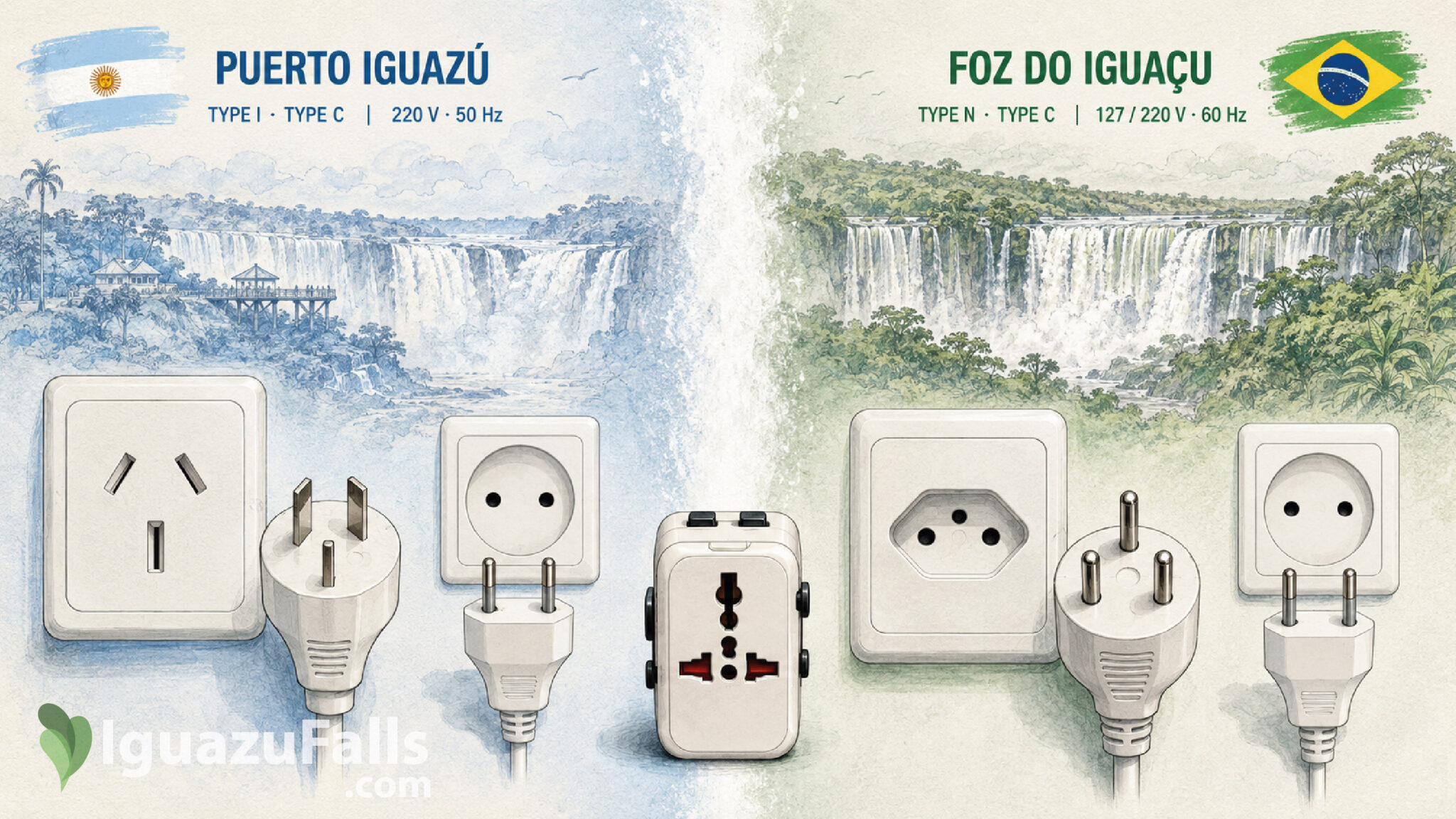
Visiting both sides of Iguazu Falls means travelling between two countries with different electrical systems. Puerto Iguazú, on the Argentine side, generally uses 220-volt electricity and Type I plugs. Foz do Iguaçu, in Brazil, officially uses Type N plugs, while local outlets may provide either 127 or 220 volts.
The difference is important for travellers carrying mobile phones, cameras, laptops, electric shavers, hair appliances or medical equipment. A plug adaptor may allow a device to fit into an outlet, but it does not necessarily make the voltage safe.
| Destination | Main plug types | Voltage | Frequency |
|---|---|---|---|
| Puerto Iguazú, Argentina | Type I; Type C also encountered | 220 V | 50 Hz |
| Foz do Iguaçu, Brazil | Type N; some Type C compatibility | Commonly 127 V, but 220 V or both may be available | 60 Hz |
| Iguazú National Park, Argentina | Argentine standard | 220 V | 50 Hz |
| Iguaçu National Park, Brazil | Brazilian standard | Confirm locally | 60 Hz |
The safest solution for visiting both countries is a quality universal travel adaptor that explicitly supports Argentina’s Type I and Brazil’s Type N sockets.
One single amazing destination, three different countries!

Argentina primarily uses the Type I plug. It has two flat pins angled towards each other in a V shape. Grounded versions add a third vertical flat pin.
This design is also used in Australia and New Zealand. As a result, most Australian plugs fit directly into Argentine Type I outlets without an adaptor.
Type C outlets or compatible sockets are also found in some Argentine buildings. Type C is the familiar European-style plug with two thin, round pins. Travellers should not assume that every hotel room will provide both formats.
Argentina’s standard electricity supply is:
The official Visit Argentina guidance identifies Type I as the principal plug, with Type C also encountered, and confirms the country’s 220 V, 50 Hz supply.
Modern phone, tablet, camera and laptop chargers usually accept 100–240 V and 50/60 Hz. These devices generally need only the correct plug adaptor.
Devices designed exclusively for 110 or 120 volts must not be connected directly to Argentina’s 220-volt supply. Doing so can permanently damage the appliance, cause overheating or create a fire risk.
High-powered appliances require particular care, including:
Check the electrical label on every device before plugging it in.

Experience the awe of Iguazu Falls on a 3-day tour from Buenos Aires. Book now for an unforgettable adventure!
From Price: USD190
Brazil’s official modern socket is Type N. It has two round pins and, on grounded versions, a third round pin positioned between them to form a triangular pattern.
Type N exists in two principal versions:
Travellers should never force a plug or adaptor into a socket. If the pins do not enter easily, the adaptor may be incompatible with that particular outlet.
Two-pin Type C plugs may fit some Brazilian sockets, especially when they use thin pins, but compatibility is not guaranteed. A dedicated Type N or properly certified universal adaptor remains the more dependable option. Brazil’s system operates at 60 Hz. Electrical Safety First explains the country’s Type C and Type N configurations.
Brazil does not use one single household voltage nationwide. Depending on the state, city, building and circuit, an outlet may provide 127 or 220 volts.
In Foz do Iguaçu, ordinary outlets commonly supply 127 V—sometimes informally called 110 V. Nevertheless, newer properties and many hotels may also have 220 V circuits, particularly for air conditioners, showers and other high-powered equipment. Some hotel rooms provide both voltages.
Most importantly, the shape of a Brazilian Type N outlet does not reveal its voltage. Identical-looking sockets may supply 127 or 220 V. Brazil’s varying voltage system and Type N standard are explained in this country electricity reference.
Before using a voltage-sensitive appliance in Foz, travellers should:

Enhance your visit to Iguaçu National Park in Brazil and experience a breathtaking sunset at Iguazu Falls with a delightful drink in hand.
From Price: USD139
These two accessories perform different jobs.
A plug adaptor changes the physical shape of the connection. For example, it allows a British Type G plug to enter an Argentine Type I or Brazilian Type N outlet.
It does not change the voltage or frequency.
A voltage converter changes the electrical supply. It may step 220 V down to approximately 110 V or perform the reverse operation, depending on its design.
Converters must have sufficient power capacity for the appliance. A small converter intended for a phone charger should not be used for a high-wattage hairdryer.
Modern USB chargers rarely require a voltage converter. High-powered single-voltage appliances are much more complicated and are often best left at home.
Look for a label on the charger, power brick or appliance. It normally begins with the word “Input”.
A label such as:
Input: 100–240 V, 50/60 Hz
means the device can normally operate on both sides of Iguazu Falls. You need only the correct plug adaptor.
This is common on:
A label such as:
Input: 110–120 V, 60 Hz
means the device is not designed for Argentina’s 220 V supply. It may also be unsafe in a 220 V outlet in Brazil.
A device marked:
220–240 V, 50 Hz
is generally suitable for Argentina. In a 127 V Brazilian outlet it may fail to work properly or deliver insufficient power. Frequency-sensitive motors and timing equipment may also behave differently on Brazil’s 60 Hz system.
Some older appliances have a physical 110/220 V switch. Confirm its position before connecting the device. Never move the selector while the appliance is plugged in.
DISCOVER A WONDERFUL PLACE TO ENJOY BIRDWATCHING. BE READY WITH YOUR BINOCULARS.

Australia and Argentina both commonly use Type I plugs, 220–240 V electricity and 50 Hz frequency. Most Australian phone chargers, camera chargers and laptop supplies therefore work in Puerto Iguazú without an adaptor or converter.
However, carrying a universal adaptor is still worthwhile because:
In Foz do Iguaçu, Australians generally need a Type N adaptor. Most Australian electronic chargers accept 100–240 V, but hair appliances and other high-powered equipment must be checked individually.
Visitors from the United States and Canada normally carry Type A or B plugs and often use 120 V appliances.
They will need:
Phone and laptop chargers are often universal voltage, but this must be confirmed on the label.
North American hairdryers are among the appliances most frequently damaged abroad. Using the hotel’s hairdryer is usually safer than carrying a single-voltage model.
Many continental European travellers use Type C plugs. Thin two-pin Type C plugs may fit certain outlets on both sides of Iguazu, but this should not be treated as guaranteed.
A universal adaptor supporting Type I and Type N remains advisable.
Most European appliances are designed for 220–240 V. They are normally compatible with Argentina’s voltage, but a high-powered appliance may not operate properly on a 127 V Brazilian outlet.
The United Kingdom and Ireland use the large Type G plug. Travellers will need an adaptor in both Argentina and Brazil.
Their 220–240 V devices are generally compatible with Argentina’s voltage. In Foz, the device’s input range should be checked because some outlets may provide 127 V.
Do not remove the earth pin or use an unsafe, loose-fitting adaptor to make a Type G appliance fit.

Enjoy visiting Puerto Iguazu, the three frontier landmark, Guira Oga and the Aripuca in a wonderful half day trip
From Price: USD55
Visitors should not depend on finding accessible charging points during a day inside either national park. Charge devices fully at the hotel and carry a power bank.
A good electronic kit includes:
The waterfall environment is extremely humid. Keep charging equipment dry and never handle plugs or outlets with wet hands.
After a boat excursion, wait until devices, cables and clothing are completely dry before connecting them to electricity.
A compact multi-port USB charger is usually more practical than carrying several separate adaptors. Confirm that it supports 100–240 V and 50/60 Hz.
If using an Australian, British or North American power board through a single travel adaptor, check:
Avoid connecting hairdryers, kettles, heaters or irons through small universal travel adaptors. Their power demand may exceed the adaptor’s safe capacity.
DISCOVER A WONDERFUL PLACE TO ENJOY BIRDWATCHING. BE READY WITH YOUR BINOCULARS.
Travellers using electrically powered medical equipment should make additional preparations.
Before travelling:
Continuous positive airway pressure machines, mobility-device chargers and refrigerated medication equipment may have specific electrical requirements. Contact the manufacturer or healthcare provider if anything is unclear.
Adaptors may be available in supermarkets, electronics shops, airport stores and tourist areas in Puerto Iguazú or Foz do Iguaçu. However, availability and quality vary.
Purchasing a certified adaptor before departure is preferable. Look for:
Avoid loose, cracked or unmarked adaptors.

Experience a breathtaking night under the stars at Iguazu Falls, in a peaceful and exclusive setting inside the Brazilian side of the national park.
From Price: USD265
Brazilian Type N sockets can carry either 127 or 220 V. Always verify before using a single-voltage appliance.
An adaptor only changes the plug shape unless it specifically includes a voltage-conversion function.
Hotel hairdryers are safer and usually eliminate the need for a large high-wattage converter.
Most electronic chargers accept both 50 and 60 Hz. Certain motors, clocks and specialist equipment may not.
Keep outlets, adaptors and chargers away from ponchos, wet footwear and drying clothes.
Brazil’s 10-amp and 20-amp Type N versions have different pin thicknesses. Resistance usually indicates incompatibility.
DISCOVER A WONDERFUL PLACE TO ENJOY BIRDWATCHING. BE READY WITH YOUR BINOCULARS.
For most international travellers, the ideal kit is:
Only if it explicitly supports both Argentine Type I and Brazilian Type N outlets. These plugs are physically different.
Probably, provided its label says 100–240 V and 50/60 Hz. You will still need the correct plug shape.
Regular outlets are commonly 127 V, historically called 110 V. Some properties provide 220 V or both voltages. Confirm with the accommodation because the socket shape does not identify the voltage.
Yes. Argentina’s standard supply is 220 V at 50 Hz.
Usually not when a Type I outlet is available. Australian Type I plugs are physically compatible. Carrying a universal adaptor is still useful for Type C outlets and the Brazilian side.

Experience the wonder of Iguazu Falls on a private 2 day tour from Buenos Aires. Easily reserve accommodations and optional activities. Book now!
From Price: USD150
Do not build your plans around finding a public outlet. Charge overnight and carry a power bank.
Only when carrying a device that cannot accept the local voltage. Most modern USB electronics do not need one.
For a trip covering both sides of Iguazu Falls, bring a quality universal adaptor supporting Type I and Type N, together with a 100–240 V multi-port USB charger.
Puerto Iguazú is straightforward: 220 V, 50 Hz and mainly Type I outlets. Foz do Iguaçu requires more attention because Brazil uses Type N plugs and local sockets may provide 127 or 220 V.
The golden rule is simple: check the device label, confirm the outlet voltage and remember that a plug adaptor does not convert electricity.
Experience the awe of Iguazu Falls on a 3-day tour from Buenos Aires. Book now for an unforgettable adventure!
From Price: USD190
Experience the wonder of Iguazu Falls on a private 2 day tour from Buenos Aires. Easily reserve accommodations and optional activities. Book now!
From Price: USD150
