
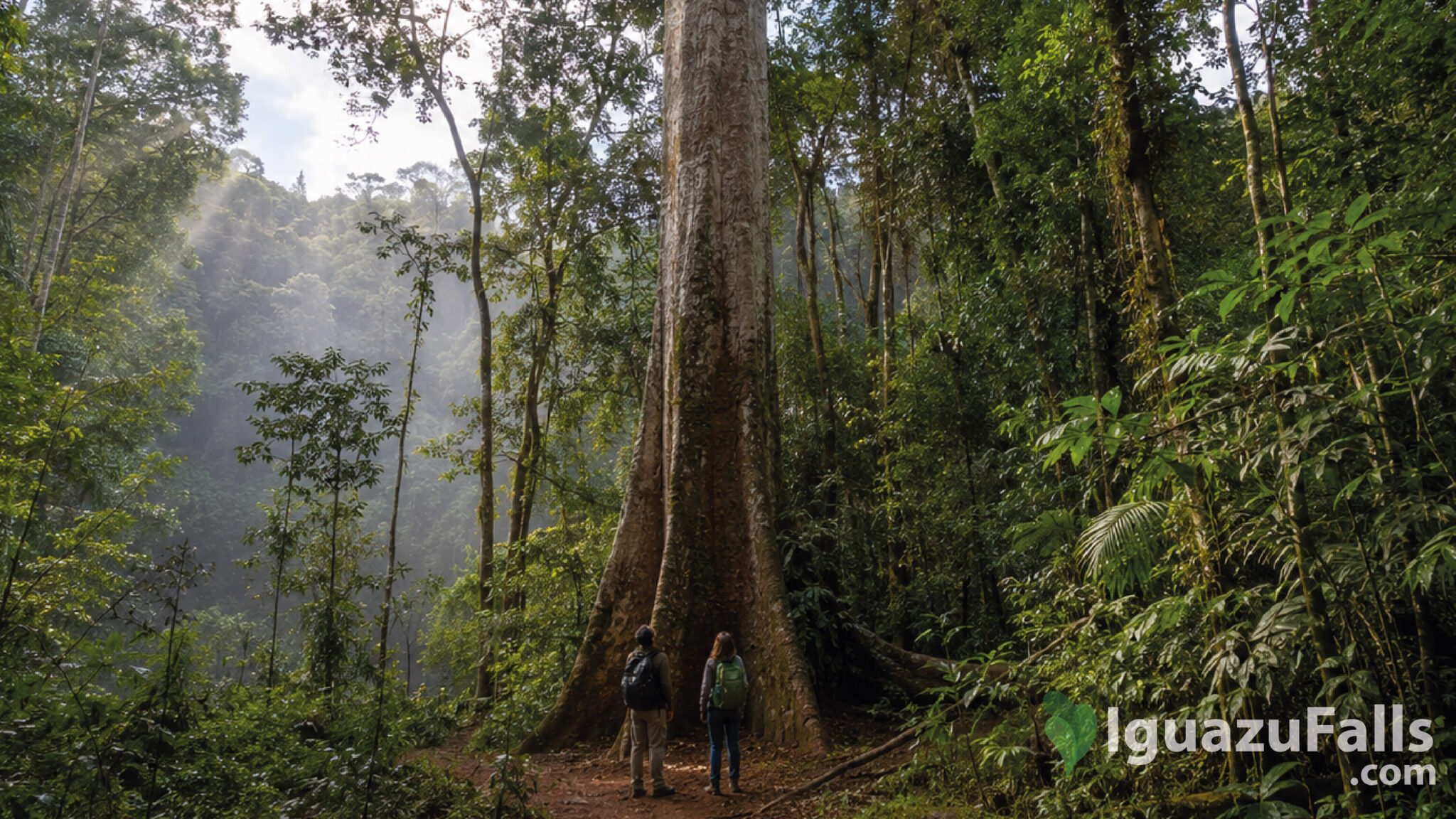
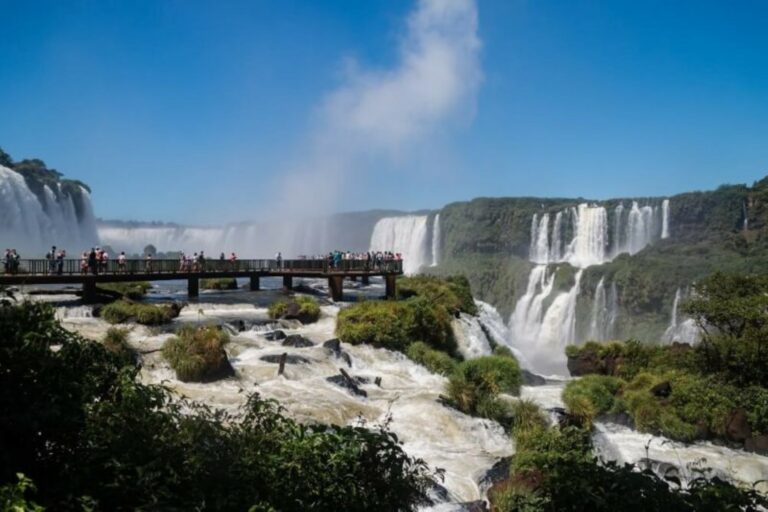
Most travellers arrive in Iguazu expecting to be overwhelmed by water. They remember the roar of Devil’s Throat, clouds of spray rising from the canyon and countless cascades appearing between walls of green.
Yet the waterfalls exist within another natural monument that deserves equal attention: the Atlantic Forest.
Look beyond the viewpoints and the forest reveals a world of extraordinary vertical proportions. Some trees rise more than 30 or even 40 metres, emerging above the general canopy like towers. Their trunks store decades—or centuries—of growth, while their crowns create habitats for birds, monkeys, insects, orchids, bromeliads and climbing plants.
These are the giant trees of Iguazu: living structures that regulate temperature, retain moisture, store carbon and hold together one of South America’s most diverse ecosystems.
The Argentine and Brazilian national parks protect substantial areas of the Upper Paraná Atlantic Forest, also known as the Atlantic Forest of Alto Paraná or the Paraná rainforest.
This ecosystem once extended across a vast area of Argentina, Brazil and Paraguay. Agriculture, logging, roads and urban expansion reduced and fragmented much of the original forest. Iguazu’s protected areas consequently represent essential refuges for native plants and animals.
The Brazilian park reports more than 700 species of terrestrial plants and protects one of Brazil’s largest remaining areas of Seasonal Semideciduous Forest. Its vegetation ranges from prehistoric-looking ferns and palms to trees whose crowns extend far above the observer.
On the Argentine side, Iguazú National Park protects a portion of the Selva Misionera, the country’s most biologically diverse forest environment.
One single amazing destination, three different countries!
There is no single official height at which a tree becomes a “giant.” The term generally describes exceptionally tall, old or massive trees that dominate the surrounding vegetation.
In Iguazu, many of the most impressive individuals are known as emergent trees.
Most mature rainforest crowns meet at a level known as the canopy. Certain species grow beyond this ceiling, placing their upper branches in direct sunlight above the surrounding forest.
These emergent trees may reach or exceed 30 to 40 metres under favourable conditions. Their exposed crowns must withstand stronger winds, intense sunlight and greater temperature variation than vegetation beneath the canopy.
A tree may also appear gigantic because of:
Timbós, for example, may develop broad crowns and enormous trunks even when they do not tower above the forest as dramatically as the tallest Palo Rosa.
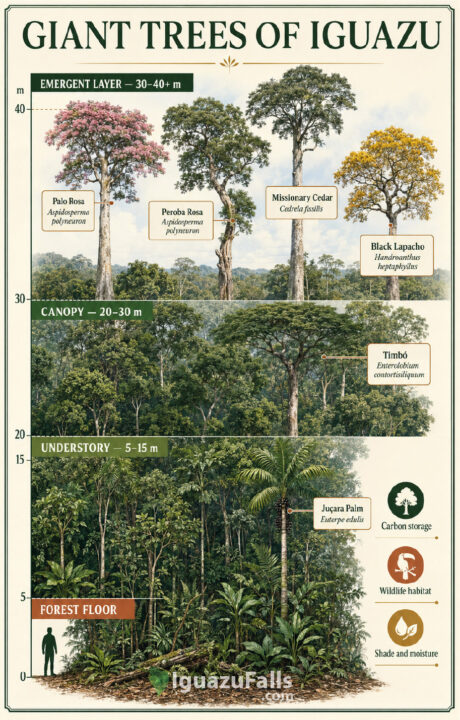
The forest is not a uniform collection of trees. It is organized into interconnected layers, each with different levels of light, wind and moisture.
The tallest trees rise above the main canopy, sometimes reaching approximately 30 to 40 metres or more. Palo Rosa and mature cedars are among the species capable of occupying this elevated position.
These crowns receive the greatest amount of sunlight and provide resting or feeding sites for birds and other canopy animals.
The crowns of mature trees create a relatively continuous green ceiling, generally around 20 to 30 metres high, although forest height varies considerably.
This is one of the most biologically active parts of the forest. Branches hold epiphytes, vines and leaves that provide food and shelter.
Smaller trees, palms and young individuals grow beneath the canopy. They must survive with limited and constantly changing light.
Some may remain at modest heights throughout their lives, while young canopy trees can wait years for a gap to provide the sunlight required for rapid growth.
Only a small proportion of the sunlight entering the upper forest reaches the ground. Fallen leaves, branches and dead wood decompose, returning nutrients to the soil.
Fungi, insects and microorganisms perform much of the recycling that supports the giants above them.
DISCOVER A WONDERFUL PLACE TO ENJOY BIRDWATCHING. BE READY WITH YOUR BINOCULARS.

The Palo Rosa, scientifically known as Aspidosperma polyneuron, is one of the most emblematic trees of the Iguazu region.
In Brazil it is generally known as Peroba Rosa or Peroba-Rosa. The Spanish and Portuguese common names refer to the pinkish or reddish tone of its wood—not to pink flowers.
Mature individuals can rise above the surrounding canopy, with exceptional trees reaching approximately 40 metres or more. Their tall, relatively straight trunks and elevated crowns make them classic emergent trees.
Seen from below, the trunk can appear to disappear into the green ceiling of the forest.
Palo Rosa is characterized by:
Identification can be difficult for an untrained visitor because the leaves and flowers may be far above the ground.

Enhance your visit to Iguaçu National Park in Brazil and experience a breathtaking sunset at Iguazu Falls with a delightful drink in hand.
From Price: USD139
Its durable and attractive wood made the species valuable for construction, flooring, beams and furniture. Decades of intensive extraction reduced its populations across Argentina, Brazil and Paraguay.
Research associated with CONICET notes that Aspidosperma polyneuron was among the Atlantic Forest trees most heavily exploited for the quality of its timber. Today, scientists study the factors limiting its regeneration and its ability to recover in degraded forests.
Palo Rosa has special legal protection in Misiones, reflecting both its ecological significance and the damage caused by historical logging.
The surviving giants are therefore more than impressive trees: they are representatives of forests that have disappeared from much of their original range.
The Missionary Cedar, Cedrela fissilis, is another great native tree of the Atlantic Forest. It is known in Spanish as Cedro Misionero and in Portuguese as Cedro-Rosa or simply Cedro.
Missionary Cedar produces aromatic, workable wood historically used for furniture, doors, instruments and fine carpentry.
This commercial value resulted in selective extraction throughout much of its range. Large old specimens have consequently become far less common outside protected forests.
A mature cedar may develop:
The species may lose part of its foliage seasonally, illustrating why portions of the Iguazu ecosystem are described as semideciduous forest.
Cedar crowns contribute to the upper forest structure, while their flowers, leaves and fruits participate in relationships with insects and other animals.
Large individuals also store substantial quantities of carbon in their trunks and branches.
Experience Argentina’s Icons with Comfort and Style

The Black Lapacho, Handroanthus heptaphyllus, is among the most visually celebrated trees of Misiones and southern Brazil.
It is known by several regional names, including Lapacho Negro, Lapacho Rosado and Ipê-Roxo.
During its flowering period, a mature lapacho can cover its crown with pink to purple trumpet-shaped blossoms, sometimes while carrying relatively few leaves.
This produces a dramatic burst of colour above the otherwise green forest.
The precise flowering period varies with climate, rainfall and local conditions, so visitors should not assume they will always see blooming trees.
Lapacho wood is exceptionally hard and durable. Like other valuable timber species, this made the tree commercially desirable and contributed to logging pressure.
Within protected areas, mature specimens can complete their natural life cycle and provide genetic material for future generations.
The flowers attract insects and other pollinators. Flowering trees become temporary centres of biological activity, demonstrating that a giant tree’s importance changes through the seasons.
The Timbó, Enterolobium contortisiliquum, is remarkable for its great trunk and expansive crown.
Rather than appearing as a narrow column rising above the forest, a mature Timbó can occupy an enormous horizontal space.
The species produces dark, curved pods whose form resembles an ear. This explains common names such as oreja de negro and orelha-de-macaco used in parts of South America.
The broad crown creates shade and influences the microclimate beneath the tree. Its branches can provide:
A mature Timbó functions almost like a small ecosystem suspended above the ground.

Enjoy visiting Puerto Iguazu, the three frontier landmark, Guira Oga and the Aripuca in a wonderful half day trip
From Price: USD55
The Alecrín, Holocalyx balansae, is a tall native tree found in the Atlantic Forest of Argentina, Brazil and Paraguay.
It may not be as internationally known as Palo Rosa or Lapacho, but it contributes to the diversity and structure of mature forest.
Alecrín produces dense, resistant wood, a characteristic that historically made it commercially valuable.
Its slow development means that removing a mature specimen eliminates decades of forest growth that cannot be quickly replaced.
Large Alecrín trees form part of the canopy and sometimes approach the emergent layer. Their presence indicates a forest that has retained enough time and stability for slow-growing species to mature.
Peteribí, Cordia trichotoma, is another important native tree of the Upper Paraná Atlantic Forest.
Known in Portuguese as Louro-Pardo, it develops valuable timber and can grow into a substantial canopy tree.
Peteribí may lose leaves and produce pale flowers, temporarily changing its appearance and increasing its visibility within the forest.
Its wood has been used in furniture, decorative work and construction. As with many large native trees, the most impressive individuals are now strongly associated with protected or well-conserved areas.
Anchico Colorado, Parapiptadenia rigida, is a tall, strong-trunked tree found in the regional forest.
Its dense timber has been valued for heavy construction, posts and other uses requiring resistance.
Mature Anchicos help form the upper canopy. Their compound leaves create a different texture from the broader foliage of neighbouring species, increasing structural variety within the forest.
The bark, flowers and seeds support different organisms, while fallen material contributes nutrients to the forest floor.

Experience a breathtaking night under the stars at Iguazu Falls, in a peaceful and exclusive setting inside the Brazilian side of the national park.
From Price: USD265
Cancharana, Cabralea canjerana, belongs to the mahogany family and is native to the Atlantic Forest.
It can become a substantial canopy tree and has historically been valued for its reddish timber.
Its fruits provide food for wildlife, making the tree part of the relationship between forest plants and seed-dispersing animals.
When animals carry or consume fruit, they may transport seeds away from the parent tree and help new individuals become established.
Juçara Palm, Euterpe edulis, does not reach the dimensions of Palo Rosa or Cedar, but it is fundamental to the forest beneath them.
It occupies the understory and lower canopy, where its dark fruits feed numerous birds and mammals.
Juçara is often considered a keystone food resource because different animals consume its fruit and disperse the seeds.
Its ecological role connects forest levels:
The edible heart of the palm can be obtained only by killing the plant. Illegal harvesting consequently eliminated many wild populations.
The Brazilian park identifies Juçara among the native Atlantic Forest plants still protected within Iguaçu National Park.
Experience Argentina’s Icons with Comfort and Style
A rainforest giant is not a single organism functioning in isolation. It is a vertical habitat shared by many species.
Orchids, bromeliads, ferns and other plants may grow on branches without extracting nutrients directly from the host tree.
They use the branches as support and collect moisture, dust and organic material.
Woody climbing plants begin near the ground and use trees to reach sunlight. Some stretch from trunk to trunk, creating aerial connections through the canopy.
A limited number are part of a healthy forest, although excessive liana growth can place stress on trees in disturbed areas.
Toucans, woodpeckers, parrots and numerous smaller birds use large trees for:
Old trees are especially valuable because holes and broken branches create nesting spaces not found in young trunks.
Monkeys and other arboreal mammals use connected crowns as pathways. A continuous canopy allows them to move without descending to the forest floor.
The bark, leaves, flowers, roots and decaying wood support immense communities of insects and microorganisms.
Fungi form relationships with roots, helping trees access water and nutrients. Other fungi decompose fallen wood and return its components to the ecosystem.

A mature forest is generally cooler and more humid than a cleared landscape.
The crowns intercept sunlight, while leaves release water vapour through transpiration. Shade limits direct heating of the soil, and roots help retain water.
Together, giant trees:
This microclimate benefits amphibians, insects, plants and other organisms that depend on moist conditions.
Trees remove carbon dioxide from the atmosphere as they grow and incorporate carbon into wood, roots, leaves and surrounding soil.
Large, old trees contain an especially substantial quantity of stored carbon. When one is cut and the wood decays or burns, some of that carbon returns to the atmosphere.
Protecting mature forest giants is therefore relevant not only to local biodiversity but also to climate regulation.
A young plantation can absorb carbon as it grows, but it does not immediately reproduce the complexity or accumulated biomass of a centuries-old native forest.
From Bustling City to Majestic Natural Wonders: Buenos Aires, El Calafate & Iguazu Falls in 9 Nights

The forest and waterfalls should not be understood as separate attractions.
Tree roots stabilize soil and reduce erosion. Forest vegetation slows surface runoff and helps water enter the ground gradually.
This contributes to the health of the river system feeding the falls.
Forest soils and root networks trap sediment and influence water quality. Removing vegetation can increase erosion and the amount of material entering streams.
Water from the river and spray from the waterfalls contribute moisture to the environment. Forest vegetation captures and recycles that moisture.
The result is a landscape shaped by continuous interaction between water, rock, soil and plants.
Determining the age of a tropical tree is not always simple.
Some trees form growth rings, but these may not correspond as clearly to annual cycles as they do in strongly seasonal temperate forests. Researchers may use trunk measurements, growth monitoring, wood samples and long-term forest plots to estimate age and development.
Many large trees are likely to be well over a century old. Their precise age depends on species, growing conditions and individual history.
Size alone is not a perfect age indicator. Some species grow relatively quickly, while slow-growing hardwoods may take many decades to reach a moderate diameter.
Some tropical trees develop large, flaring roots at the base of their trunks. These are often called buttress roots.
They help support tall trees in soils where a large proportion of nutrients and biological activity is concentrated near the surface.
Buttresses can:
Visitors should not climb, sit on or damage these structures. They are living parts of the tree, not natural benches.

Uncover pristine jungle near Iguazu Falls: trek, enjoy a delightful lunch, and relax by the pool in our natural reserve!
From Price: USD150
Protected status does not eliminate every risk.
The selective removal of Palo Rosa, Cedar, Lapacho, Alecrín and other valuable species changed the structure of forests across the region.
When the largest seed-producing trees disappear, future generations may also become less abundant.
Roads, farms and towns divide continuous forest into smaller sections. Fragmentation exposes trees to stronger winds, heat and dry conditions along forest edges.
It also interrupts the movement of animals that pollinate flowers and disperse seeds.
Illegal logging and the collection of Juçara palm remain concerns in parts of the Atlantic Forest.
Changing rainfall, higher temperatures, drought and extreme storms may affect tree growth, mortality and regeneration.
Species adapted to particular temperature and moisture patterns may struggle if those conditions shift rapidly.
The humid Atlantic Forest is not naturally adapted to frequent intense fires. Drought and human activity can increase fire risk, damaging mature trees and making the forest more vulnerable to future disturbance.
Non-native plants may compete with native seedlings or change forest processes. Protecting giant trees also requires protecting the smaller native plants that will form the future canopy.
Large trees are visible throughout both national parks, but visitors must look beyond the waterfalls.
Forest sections along the official circuits provide opportunities to observe tall trunks, palms, lianas and canopy trees.
The Macuco Trail, when open and visited under current park rules, offers a deeper forest atmosphere than the busiest waterfall walkways.
The road into the park and the principal visitor areas cross extensive native forest. Additional authorized trails and experiences may offer closer observation of vegetation.
Some accommodations and reserves around Puerto Iguazú protect native forest on their properties. Guided walks can help visitors recognize trees that might otherwise appear indistinguishable.
A guide with botanical or ecological knowledge can explain:
Identification based solely on distant leaves or trunk shape can be difficult, making expert interpretation valuable.

Explore a 16.5-hectare bird park with 130+ species in natural habitat. Vibrant guacamayos await in the lush green house.
From Price: USD65
Visitors can appreciate these trees without leaving a negative impact.
A fallen seed or colourful leaf may seem like a harmless souvenir, but protected-area regulations exist to keep natural material within the ecosystem.
Capturing their scale is challenging because the crowns may be far above the photographer.
A small human figure near the trunk communicates size more effectively than a photograph of the tree alone.
The person should remain on the official trail rather than standing among roots or vegetation.
Photographing upward emphasizes the height of the trunk and the vertical layers of the canopy.
A wide-angle lens can include more of the tree, but extreme settings may distort the trunk. Keep the camera reasonably level when possible.
A complete tree is not the only useful composition. Look for:
Humidity, rain and waterfall spray can affect cameras. Carry a protective cover and a dry lens cloth.
Experience the Best of Argentina: From the Vibrant Buenos Aires to the Stunning Ibera Wetlands and Majestic Iguazu Falls!

Palo Rosa is generally recognized as one of the tallest and most imposing species in the Misiones and Iguazu forest. Exceptional specimens can approach or exceed 40 metres, although height varies by individual and site.
No. Its name refers primarily to the pinkish tone of its wood. Its flowers are small and are not responsible for a bright pink crown.
Many mature specimens almost certainly began growing before the parks were established. Their exact ages are difficult to determine without scientific study.
Briefly touching an ordinary trunk is unlikely to cause damage, but visitors should avoid climbing, carving, collecting bark or stepping on sensitive roots. Remaining on designated paths is the best approach.
No. The giant trees of Iguazu belong to subtropical South American species and are not related to the famous redwoods and sequoias of North America.
Like all trees, they can be damaged by wind, lightning, disease or age. Fallen giants are not wasted: their wood becomes habitat and eventually returns nutrients to the soil.
Many of those plants are epiphytes that use the tree for physical support. They do not necessarily harm it or take nutrients directly from its tissue.
Planting inside a national park is a specialized conservation activity and cannot be performed independently. Visitors interested in restoration should support authorized native-forest projects.
The waterfalls may be Iguazu’s most visible attraction, but the giant trees give the landscape its depth, shade and living structure.
Palo Rosa, Cedar, Lapacho, Timbó, Alecrín and many other species form a forest that stores carbon, regulates water, protects soil and provides habitat from the roots to the highest branches.
Some of these trees began growing before modern tourism existed. They survived logging, storms, droughts and dramatic changes beyond the borders of the protected areas. Their continued presence is evidence of both resilience and the importance of conservation.
When visiting Iguazu, look up as well as outward. The forest giants may not roar like the waterfalls, but they tell an equally powerful story—one written slowly in wood, leaves and living time.

Experience the wonder of Iguazu Falls on a private 2 day tour from Buenos Aires. Easily reserve accommodations and optional activities. Book now!
From Price: USD150
Experience the awe of Iguazu Falls on a 3-day tour from Buenos Aires. Book now for an unforgettable adventure!
From Price: USD190
