

The walkways at Iguazu Falls are so closely integrated into the landscape that visitors may not immediately appreciate the engineering behind them. Yet these elevated paths cross islands, forest, rocky ledges and channels exposed to one of South America’s most powerful rivers.
Their construction transformed the way people experience Iguazu. Instead of observing the waterfalls exclusively from distant viewpoints, visitors can now walk above the river, stand beside individual cascades and approach the immense Devil’s Throat.
Building that access was never a conventional infrastructure project. Engineers had to work inside protected national parks, minimize environmental disturbance and prepare the structures for sudden changes in river level. The resulting network is an evolving system that has been expanded, damaged by floods and reconstructed several times.
Before modern visitor infrastructure was developed, reaching the waterfalls was far more difficult. Early travelers followed forest paths, navigated the river or approached viewpoints over irregular terrain.
As Iguazu became an internationally recognized destination, the national parks needed safer ways to accommodate growing visitor numbers. Trails and viewing platforms had to achieve several objectives:
The walkways therefore became much more than observation platforms. They created a controlled interface between tourism and conservation.

Experience the wonder of Iguazu Falls on a private 2 day tour from Buenos Aires. Easily reserve accommodations and optional activities. Book now!
From Price: USD150
Following the establishment of Iguazú National Park in Argentina in 1934 and Iguaçu National Park in Brazil in 1939, visitor access gradually became more organized.
The earliest routes were much simpler than today’s circuits. Forest paths connected natural viewpoints, while basic stairways, bridges and platforms allowed travelers to approach some of the cascades.
These structures were built in a challenging environment. The subtropical climate produces intense rainfall, constant humidity and rapid vegetation growth. Metal corrodes, wooden surfaces deteriorate and moss can make exposed areas slippery. In addition, the Iguazu River can rise dramatically following heavy rainfall upstream.
Over time, it became clear that the parks needed infrastructure designed specifically for these conditions.
One single amazing destination, three different countries!
The Argentine side contains the largest and most complex network of walkways at Iguazu Falls. Its circuits allow visitors to move above, beside and below different sections of the waterfall system.
The Upper Circuit was designed to provide views from the top of the waterfalls. Its elevated walkways cross sections of forest and river before reaching balconies overlooking several major cascades.
Constructing a walkway in this location required careful positioning of structural supports. Engineers needed to create stable foundations while avoiding unnecessary disturbance to the riverbed and surrounding vegetation.
The route connects multiple viewpoints, allowing visitors to observe the upper Iguazu River shortly before it plunges over the basalt cliffs. It also distributes visitors across several balconies instead of concentrating everyone at a single observation point.
An extension to the return section of the Upper Circuit was officially inaugurated in 2015. This improvement created a more continuous route and increased the circuit’s capacity. The project represented an investment of 42 million Argentine pesos at the time, according to Argentina’s National Parks Administration.
One single amazing destination, three different countries!
The Lower Circuit offers a different engineering challenge because it descends through uneven rainforest terrain and approaches the base of several waterfalls.
This route includes ramps, stairs, elevated platforms and balconies built along forested slopes. Drainage is particularly important because heavy rainfall can produce surface runoff, erosion and unstable ground.
The walkways help keep visitors away from delicate plants and reduce the creation of informal trails. At the same time, the descending route provides close views of waterfalls such as Dos Hermanas and Bossetti.
Unlike the mostly level Upper Circuit, sections of the Lower Circuit include stairs and changes in elevation. Its construction therefore had to respond closely to the natural topography.
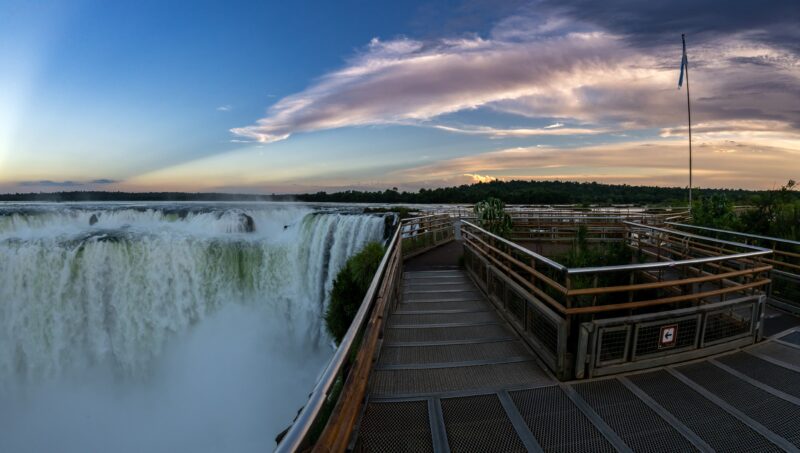
The walkway to Devil’s Throat—Garganta del Diablo—is the most dramatic example of infrastructure at Iguazu Falls.
The route begins near the Devil’s Throat station of the Ecological Train and continues across the Upper Iguazu River. Instead of following a riverbank, the walkway passes over channels and between small islands until it reaches a large viewing balcony beside the waterfall.
This design creates a gradual transition. Visitors begin in a calm area of the river where the surface may appear surprisingly peaceful. As they advance, the sound grows louder, mist becomes visible and the current accelerates toward the enormous U-shaped gorge.
The experience depends entirely on the placement of the walkway. Its purpose is not simply to reach a destination but to reveal the changing character of the river.

Experience a breathtaking night under the stars at Iguazu Falls, in a peaceful and exclusive setting inside the Brazilian side of the national park.
From Price: USD265
A decisive transformation began in 1997, when a major infrastructure development program was launched in the Argentine park’s waterfall area.
The project included:
The modern infrastructure was officially inaugurated on November 21, 2001. It established much of the visitor system recognizable today.
One of the project’s most important principles was reducing motor vehicle traffic near the waterfalls. The narrow-gauge ecological train and organized pedestrian routes helped concentrate transportation along a defined corridor.
The modern walkways also improved accessibility. Many sections were designed with level surfaces or gentle ramps, although some parts of the park—particularly areas of the Lower Circuit—remain more demanding.
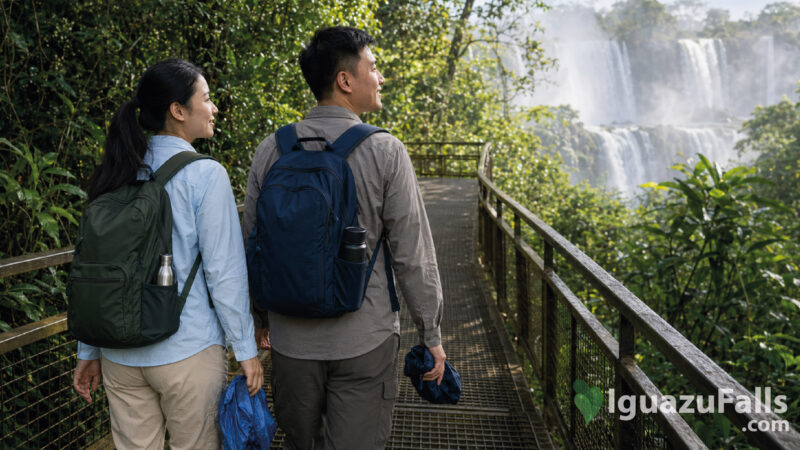
The exact construction method varies according to the circuit and its location, but the walkways generally combine durable structural elements with modular components.
Where paths cross the river, supports must resist the force of moving water and impacts from branches or other debris.
Concrete foundations and structural supports anchor the walkway at carefully selected points. Their locations are determined by geological conditions, river behavior and the need to reduce environmental intervention.
The basalt underlying the Iguazu Falls region provides a strong geological base, but working above active river channels remains complicated. Construction activities must be coordinated with water levels and weather conditions.
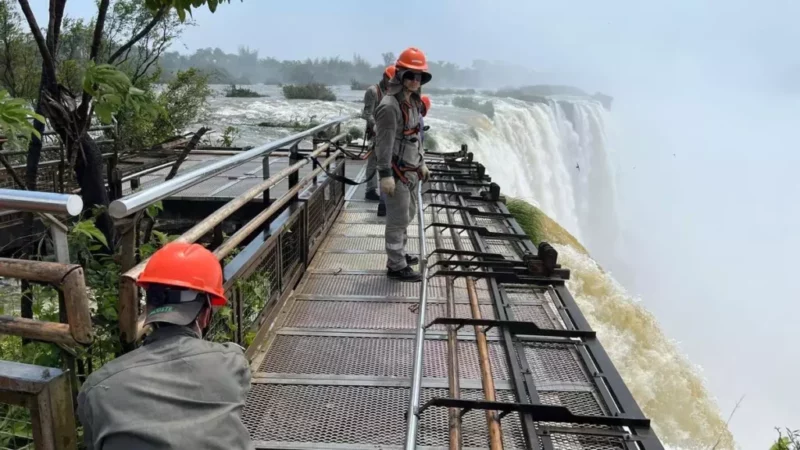
Metal components are widely used because they can be manufactured in sections, transported to the construction area and installed with greater precision.
Open-grid flooring may also allow rainwater and spray to pass through instead of accumulating on the walking surface. Railings provide protection while preserving visibility toward the river and forest.
Constant exposure to moisture requires corrosion-resistant treatments, inspections and periodic maintenance.
One of the most valuable characteristics of the Argentine walkways is their modular nature. Sections can be disconnected, recovered or replaced when floods cause damage.
This does not make the infrastructure immune to extreme water levels. However, it can prevent damage to one section from destroying the entire system and makes reconstruction more practical.
The design reflects an important reality: the Iguazu River cannot be completely controlled. The infrastructure must accommodate its behavior rather than attempt to dominate it.
Both sides of Iguazu Falls are protected national parks and UNESCO World Heritage properties. Construction therefore needs to consider far more than visitor convenience.
Elevated walkways reduce direct contact between visitors and the forest floor. Concentrating people on defined routes protects tree roots, understory plants and riverbank vegetation.
During construction, materials and machinery must also be moved through environmentally sensitive areas. Modular elements help because portions of the structure can be prepared elsewhere and assembled on site.
Rainfall is a fundamental part of the Atlantic Forest ecosystem. Walkways and paths must not create barriers that cause water to accumulate or redirect runoff toward vulnerable slopes.
Drainage channels, permeable surfaces and elevated sections allow water to continue moving through the landscape.
The forest around Iguazu Falls supports monkeys, coatis, toucans, reptiles, butterflies and many other animals. Elevated structures can help preserve movement at ground level, although wildlife sometimes appears directly on the visitor routes.
Visitors should never feed animals or leave the walkway in an attempt to approach them.
One single amazing destination, three different countries!
The Iguazu River basin extends far beyond the immediate waterfall area. Heavy rainfall upstream can cause river levels to rise rapidly, even when local weather appears relatively calm.
During exceptional floods, the water carries enormous quantities of sediment, logs and vegetation. These materials can strike railings, platforms and structural supports with considerable force.
For this reason, the parks operate safety protocols. Circuits may be closed before water physically reaches the visitor areas. These closures are preventive measures based on river monitoring and engineering assessments.
In June 2014, an exceptional flood damaged sections of the Argentine walkways. Access to Devil’s Throat and portions of the Upper Circuit had to be suspended while the structures were inspected and repaired.
National Parks personnel and the park concessionaire worked together to replace damaged components and restore safe access. The event demonstrated the value of having walkway sections that could be repaired without rebuilding every part of the circuit.

Another extraordinary rise of the Iguazu River damaged the Devil’s Throat walkway in October 2022.
Following more than four months of work, the circuit reopened in March 2023. The project repaired approximately 275 square meters and expanded the observation balcony, producing almost 600 square meters of renewed and enlarged visitor infrastructure.
Before reopening, specialists examined the reinforced-concrete supports, walkway sections, railings and observation area. This technical verification was essential because visible repairs alone are not enough: foundations and structural connections must also be evaluated after a flood.
In October 2023, another historic flood severely affected the Devil’s Throat Circuit. According to the Argentine government, the event destroyed around 90 percent of its walkways and damaged the viewing balcony. It also affected a gastronomic facility and part of the Ecological Train tracks.
Reconstruction continued for more than eight months. Engineers and geology specialists from Argentina’s National Institute of Industrial Technology inspected the infrastructure and superstructure before the circuit was authorized to reopen.
The Devil’s Throat walkway returned to public use on July 13, 2024. This reconstruction illustrates why engineering at Iguazu is an ongoing process rather than a completed, permanent intervention.
Experience the Best of Argentina: From the Vibrant Buenos Aires to the Stunning Ibera Wetlands and Majestic Iguazu Falls!

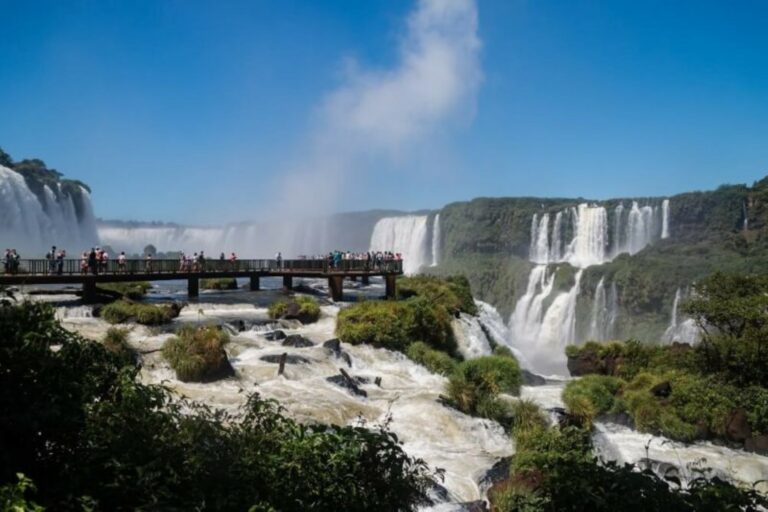
The Brazilian side developed a different kind of visitor route because it faces most of the Argentine waterfalls from across the gorge.
Instead of building an extensive network between individual cascades, the Brazilian park created a panoramic trail with a sequence of viewpoints. The route culminates in a walkway extending over the river near Floriano Fall and Devil’s Throat.
This final platform places visitors inside the mist and close to the turbulent water while preserving a broad view of the waterfall system.
The contrast between the two countries reflects their geography:
Neither system replaces the other. Together, they demonstrate how infrastructure can respond to two very different sides of the same natural formation.

Enhance your visit to Iguaçu National Park in Brazil and experience a breathtaking sunset at Iguazu Falls with a delightful drink in hand.
From Price: USD139
Modern walkway construction has made large portions of Iguazu Falls available to visitors who might have been unable to explore the old forest paths.
Level sections, ramps, handrails and organized transportation have improved access for wheelchair users, families with children and travelers with reduced mobility. The Argentine government notes that much of the visitor route is accessible, although conditions vary by circuit.
Safety measures include:
Visitors should always respect barriers and closure notices. Conditions near a major waterfall can change faster than they appear from the shore.
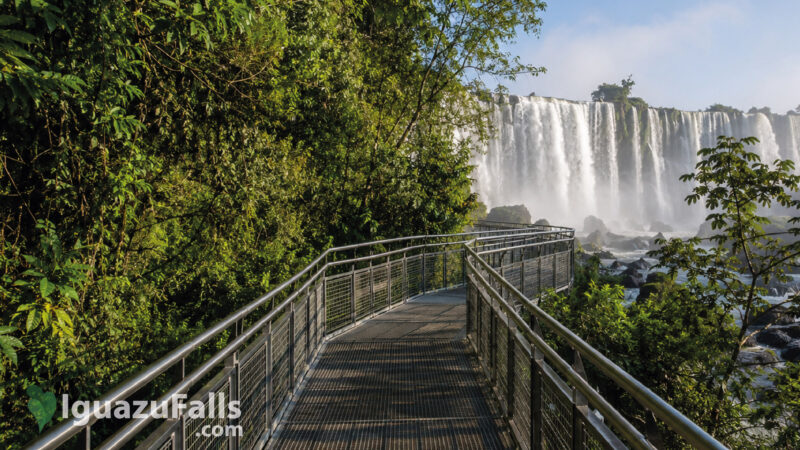
The construction of the walkways did not merely make the waterfalls easier to reach. It created a carefully choreographed experience of water, forest, sound and movement.
On the Upper Circuit, visitors see the river disappear over the edge. On the Lower Circuit, they face the falling water from below. At Devil’s Throat, they cross a seemingly peaceful river before arriving beside its most violent transformation. From Brazil, they observe the enormous scale of the entire system.
These perspectives would not be possible from a single conventional observation deck.
Any infrastructure inside a protected landscape produces some impact. The relevant question is whether that impact is controlled and justified by conservation and visitor-management benefits.
At Iguazu, designated walkways help prevent thousands of visitors from dispersing through the forest. They reduce trampling, concentrate waste collection, simplify emergency operations and make it easier for park authorities to protect closed areas.
Their sustainability nevertheless depends on continued maintenance, capacity management and responsible visitor behavior. Even well-designed infrastructure can create problems if visitor numbers exceed what the surrounding environment can tolerate.
Visitors should check official park information before traveling, particularly during periods of heavy rain. An individual circuit may close temporarily even when the national park remains open.
Comfortable footwear with good traction is recommended because spray and humidity can leave surfaces wet. Lightweight rain protection is useful near the Brazilian platform and Devil’s Throat, but umbrellas can be awkward in crowded or windy areas.
Most importantly, travelers should allow enough time to appreciate the differences between the circuits. The walkways are not simply routes to the waterfalls—they are part of the attraction themselves.

Enjoy visiting Puerto Iguazu, the three frontier landmark, Guira Oga and the Aripuca in a wonderful half day trip
From Price: USD55
Visitor paths developed gradually throughout the twentieth century. On the Argentine side, the major modern infrastructure project began in 1997 and was inaugurated in 2001. Later extensions, repairs and reconstructions continued to modify the system.
The pedestrian route from the Devil’s Throat station crosses approximately one kilometer of the Upper Iguazu River before reaching the main observation area. Exact accessible distances can change when sections are redesigned or repaired.
The structures generally combine reinforced foundations or supports with metal walkway sections, open-grid flooring and protective railings. Materials and protective treatments must withstand constant moisture, spray and periodic flooding.
They are engineered for a demanding river environment, but extraordinary floods can damage or displace sections. Their modular construction makes inspection, recovery and replacement easier after such events.
Large portions of the principal visitor circuits are accessible, especially the Upper Circuit and Devil’s Throat route on the Argentine side. Accessibility can be temporarily affected by maintenance, weather or circuit closures.
Park authorities close them when river levels, strong currents, falling branches, structural conditions or severe weather may present a risk. A closure does not necessarily mean a structure has already been damaged.
The walkways of Iguazu Falls represent an unusual partnership between engineering and nature. They provide intimate access to an immense waterfall system, but they exist on the river’s terms.
Every flood offers new information about structural resistance, water behavior and visitor safety. Every reconstruction is an opportunity to improve the system while preserving the forest surrounding it.
For travelers, the result feels effortless: a path across the water and a balcony beside one of the planet’s most spectacular waterfalls. Behind that experience, however, lies decades of planning, construction, inspection and adaptation—an engineering story as dynamic as the Iguazu River itself.
Experience the wonder of Iguazu Falls on a private 2 day tour from Buenos Aires. Easily reserve accommodations and optional activities. Book now!
From Price: USD150
Experience the awe of Iguazu Falls on a 3-day tour from Buenos Aires. Book now for an unforgettable adventure!
From Price: USD190
