
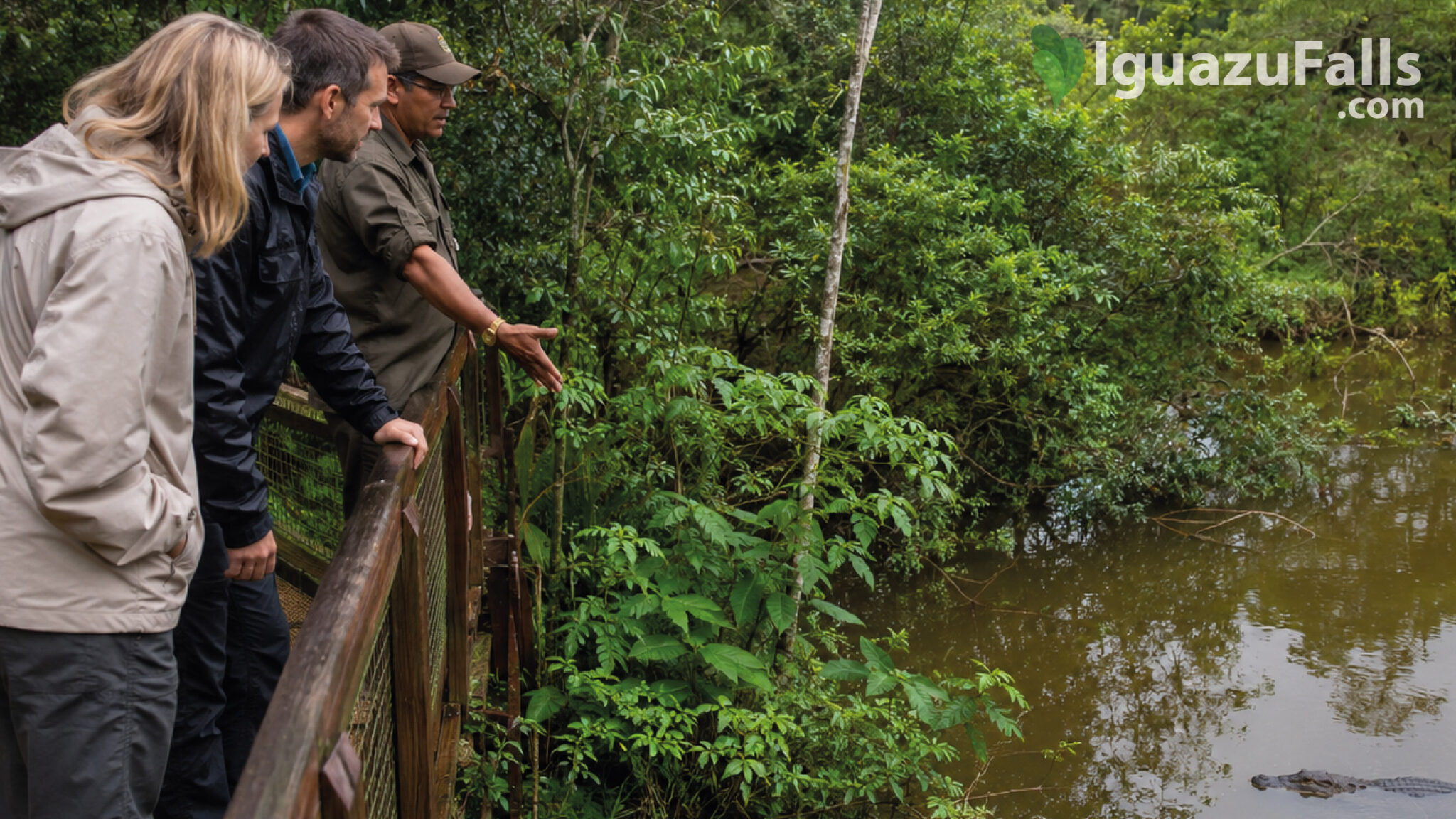
If you are wondering whether there are crocodiles in Iguazu Falls, the short answer is: not true crocodiles, but the region is home to caimans, locally known as yacarés.
Caimans belong to the same reptile family group as crocodiles and alligators, but they are different animals. They inhabit rivers, wetlands, lagoons and quiet waterways throughout northeastern Argentina, southern Brazil and Paraguay.
Although caimans live within the broader Iguazu ecosystem, seeing one beside the main waterfall circuits is uncommon. Most visitors explore Iguazu National Park without encountering one.
There are no established wild populations of the large crocodile species people usually associate with Africa, Australia or Central America. The crocodilian reptiles found around Iguazu are caimans.
Because caimans and crocodiles look similar, travelers often use the word “crocodile” when describing them. In Spanish, the animals are generally called yacarés, while Portuguese speakers use the word jacaré.
Caimans, crocodiles and alligators belong to the order Crocodylia, but they are not the same animal.
Caimans generally have:
Crocodiles are often associated with more open-water habitats and may tolerate saltwater, depending on the species. The caimans of the Iguazu region prefer freshwater environments such as marshes, lagoons, streams and slow-moving sections of rivers.
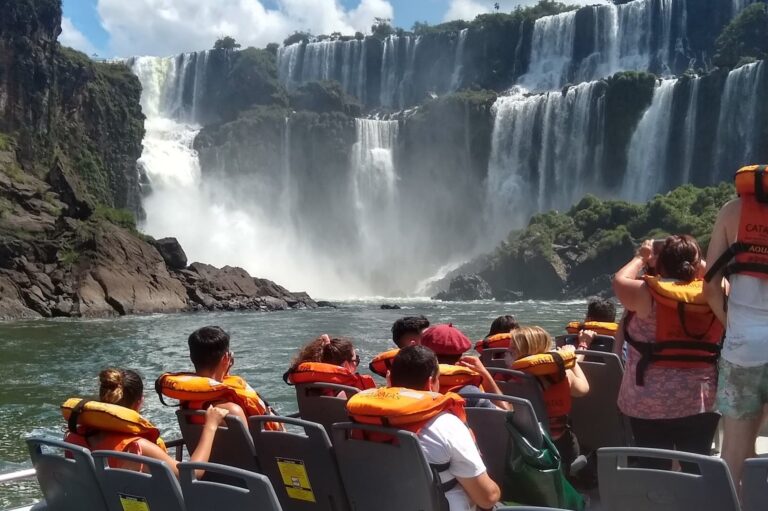
Experience the awe of Iguazu Falls on a 3-day tour from Buenos Aires. Book now for an unforgettable adventure!
From Price: USD150
The species most commonly associated with the Atlantic Forest and the broader Iguazu region is the broad-snouted caiman, scientifically known as Caiman latirostris.
The broad-snouted caiman is recognizable by its unusually wide muzzle. It generally inhabits freshwater wetlands, forest streams, ponds and slow-moving waterways.
Its diet may include:
The species plays an important ecological role as both predator and scavenger. It helps regulate aquatic animal populations and contributes to the balance of wetland ecosystems.
Most broad-snouted caimans are considerably smaller than Nile or saltwater crocodiles. Adults commonly measure approximately 1.5 to 2.5 meters, although large males may occasionally grow longer.
Visitors should never interpret their smaller size as an invitation to approach them. Like all wild animals, caimans can react defensively if cornered, threatened or disturbed.
One single amazing destination, three different countries!
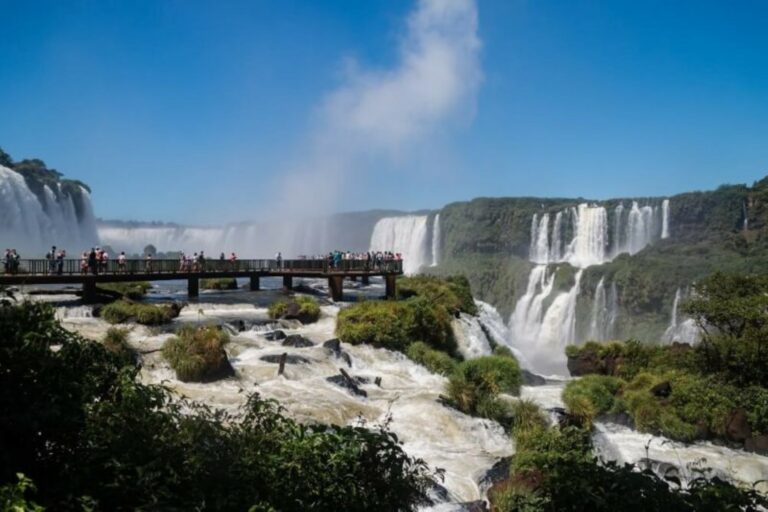
Caimans are more likely to inhabit calm, protected water than the turbulent areas immediately surrounding the falls.
Possible habitats include:
The enormous volume, strong currents and rocky environment around the main waterfalls are not the caiman’s preferred resting areas.
It is unusual to see a caiman along the Upper Circuit, Lower Circuit or Devil’s Throat walkway on the Argentine side. These are busy visitor areas dominated by fast-moving water, rocky channels and elevated platforms.
Sightings may occasionally occur in quieter bodies of water elsewhere in
Visit Three Beautiful Destinations in 9 Nights

The natural ecosystem extends across Argentina and Brazil, so caimans can potentially be found on both sides of the border.
The animals do not recognize political boundaries. Their distribution depends on habitat, water conditions, food availability and human disturbance rather than whether they are in Argentina or Brazil.
DISCOVER A WONDERFUL PLACE TO ENJOY BIRDWATCHING. BE READY WITH YOUR BINOCULARS.

Caimans are wild predators and should be treated with respect. Nevertheless, they do not normally represent a significant danger to tourists following the established rules.
The public circuits at Iguazu Falls are designed to keep visitors on marked trails, observation platforms and elevated walkways. These structures separate travelers from most aquatic habitats.
Millions of visitors explore the destination without experiencing dangerous encounters with caimans.
A caiman may react defensively if a person:
The greatest risk generally results from irresponsible human behavior rather than an animal deliberately seeking contact with tourists.
Visitors should never enter rivers, streams or natural pools unless an activity is taking place in a specifically authorized location under professional supervision.
The most immediate danger is usually not wildlife but the water itself. The Iguazu River can have powerful currents, abrupt changes in depth, submerged rocks and rapidly changing conditions.
Swimming near the waterfalls is prohibited and extremely dangerous.

Go biking to the amazing Iguazu Falls National Park Brazilian Side ,enjoying the nature, the animals, the flora.
From Price: USD35
A caiman sighting can be a memorable wildlife experience if it is handled responsibly.
Remain on the marked path or observation platform. Never move closer simply to obtain a better photograph.
Feeding wild animals can change their behavior and teach them to associate people with food. This can create dangerous situations for future visitors and may ultimately harm the animal.
Avoid actions that could startle wildlife. Use a zoom lens or the optical zoom on your camera instead of approaching.
If a caiman appears near a visitor area, respect any temporary closures or instructions given by park staff.
Children should remain beside a responsible adult whenever wildlife is present. They should never attempt to touch, chase or attract an animal.

Enjoy a city tour in Puerto Iguazu, to visit differnt areas and views of the river, and the famous triple frontier landmark
From Price: USD75
The Atlantic Forest surrounding Iguazu Falls supports an extraordinary variety of reptiles.
Depending on the location and season, the ecosystem may contain:
Most reptiles avoid busy trails and human activity. Sightings are possible but are far less frequent than encounters with coatis, monkeys, birds and butterflies.
Enjoy a city tour in Puerto Iguazu, to visit differnt areas and views of the river, and the famous triple frontier landmark
From Price: USD75
Iguazu National Park protects a rich ecosystem that includes jaguars, pumas, snakes and other wild animals. However, most large predators remain deep in the forest and avoid crowded visitor areas.
For the average traveler, more realistic concerns include:
Coatis may appear friendly, but they have sharp teeth and claws. Visitors should never feed or touch them.
Yes. Iguazu Falls is a safe and highly organized natural attraction when visitors follow national park regulations.
Stay on designated walkways, respect wildlife, avoid entering unauthorized water areas and follow the directions of guides and park rangers.

Explore the Brazilian side of Iguazu Falls and visit Parque das Aves in a single full-day experience.
From Price: USD95
Animals described by visitors as crocodiles are almost certainly caimans. They may live in the wider river system, but sightings next to the principal waterfall platforms are very unusual.
Probably not. Caimans are present in the ecosystem, but they generally remain in quiet and less disturbed aquatic habitats.
Caimans may be more active during the evening and at night, particularly when feeding. Tourist access to the principal park circuits is controlled, so ordinary visitors are not walking near the waterfalls after closing time.
Yes, provided you stay at a safe distance, remain within authorized areas and do not disturb the animal.
Wildlife inside the Argentine and Brazilian national parks is protected. Hunting, capturing, feeding or disturbing animals is prohibited.
There are no true crocodiles commonly living at Iguazu Falls, but the surrounding ecosystem is home to caimans known locally as yacarés. They prefer quiet wetlands, lagoons and slow-moving waterways rather than the violent currents directly beside the falls.
Seeing one is possible but uncommon on a standard visit. By remaining on marked paths and respecting wildlife, travelers can explore Iguazu Falls safely while helping protect one of South America’s richest natural environments.

Experience the wonder of Iguazu Falls on a private 2 day tour from Buenos Aires. Easily reserve accommodations and optional activities. Book now!
From Price: USD150
Experience the awe of Iguazu Falls on a 3-day tour from Buenos Aires. Book now for an unforgettable adventure!
From Price: USD150
