
Iguazu Falls has been photographed millions of times, but its early artistic representations tell a very different story. Before modern roads, panoramic platforms, drones and digital cameras, reaching the waterfalls required difficult journeys through rivers and subtropical forest.
The best-known historical paintings of Iguazu date from the late nineteenth century, when artists joined scientific expeditions into northeastern Argentina. Their works were not simply decorative landscapes. They helped introduce Iguazu to audiences who had never seen the falls and contributed to the construction of Argentina’s visual identity.
Unlike Niagara Falls, Yosemite or the Andes, Iguazu does not have a large internationally recognized canon of paintings by dozens of famous artists. Two names stand above the others: Argentine painter Augusto Ballerini and Swiss-born artist Adolf Methfessel.
Their paintings are important not only because they depict the falls, but because they document how artists confronted a landscape that appeared almost impossible to represent.
Iguazu Falls was known to Indigenous peoples long before European arrival, and Álvar Núñez Cabeza de Vaca recorded seeing the waterfalls in 1541. Nevertheless, the region remained difficult for outside travelers to access for centuries.
During much of the nineteenth century, an artist hoping to paint Iguazu needed to overcome:
European and North American artists could reach Niagara Falls comparatively easily. Iguazu, by contrast, remained distant from the major cultural centers of Buenos Aires, Rio de Janeiro, Europe and the United States.
This helps explain why its most important early paintings were produced by artists connected to scientific or geographical expeditions rather than by conventional tourists.
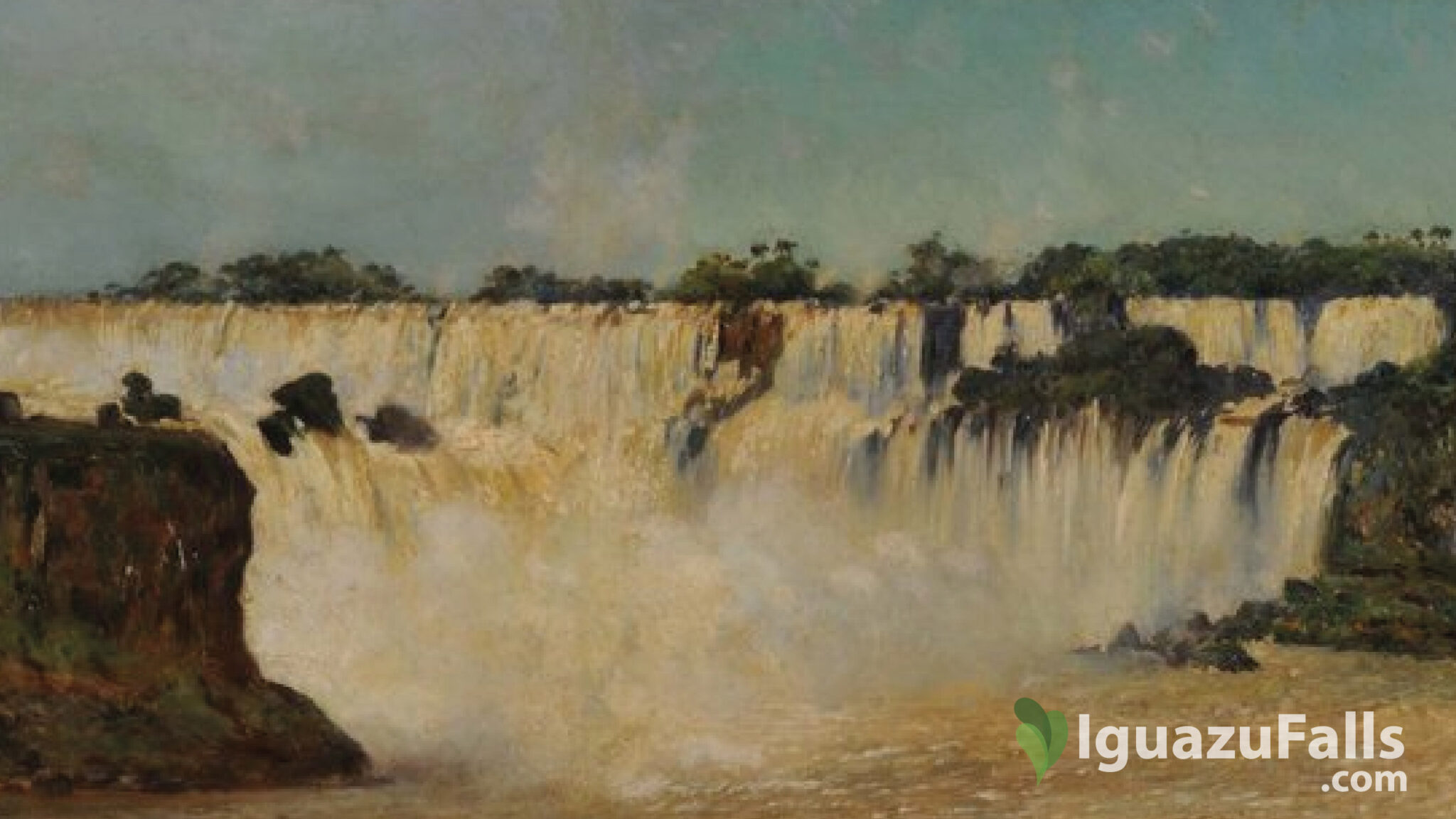
The most important painting of Iguazu Falls in Argentina’s national art collections is Augusto Ballerini’s La cascada del Iguazú, completed in 1892.
Ballerini was born in Buenos Aires in 1857 and trained both in Argentina and at the Reale Istituto di Belle Arti in Rome. His work combined academic training, naturalism and an interest in open-air landscape painting.
The painting belongs to the Museo Nacional de Bellas Artes in Buenos Aires.
According to the museum’s official catalogue:
The unusually wide horizontal format allows Ballerini to spread the waterfall across the composition. Instead of concentrating on one vertical cascade, he presents Iguazu as a vast sequence of water, mist, rock and forest.
The work is part of the museum’s collection but is not always on public display. Its catalogue entry can be viewed through the Museo Nacional de Bellas Artes.
Unveiling the Wonders of Argentina: Explore Buenos Aires and Iguazu Falls on a 6-Night Journey

Ballerini traveled to Iguazu as part of a scientific collecting commission organized by the Argentine government and the Argentine Geographic Institute.
The expedition was led by scientist Gustavo Niederlein and traveled through:
The journey formed part of a wider nineteenth-century effort to study, map and visually document territories that remained unfamiliar to much of Argentina’s urban population.
The expedition remained around the waterfalls from October 23 to 26, 1892. At that time, there were no panoramic platforms, elevators or established trails.
According to the Museo Nacional de Bellas Artes, Ballerini and photographer Enrique C. Moody were raised into the tops of trees using ropes. From this precarious position, Ballerini produced several watercolor sketches and at least one oil painting.
This extraordinary working method explains the painting’s elevated perspective. Ballerini was not simply using artistic imagination to create a panoramic view—he had physically climbed above the forest to find one.
Ballerini avoids presenting the falls as a precise scientific diagram. Instead, the water appears almost fused with the clouds and rising spray.
The principal visual elements are:
The base of the falls is difficult to see clearly. This creates a sense of mystery and scale: the viewer understands that the landscape continues beyond what can be visually controlled.
Although painted near the end of the nineteenth century, the work draws strongly upon the Romantic concept of the sublime.
In art, the sublime refers to an experience of nature so powerful that it produces wonder, fear, humility and fascination at the same time.
Ballerini’s Iguazu is:
The painting does not place human figures prominently within the composition. Without people providing an obvious scale, the waterfall seems even larger and less controllable.
Ballerini sent his Iguazu paintings to the World’s Columbian Exposition held in Chicago in 1893.
La cascada del Iguazú received a medal, bringing international attention to both the artist and the landscape he represented.
For foreign visitors, the painting offered a rare view of a South American natural wonder that most could not realistically visit.
Ballerini exhibited the work at the Ateneo in Buenos Aires in 1894. This helped position Iguazu within the emerging discussion about what landscapes could visually represent Argentina.
At the time, artists and intellectuals were searching for national landscapes beyond the familiar imagery of Buenos Aires and the Pampas.
Eduardo Schiaffino, director of the Museo Nacional de Bellas Artes, later included the painting in the 1904 Louisiana Purchase Exposition in Saint Louis.
Its presence at major international exhibitions transformed it from an expedition image into a cultural representation of Argentina.
The Museo Nacional de Bellas Artes painting was not Ballerini’s only representation of the falls.
After the success of his 1892 work, he produced different versions, studies and replicas. Examples entered institutions including:
One of his watercolors was acquired by Argentine president Julio A. Roca. Other watercolors reportedly entered a German private collection.
In 1901, Eduardo Schiaffino commissioned a replica for the Unión Industrial Argentina.
As a result, the phrase “Ballerini’s Iguazu Falls” can refer to several related works rather than a single image. Dimensions, techniques and compositions should always be checked before identifying a specific version.
Adolf—or Adolfo—Methfessel was born in Bern, Switzerland, in 1836. He arrived in Argentina in 1864 and developed a career combining art, science, exploration and visual documentation.
He worked in oil, watercolor, drawing and illustration and maintained a close association with the Museo de La Plata.
Methfessel was particularly well suited to expeditionary art. His images often combined careful observation with the dramatic composition expected of nineteenth-century landscape painting.
Methfessel traveled to the falls in 1892 with naturalist and archaeologist Juan Bautista Ambrosetti.
His expedition reached Iguazu shortly before Ballerini’s scientific commission. The Museo Nacional de Bellas Artes notes that Ballerini encountered Methfessel during the journey and that the Swiss-born artist had painted the falls approximately one month earlier.
This remarkable coincidence means that two of Iguazu’s most important historical painters worked in the region during the same year.
Methfessel’s principal painting of Iguazu is generally identified as Cataratas del Iguazú, an oil on canvas dated to around 1892 or 1893.
Published research connected with the Universidad Nacional de La Plata identifies a major version measuring approximately:
The painting forms part of the artistic heritage associated with the Museo de La Plata. A study of Methfessel’s life and work documents the piece and his wider relationship with the museum. Universidad Nacional de La Plata’s publication on Adolf Methfessel provides further historical background.
Another painting attributed to Methfessel and titled Cataratas del Iguazú is recorded as:
As with Ballerini, Methfessel appears to have produced more than one version or composition based on his expedition sketches.
Collectors and researchers should therefore avoid assuming that every Methfessel image of Iguazu refers to the same canvas.
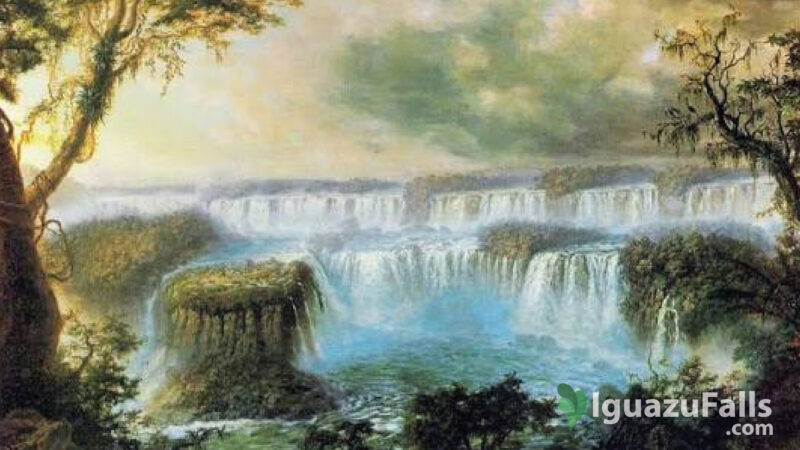
Both artists used an elongated horizontal format, but their artistic identities were different.
Ballerini emphasizes:
Methfessel’s work reflects:
These categories should not be treated as absolute. Ballerini documented a real site, and Methfessel also dramatized nature. However, their professional backgrounds influenced how each interpreted the waterfalls.
Experience Argentina’s Icons with Comfort and Style

In the nineteenth century, paintings, drawings and watercolors played roles now largely occupied by photography, film and satellite imagery.
Artists attached to expeditions documented:
A painting of Iguazu could therefore function simultaneously as:
Methfessel’s close relationship with natural-history institutions is particularly important. His art existed at the intersection of museum science and visual culture.

Enhance your visit to Iguaçu National Park in Brazil and experience a breathtaking sunset at Iguazu Falls with a delightful drink in hand.
From Price: USD139
During the late nineteenth century, Argentina was developing political, scientific and cultural narratives about its territory.
The Pampas already held a central position in literature and national identity. Patagonia, the Andes and the subtropical north offered very different landscapes.
Paintings of Iguazu demonstrated that Argentina also contained:
Ballerini and Methfessel helped transform Iguazu from a distant geographical feature into a recognizable national image.
They were among the earliest important artistic representations, but the expression “first image” requires caution.
Indigenous peoples had known and culturally interpreted the falls for centuries. Earlier maps, written descriptions or less widely preserved illustrations may also have existed.
What makes the paintings of Methfessel and Ballerini especially significant is that they were:
Their fame comes as much from their historical context as from their chronological position.
Experience the Best of Argentina: From the Vibrant Buenos Aires to the Stunning Ibera Wetlands and Majestic Iguazu Falls!

Gastón Bourquin was a Swiss-born photographer active in Argentina during the early twentieth century.
The Museo Nacional de Bellas Artes holds several works titled Cataratas del Iguazú, dated approximately 1920. These are photographic works rather than oil paintings, but they belong to the visual history established by the earlier expedition artists. The museum’s digital collection records three Iguazu images by Bourquin.
By Bourquin’s period, photography had become increasingly important for:
His work marks a transition. Painters had introduced Iguazu through the language of the sublime; photographers increasingly presented it as a place that could be documented, promoted and eventually visited.
As access improved during the twentieth century, the image of Iguazu began to appear in:
These images often simplified the waterfalls into several recognizable elements:
Commercial illustration helped turn Iguazu into one of the most recognizable tourism symbols of Argentina and Brazil.
Unlike Ballerini’s uncertain and mist-filled landscape, many tourism posters presented the falls as accessible, colorful and inviting.

Enjoy a city tour in Puerto Iguazu, to visit differnt areas and views of the river, and the famous triple frontier landmark
From Price: USD75
Iguazu continues to inspire professional artists, local painters and international visitors.
Contemporary works use a wide variety of media:
Modern painters frequently move away from geographical precision. Instead, they explore:
Some artists paint recognizable panoramas, while others reduce the falls to abstract bands of white, green and blue.
Puerto Iguazú has an active community of painters, illustrators, craftspeople and cultural organizations.
Events such as Cataratas en Colores encourage artists and families to interpret the waterfalls through painting and other visual media. These initiatives connect the monumental landscape with local cultural participation.
The resulting works may not yet have the international museum recognition of Ballerini or Methfessel, but they reveal how Iguazu continues to function as a living artistic subject.
For local artists, the waterfalls are not a distant exotic landscape. They are part of everyday regional identity.
Experience the Best of Argentina: From the Vibrant Buenos Aires to the Stunning Ibera Wetlands and Majestic Iguazu Falls!
Contemporary Iguazu art often extends beyond a realistic representation of water.
Artists may include imagery associated with the legend of Naipí and Tarobá:
Such works combine landscape painting with mythology, memory and Indigenous cultural references.
Responsible interpretations should acknowledge that Guaraní culture is living and diverse—not merely a source of picturesque legends.
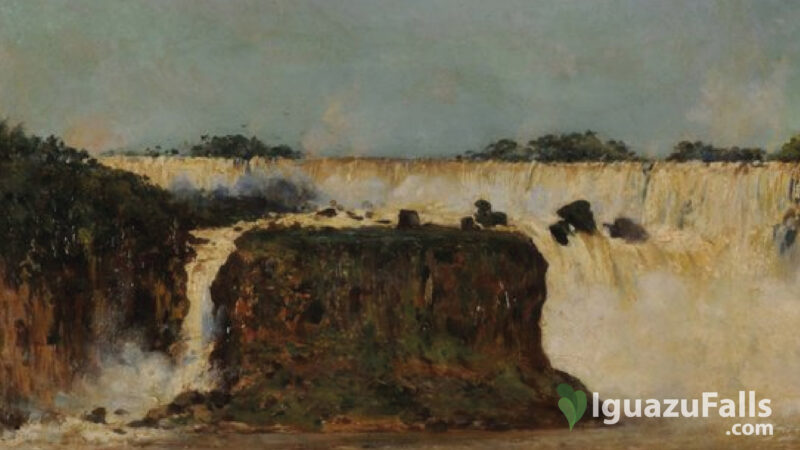
Iguazu presents an unusual artistic problem: painting is static, while the waterfall is defined by motion.
An artist must somehow suggest:
Historical painters used diagonal brushwork, repeated white lines and mist-filled areas. Contemporary artists may employ abstraction, video or installation to overcome the limitations of a still image.
The difficulty of representing Iguazu is one reason its paintings are so revealing. Every artist must decide what can be shown and what must remain implied.
Waterfall spray may include:
An entirely white waterfall can appear flat. Painters often build water through layers of color.

Experience the wonder of Iguazu Falls on a private 2 day tour from Buenos Aires. Easily reserve accommodations and optional activities. Book now!
From Price: USD150
The Atlantic Forest contains countless variations:
The contrast between the dark forest and bright water is one of the central visual structures in Iguazu art.
Rainbows are a common element in modern paintings and tourism illustrations.
They appear when sunlight interacts with suspended droplets in the waterfall spray. Because Iguazu produces enormous quantities of mist, rainbow conditions can occur frequently when the sun is at a suitable angle.
In art, the rainbow serves several purposes:
However, not every historical painter included one. Ballerini’s cloudy composition, for example, is more concerned with atmosphere and sublimity than with bright tourism imagery.
Photography can capture a fraction of a second. Painting can combine observation from different moments.
A painter may:
For this reason, a painting should not be evaluated only according to photographic accuracy. Its value may lie in interpreting how Iguazu feels rather than reproducing exactly how it looked at one moment.
A smart, great-value way to see Iguazu Falls in two nights. Stay at a confirmed 3-star hotel, join shared group tours to both the Brazilian and Argentine sides, and enjoy shared transfers from and to IGR or IGU.
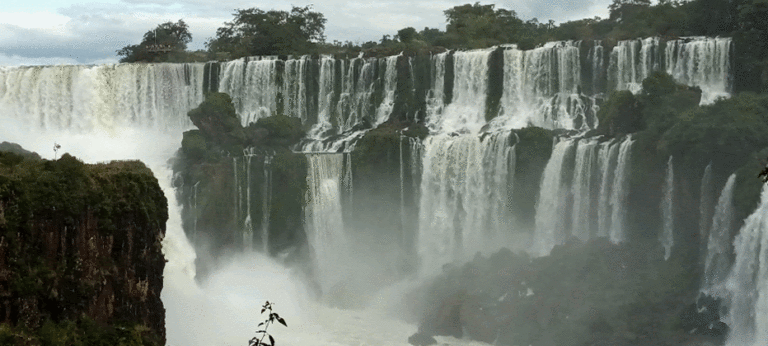
Frederic Edwin Church is frequently associated online with dramatic South American landscapes and waterfalls. However, well-known works such as The Heart of the Andes, Cotopaxi and his paintings of Tequendama Falls should not be relabeled as Iguazu.
Church traveled extensively in parts of South America, but there is no widely accepted, museum-documented masterpiece by him depicting Iguazu Falls.
Confusion occurs because his style includes:
An image that resembles Iguazu is not necessarily a painting of Iguazu.
Before sharing an image online, verify:
Check the artist’s full name and whether the person actually visited or depicted Iguazu.
Use the title given by the museum or collection, not an unofficial caption from social media.
A nineteenth-century appearance does not prove that a work was painted during an expedition.
Reliable information normally comes from:
Photographs, lithographs, engravings, posters and digital art are not paintings, even when their images appear painterly.
Both Ballerini and Methfessel created or inspired multiple versions. Dimensions and ownership can help identify the correct work.
Ballerini’s principal La cascada del Iguazú belongs to the Museo Nacional de Bellas Artes in Buenos Aires.
The painting is not necessarily included in the permanent galleries at all times. Visitors should check current exhibition information before going specifically to see it.
Methfessel’s artistic legacy is closely connected to the Museo de La Plata and its natural-history collections.
His work forms part of a broader group of paintings and illustrations reflecting scientific exploration, landscapes, archaeology and regional history.
Related versions or works have been associated with:
Not every work is permanently exhibited or readily accessible to the public.
Book Your Shore Excursion Through a Local Operator at a Much Lower Rate Than on the Ship!

Augusto Ballerini’s La cascada del Iguazú of 1892 is arguably the best-known historical painting of the falls in an Argentine national collection.
Adolf Methfessel and Augusto Ballerini produced important documented paintings in 1892. Methfessel reached and painted the waterfalls shortly before Ballerini that year.
The principal version belongs to the Museo Nacional de Bellas Artes in Buenos Aires.
Yes. He joined a scientific expedition and produced sketches and paintings in the waterfall area. He was reportedly raised into the trees by ropes to obtain a panoramic viewpoint.
Yes. Methfessel painted the waterfalls following his 1892 expedition with Juan Bautista Ambrosetti. Several related versions or records exist.
No major museum-documented Iguazu painting by Church is generally recognized. His other South American landscapes are sometimes incorrectly identified as Iguazu online.
Brazilian and local artists have produced many images of Iguaçu, particularly in modern and tourism art. However, the nineteenth-century paintings by Ballerini and Methfessel remain the most thoroughly documented historical works directly associated with early expeditions.
Many nineteenth-century works may be in the public domain, but the digital photograph supplied by a museum can have separate terms of use. Check the institution’s licensing policy before commercial publication.
The most famous paintings of Iguazu Falls emerged from a brief but remarkable historical moment in 1892. Adolf Methfessel and Augusto Ballerini reached the waterfalls through difficult expeditionary journeys and attempted to represent a landscape few people outside the region had ever seen.
Ballerini transformed Iguazu into a sublime national landscape and carried its image to international exhibitions. Methfessel connected art with science, exploration and the visual documentation of Argentina’s interior.
Later photography, posters, contemporary painting and digital art expanded the visual tradition. Yet the central artistic challenge remains unchanged: how can a static image communicate the movement, sound, mist and overwhelming scale of Iguazu Falls?
No painting can reproduce the complete physical experience. The most successful works do something different—they reveal how each generation has imagined, understood and emotionally encountered the “Great Water.”
Experience the wonder of Iguazu Falls on a private 2 day tour from Buenos Aires. Easily reserve accommodations and optional activities. Book now!
From Price: USD150
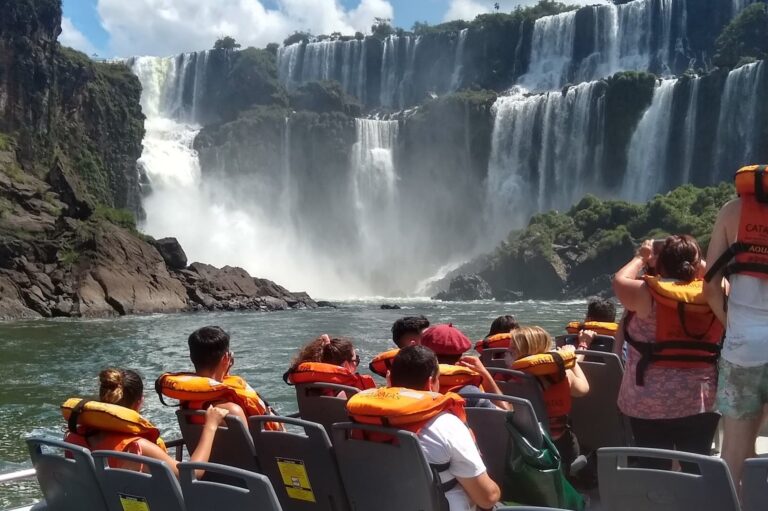
Experience the awe of Iguazu Falls on a 3-day tour from Buenos Aires. Book now for an unforgettable adventure!
From Price: USD150
