

For Australians, reaching Iguazu Falls requires a serious journey across the Pacific and into the heart of South America. Yet the reward is one of the most powerful natural spectacles on Earth: an immense system of waterfalls surrounded by subtropical Atlantic rainforest, colourful butterflies, toucans, monkeys and clouds of rising mist.
Iguazu is not simply a viewpoint that can be photographed in an hour. The falls sit between Argentina and Brazil, and each country offers a completely different experience. The Argentine side takes visitors through the forest and directly above numerous cascades, while the Brazilian side provides the great panoramic view that reveals the scale of the entire system.
Australians planning such a long trip should allow enough time to explore both.
Australians are accustomed to dramatic natural landscapes, long travel distances and national parks where the environment is the main attraction. In that sense, Iguazu feels immediately understandable. At the same time, almost everything about its ecosystem is unfamiliar.
The surrounding forest may remind Queensland visitors of the Wet Tropics or the Daintree, but Iguazu is not part of the Amazon. It lies within the Atlantic Forest, or Mata Atlântica, a separate ecosystem extending along parts of Brazil, Argentina and Paraguay.
Instead of cassowaries, wallabies and cockatoos, visitors may encounter toucans, capuchin monkeys, coatis, blue morpho butterflies, giant lizards and numerous species of tropical birds. Jaguars and tapirs also survive in the protected forest, although sightings near the public walkways are extremely rare.
The two adjoining national parks protect one of the largest remaining areas of inland Atlantic Forest. Argentina’s Iguazú National Park became a UNESCO World Heritage Site in 1984, followed by Brazil’s Iguaçu National Park in 1986. Together, they protect an almost three-kilometre-wide waterfall system and an internationally important centre of biodiversity. UNESCO describes the two parks and their ecological significance.
Iguazu Falls lies on the border between Argentina and Brazil. Paraguay is close enough to form part of the region known as the Triple Frontier, but the waterfalls are not in Paraguay and cannot be properly seen from Paraguayan territory.
Three cities serve as regional bases:
The Spanish spelling is Iguazú, while Portuguese uses Iguaçu. English-language travel material commonly uses Iguazu. All three refer to the same river and waterfall system.
The name comes from Indigenous languages of the region and is commonly interpreted as “great water”—an accurate description once visitors hear the roar of Devil’s Throat.
Australians should resist choosing only one side unless time or visa restrictions make a second visit impossible. The two parks are complementary rather than repetitive.
| Argentine side | Brazilian side |
|---|---|
| Requires most of a full day | Usually needs half a day, longer with extra trails |
| Extensive network of walkways | Shorter principal waterfall trail |
| Close, immersive views | Wide panoramic views |
| Upper and Lower Circuits | Classic overview of the waterfall system |
| Ecological train to Devil’s Throat area | Park buses transport visitors from the entrance |
| Best for exploring individual cascades | Best for understanding the overall scale |
Iguazú National Park offers the most extensive exploration. The principal visitor area includes the Upper Circuit, Lower Circuit and access towards Devil’s Throat.
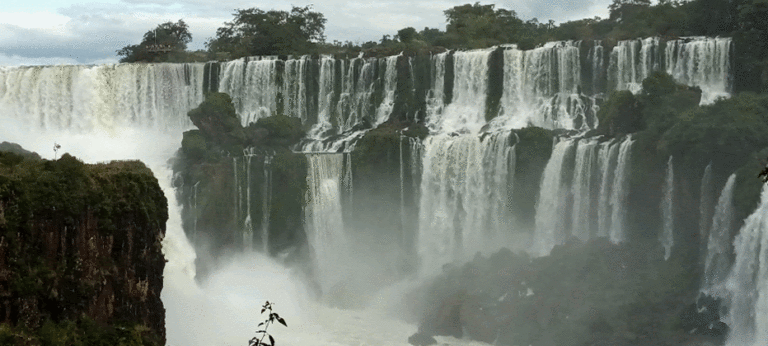
The Upper Circuit travels above several waterfalls, offering broad views over the river and forest. The Lower Circuit descends closer to the base of major cascades, where the spray, sound and movement of the water become much more intense.
Devil’s Throat—or Garganta del Diablo—is the most powerful section. Visitors normally reach its area using the Ecological Train of the Jungle, followed by a long raised walkway over the upper Iguazu River. Water levels, floods and maintenance can occasionally affect access, so conditions should be confirmed immediately before visiting.
The Argentine park asks visitors to purchase an admission ticket for a selected time. Current information and official ticket access are available through the Argentine National Parks website.
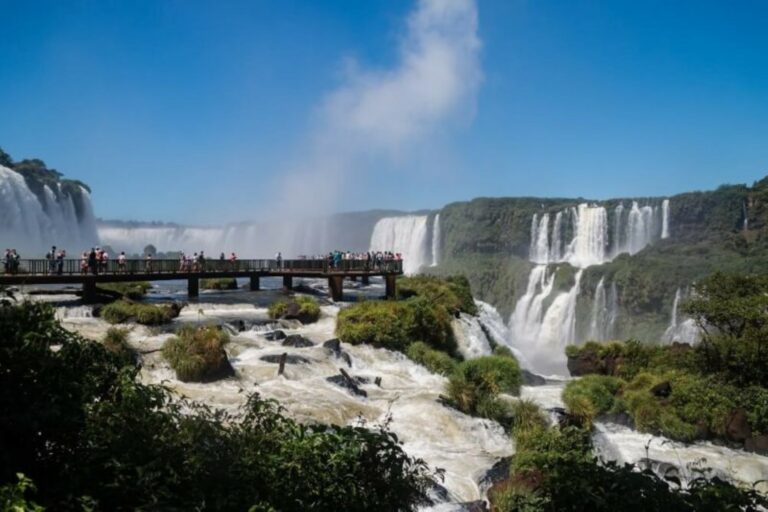
Brazil’s Iguaçu National Park presents the great panorama. From its principal trail, visitors look across the river towards a vast wall of Argentine waterfalls.
The traditional Waterfalls Trail is approximately 1.5 kilometres long. It passes a sequence of viewing platforms before reaching a walkway near Devil’s Throat and the main visitor complex at Porto Canoas.
The Brazilian park also offers longer walking and cycling routes, along with special sunrise, sunset and evening experiences on selected dates. Opening times, trail access and experiences should be checked through the official Iguaçu National Park tourism site.
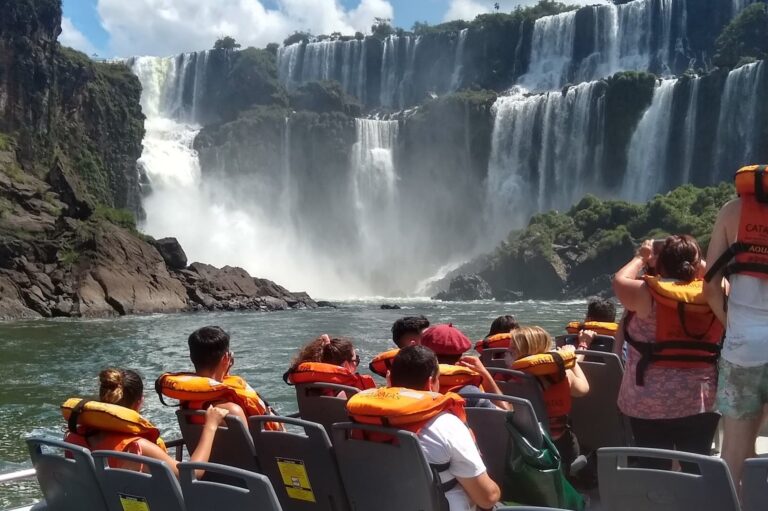
Experience the awe of Iguazu Falls on a 3-day tour from Buenos Aires. Book now for an unforgettable adventure!
From Price: USD150
There are no direct flights from Australia to Iguazu. The most natural trans-Pacific gateway is Santiago, Chile. From there, travellers can continue through Buenos Aires or São Paulo, depending on the itinerary.
Qantas currently markets direct Sydney–Santiago services with a published flight time of approximately 12 hours and 20 minutes. Connections from other Australian cities add additional travel time. Routes and frequencies vary seasonally, so travellers should verify schedules before building domestic South American flights around them. Qantas publishes current Sydney–Santiago information.
The two local airports are:
Australians travelling through Argentina will usually connect through Buenos Aires. Check the airport code carefully: long-haul flights often use Ezeiza International Airport, while many domestic flights depart from Aeroparque Jorge Newbery. If an airport change is required, allow a generous connection rather than treating it like a normal terminal transfer.
Travellers approaching through Brazil can connect through São Paulo, Rio de Janeiro or another Brazilian hub. São Paulo–Foz do Iguaçu flights are widely available, including services marketed by LATAM.
Because the total journey from Australia is so long, spending at least one night in Santiago, Buenos Aires or São Paulo can reduce the risk created by delayed flights and separate tickets.
One single amazing destination, three different countries!
This is one of the most important sections for Australians.
Australian tourists can currently stay in Argentina for up to 90 days without obtaining a tourist visa in advance. Travellers need a valid passport and may be asked for an onward or return ticket and an explanation of the purpose of the visit. Smartraveller’s Argentina advice should be checked again before departure.
Australian passport holders currently require a visa to enter Brazil. Brazil reintroduced this requirement on 10 April 2025.
An Australian staying in Puerto Iguazú still needs the Brazilian visa to make a day trip across the border. A ticket for the Brazilian national park does not replace immigration permission.
The visa must be arranged before arrival; it cannot be obtained at the airport or land border. Applications are available through Brazil’s eVisa process. The Brazilian Ministry of Foreign Affairs provides official information, while Smartraveller confirms the current requirement for Australian citizens.
Print or save an offline copy of the approved visa, even if it is electronically linked to the passport.
Visitors must complete immigration formalities when moving between Puerto Iguazú and Foz do Iguaçu. Carry the original passport, not merely a photograph or photocopy.
A private transfer, registered taxi or organised tour is usually the easiest method. Border processing can be quick or can take much longer during holidays and busy periods. Do not schedule a flight immediately after an international land crossing.
If Paraguay is added to the itinerary, its entry requirements must be checked separately. Permission to enter Argentina and Brazil does not automatically grant entry to Paraguay.
One single amazing destination, three different countries!
Because Australia and Iguazu are both in the Southern Hemisphere, their seasons correspond. December is summer in both places, while July is winter.
Summer is hot, humid and often stormy, with daytime temperatures frequently above 30°C. The forest is intensely green, and rainfall can produce impressive water volumes.
This period also overlaps with Australian summer holidays and peak travel in South America. Expect heavier demand around Christmas, New Year and the January holiday season.
Travellers from Brisbane, Cairns or Darwin may find the humidity familiar. Visitors from Melbourne, Adelaide, Perth or southern Tasmania may require more time to adjust.
Autumn is often one of the most comfortable periods. Temperatures become milder, while the forest normally remains green and active. Easter and other holiday weekends can still be busy.
Winter generally brings cooler mornings and more comfortable walking conditions. Warm clothing may occasionally be needed, particularly early and late in the day.
Australian July school holidays overlap with a major domestic holiday period in Brazil and Argentina, so accommodation and park entry slots can fill quickly. Water volume is not determined by season alone; rainfall across the wider river basin can change conditions rapidly.
Spring combines warm weather, wildlife activity and increasingly lush vegetation. Conditions become more humid as summer approaches, but this is an excellent period for photography, birdwatching and butterflies.
No season guarantees a particular water level. Iguazu changes constantly, and unusual rainfall can produce either spectacular floods or temporary trail closures.
Unveiling the Wonders of Argentina: Explore Buenos Aires and Iguazu Falls on a 6-Night Journey

Australians have travelled too far to compress Iguazu into a rushed overnight visit. Three nights should be considered the practical minimum, while four nights creates a much more comfortable trip.
Arrive in Puerto Iguazú or Foz do Iguaçu. Keep the day light after the long journey and possible jet lag.
Visit the Triple Frontier viewpoint, explore the town or enjoy the hotel pool. Purchase supplies such as bottled water, insect repellent and snacks.
Dedicate a full day to the Upper and Lower Circuits and Devil’s Throat, subject to current access conditions.
Wear comfortable shoes with reliable grip. Start early, as distances inside the visitor area are greater than they initially appear.
Visit the Brazilian panoramic trail. Add Parque das Aves, a conservation-focused bird park located close to the national park entrance, or choose an extended nature trail inside the park.
Australians interested in wildlife photography should allow extra time rather than treating the Brazilian side as a brief photo stop.
Options include:
Keep this day flexible in case weather, border delays or temporary trail closures affect the earlier schedule.
Experience the awe of Iguazu Falls on a 3-day tour from Buenos Aires. Book now for an unforgettable adventure!
From Price: USD150
Puerto Iguazú is smaller, more relaxed and convenient for the Argentine park. It offers restaurants, cafés, craft shops and accommodation ranging from hostels to high-end forest lodges.
Selva Iryapú contains several properties surrounded by subtropical vegetation. Travellers should remember that a forest hotel may involve insects, humidity and wildlife sounds; these are part of the setting rather than necessarily signs of poor maintenance.
Puerto Iguazú is the natural choice for travellers continuing through Argentina or wanting easy access to the Argentine park.
Foz is larger and generally offers a wider selection of hotels, restaurants, shopping and transport services. It is particularly convenient for the Brazilian park, Parque das Aves and the airport.
Foz is also a practical base for families who want resorts, thermal pools or larger recreational facilities.
Australians visiting both parks do not necessarily need to change hotels. A cross-border transfer can be arranged from either city. Splitting the stay becomes useful when flight schedules, early park experiences or a resort stay make it worthwhile.

Enjoy visiting Puerto Iguazu, the three frontier landmark, Guira Oga and the Aripuca in a wonderful half day trip
From Price: USD55
Australian travellers should consult a travel doctor well before departure.
Smartraveller identifies yellow fever as a risk in Misiones Province, where Puerto Iguazú and the Argentine national park are located, and recommends vaccination before travel. Brazil also has yellow fever risk areas, and proof of vaccination may sometimes be requested by airlines or subsequent destinations.
Dengue, chikungunya and Zika are also present in the wider region. Mosquito precautions remain necessary during the day as well as at night.
Visitors should:
Australia has no reciprocal healthcare agreement with Argentina or Brazil. Private treatment and medical evacuation can be expensive.
A smart, great-value way to see Iguazu Falls in two nights. Stay at a confirmed 3-star hotel, join shared group tours to both the Brazilian and Argentine sides, and enjoy shared transfers from and to IGR or IGU.
Coatis are among the animals most frequently encountered beside the walkways. They may appear friendly, but they are wild, intelligent and highly motivated by food.
Do not feed them or hold food where they can reach it. They can open bags, climb onto tables, bite and scratch. The Brazilian park specifically instructs visitors to observe wildlife from a distance and warns that coatis may approach people carrying food. The park’s official rules explain the required behaviour.
The same principles Australians use around dingoes, cassowaries or macaques overseas apply here: never confuse habituation with domestication.
Visitors should also remain on official paths, avoid touching insects and reptiles, and never remove plants, rocks, seeds or feathers.
A useful Iguazu packing list includes:
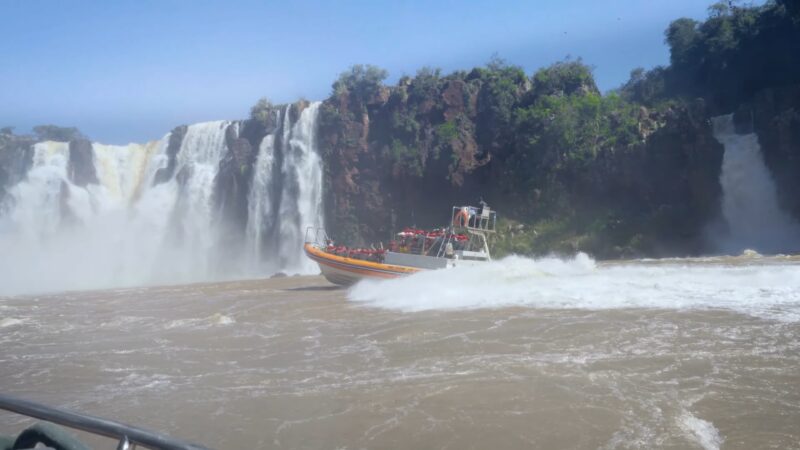
Boat excursions near the falls can soak passengers completely. A poncho may reduce the impact, but it will not keep everything dry. Protect passports, medications, phones and cameras separately.
Experience the Best of Argentina: From the Vibrant Buenos Aires to the Stunning Ibera Wetlands and Majestic Iguazu Falls!

Argentina uses the Argentine peso, while Brazil uses the Brazilian real. Each country has its own payment and exchange system.
Cards are accepted by many hotels, restaurants and attractions, but travellers should also carry a modest amount of local cash. Notify the Australian bank before travelling and check overseas transaction fees.
In Brazil, confirm the amount shown on the payment terminal before tapping a card. In Argentina, exchange rates and payment conditions can change rapidly, making old online price guides unreliable. Check current rates instead of budgeting from an article written months earlier.
Avoid carrying large amounts of cash and use ATMs located inside banks or shopping centres where possible.
English is spoken in many international hotels and by some guides, but it should not be assumed everywhere.
Spanish is used in Puerto Iguazú and the Argentine park. Portuguese is used in Foz do Iguaçu and the Brazilian park. Guaraní has deep cultural importance across the region and appears in numerous place names.
A few useful expressions include:
Using even a few local words is appreciated.
Discover two of Argentina’s most iconic destinations in one exciting journey.

Argentina and Brazil drive on the right-hand side of the road. Australians renting a vehicle must adjust to driving on the opposite side, unfamiliar signage and more unpredictable local traffic. For a short Iguazu stay, transfers and taxis are generally easier than self-driving.
Argentina commonly uses 220-volt, 50-hertz electricity and includes the Type I plug familiar to Australians, although other sockets also appear. Brazil mainly uses Type N sockets and operates at varying voltages. Carry a universal adaptor and check that chargers accept 100–240 volts.
Iguazu follows UTC−3. It is normally 13 hours behind Sydney during Australian Eastern Standard Time and 14 hours behind during daylight saving time. Jet lag can therefore be significant even if the flight itinerary looks manageable on paper.
WhatsApp is widely used by hotels, drivers and tour operators. An international eSIM or local data connection makes transfers and last-minute schedule changes much easier.
Smartraveller currently advises Australians to exercise normal safety precautions in Argentina and a high degree of caution in Brazil. It also identifies crime risks in the Triple Frontier area.
This does not mean tourists should avoid Iguazu, but normal travel discipline is important:
Inside the national parks, the most common practical risks are heat, dehydration, slippery surfaces, sudden weather changes and poor interaction with wildlife.
One single amazing destination, three different countries!
Australian visitors will find both familiar and new flavours.
On the Argentine side, look for empanadas, grilled meats, river fish, yerba mate and locally produced ice cream. Argentine dinner is often later than many Australians expect.
In Foz do Iguaçu, Brazilian churrasco, pão de queijo, fresh juices, rice-and-bean dishes and regional buffets are widely available. The city’s multicultural population has also produced strong Lebanese, Paraguayan and Argentine influences.
Coffee culture differs from Australia’s speciality-café scene. Espresso-based drinks are available, but a flat white may not be interpreted in the Australian sense. Asking for a café com leite in Brazil or café con leche in Argentina is usually simpler.
Tap-water advice varies by location and individual tolerance. Bottled or properly filtered water is the safest choice for travellers with sensitive stomachs.
The main visitor areas are relatively well developed, with transport, toilets, restaurants and extensive walkways. Many principal sections are accessible, although gradients, distances, crowds and constant moisture can still be challenging.
Families should supervise children closely near wildlife and viewing platforms. Prams may be suitable for some main routes but not every trail or boat activity.
Older travellers and visitors with reduced mobility should confirm the status of lifts, accessible transport and individual circuits directly with the parks. A private guide can reduce unnecessary walking and coordinate timing around heat and crowds.
Before leaving Australia:
Iguazu Falls is a long way from Australia, but it fits naturally into the way many Australians like to travel: outdoors, close to wildlife and with a strong sense of landscape.
What makes Iguazu exceptional is not simply the height or width of its waterfalls. It is the feeling of entering a living system. Water, forest, mist, insects, birds and immense geological forces are all present at once.
The best visit does not rush from one country to the other. It allows time for the intimate walkways of Argentina, the grand panorama of Brazil and the smaller details of the Atlantic Forest. For Australians willing to cross the Pacific, Iguazu is not just another stop in South America—it is one of the continent’s defining experiences.

Experience the wonder of Iguazu Falls on a private 2 day tour from Buenos Aires. Easily reserve accommodations and optional activities. Book now!
From Price: USD150
Experience the awe of Iguazu Falls on a 3-day tour from Buenos Aires. Book now for an unforgettable adventure!
From Price: USD150
