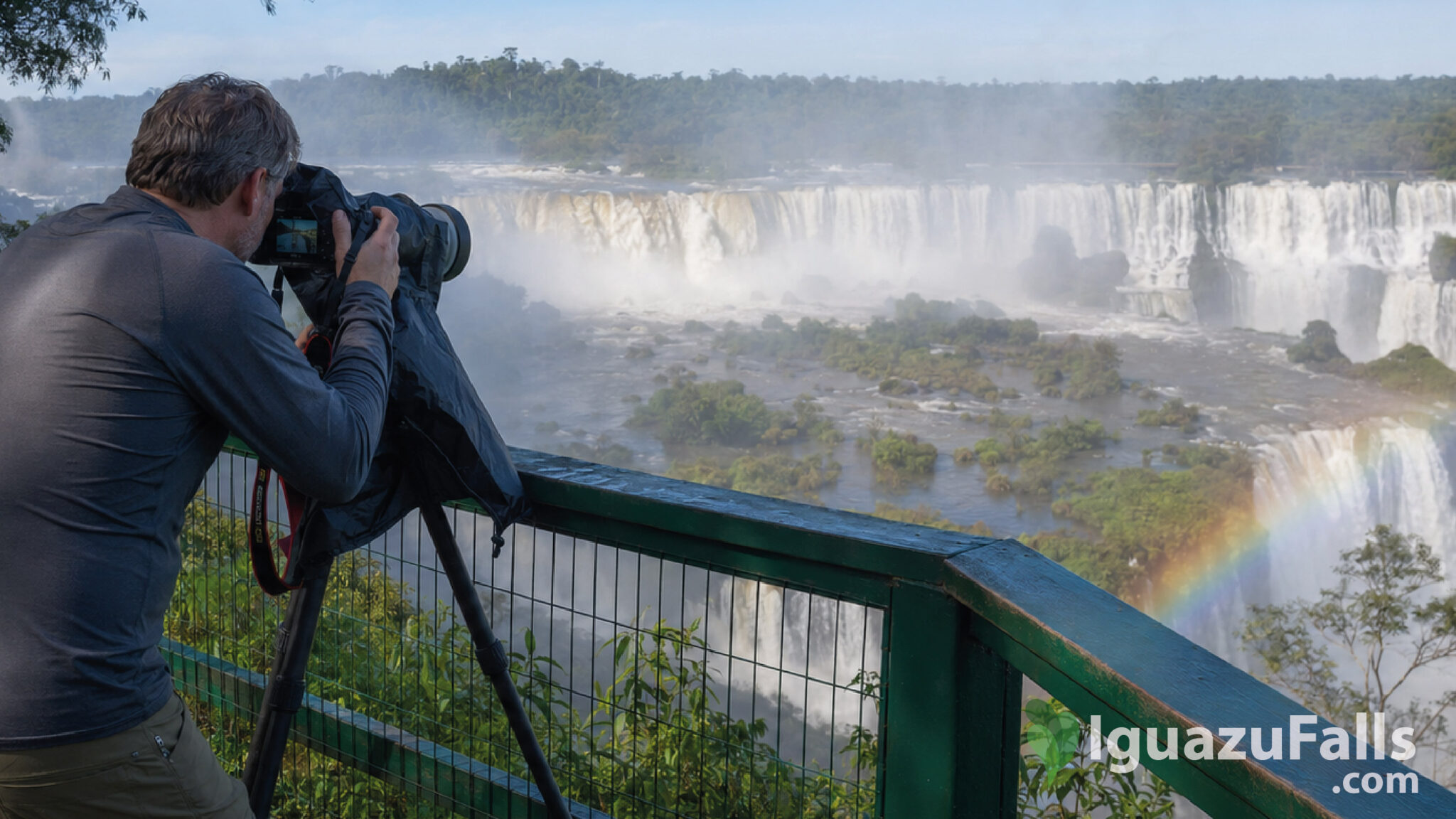
Iguazu Falls Photography Tour: The Complete Guide to the Best Locations, Light and Camera Techniques

Iguazu Falls for Photographers

Iguazu Falls is one of the world’s most rewarding destinations for landscape and nature photography. Its combination of enormous waterfalls, rising mist, subtropical rainforest, tropical wildlife, scenic walkways and changing light creates an almost unlimited range of photographic opportunities.

Unlike destinations built around a single viewpoint, Iguazu can be photographed from above, below, across the canyon, beside individual cascades and from the river. Argentina provides intimate, immersive perspectives, while Brazil offers the classic panoramic views.

A successful photography tour should therefore include both countries and allow enough time to adapt to light, weather, crowds and water conditions.

This guide explains how to organize a complete Iguazu photography tour, including the best locations, recommended times, camera equipment, exposure techniques, weather strategies and a suggested itinerary.

Why Iguazu Is an Exceptional Photography Destination

Iguazu combines several types of photography in one relatively compact destination:

  • Grand landscapes
  • Waterfall photography
  • Rainforest details
  • Wildlife and bird photography
  • Environmental portraits
  • Travel storytelling
  • Long exposures
  • Action and adventure photography
  • Panoramas
  • Macro photography
  • Atmospheric mist and rainbows
  • Black-and-white compositions

Its greatest creative advantage is variety. A photographer can produce a broad panoramic image in Brazil, photograph the edge of a cascade from Argentina, capture a toucan in the forest and create an abstract study of water—all during the same trip.

6-Night Tour: Buenos Aires & Iguazu Falls with Grand Hotels

Experience Argentina’s Icons with Comfort and Style

How Many Days Does a Photography Tour Need?

For serious photography, the ideal program is three or four nights, providing at least two complete shooting days.

Minimum program: Two full days

  • Day 1: Argentine national park
  • Day 2: Brazilian national park

Recommended program: Three shooting days

  • Day 1: Argentine circuits and Devil’s Throat
  • Day 2: Brazilian panorama and Devil’s Throat viewpoint
  • Day 3: Rainforest, wildlife, boat photography or weather backup

A single-day tour covering both countries is possible, but it is not ideal for photographers. Border formalities, park transportation and fixed routes reduce the time available to study compositions or wait for changing light.

Photography benefits from patience. The best plan is rarely the fastest one.

Birdwatching In Iguazu Falls

DISCOVER A WONDERFUL PLACE TO ENJOY BIRDWATCHING. BE READY WITH YOUR BINOCULARS.

The Ideal Photography-Tour Structure

Day Principal focus Recommended period
Day 1 Argentine Devil’s Throat Early morning
Day 1 Upper Circuit Morning
Day 1 Lower Circuit Early to mid-afternoon
Day 2 Brazilian panoramic trail Park opening
Day 2 Individual falls and mist details Late morning
Day 2 Porto Canoas area Afternoon
Day 3 Rainforest and wildlife Early morning
Day 3 Boat or alternative circuits Late morning
Day 3 Weather recovery or editing session Afternoon

Light varies according to season, cloud cover, river level and atmospheric conditions. Times should be treated as a working strategy rather than a guarantee.

Day One: Photography on the Argentine Side

Iguazú National Park in Argentina offers the greatest variety of close perspectives. A dedicated photography day should begin at opening time.

The park is currently open daily from 8:00 a.m. to 6:00 p.m. Admission closes at 4:00 p.m., and the final train toward Devil’s Throat departs at 3:30 p.m. Visitors are officially encouraged to arrive early. Always reconfirm the schedule before the tour.

Devil’s Throat: Power, Mist and Atmosphere

Garganta del Diablo, or Devil’s Throat, is the most dramatic location on the Argentine side.

The final platform places photographers immediately above the enormous gorge. Water, mist and movement dominate the scene.

Best time

Prioritize Devil’s Throat early in the morning for:

  • Lower temperatures
  • Fewer visitors
  • More space at the platform
  • Lower-angle light
  • Better atmospheric definition
  • More time to recover if the train is delayed

Rainbows depend on the relative position of the sun, mist and photographer. They cannot be guaranteed, but clear mornings frequently provide good conditions.

Recommended lenses

  • 14–24mm or 16–35mm: immersive wide views
  • 24–70mm: controlled landscapes and walkway context
  • 70–200mm: mist, water patterns and individual sections
  • Smartphone wide lens: environmental videos and vertical content

Camera protection

This is one of the wettest viewing areas.

Use:

  • Fitted camera rain cover
  • Lens hood
  • Microfiber cloths
  • Waterproof backpack
  • Dry bag
  • Sealed battery and memory-card pouch

Avoid changing lenses at the final platform. Select the lens before entering the wettest section.

Creative compositions

Try:

  • Mist filling most of the frame
  • A person against the enormous gorge
  • High-speed images freezing individual droplets
  • Slightly slower exposures showing movement
  • Telephoto details of water disappearing into the canyon
  • Walkway leading lines
  • Black-and-white images emphasizing texture and power

A tripod may be impractical on a busy, wet platform. High-quality image stabilization and careful handheld technique are often more useful.

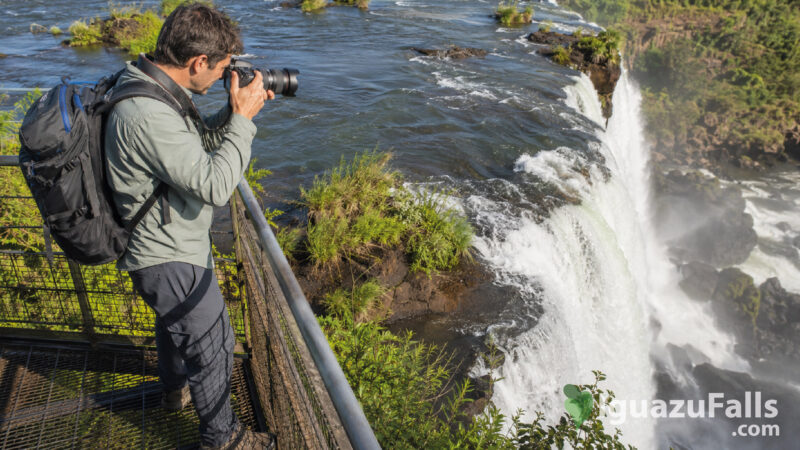
Upper Circuit: Photographing the Edge of the Falls

The Upper Circuit provides top-down perspectives from above multiple cascades.

This area is ideal for photographing the transition between the calm upper river and the sudden vertical drop.

Best time

Morning generally provides:

  • Comfortable temperatures
  • Cleaner directional light
  • Fewer people
  • Better conditions for photographing the river surface
  • Greater wildlife activity along connecting paths

Best subjects

  • The lip of individual waterfalls
  • River islands
  • Water flowing around vegetation
  • Walkway curves
  • Reflections
  • Wide forest-and-water compositions
  • Abstract patterns in the current
  • Visitors placed carefully to demonstrate scale

Recommended lenses

  • 16–35mm: river and waterfall context
  • 24–70mm: versatile circuit coverage
  • 70–200mm: individual cascades and distant viewpoints

Useful settings

To freeze the water:

  • Shutter speed: 1/500 to 1/2000 second
  • Aperture: approximately f/5.6 to f/8
  • Auto ISO with an appropriate upper limit
  • Continuous autofocus where spray or birds are moving

For softer movement:

  • Shutter speed: approximately 1/4 to 1 second
  • Low ISO
  • Neutral-density filter
  • Stable support where permitted

Do not block the boardwalk with a large tripod. A compact tripod or monopod may be more practical, subject to current park rules and crowd conditions.
Lower Circuit: Intimate and Dramatic Perspectives

The Lower Circuit brings photographers closer to the base of several waterfalls.

This is one of the best areas for:

  • Dramatic vertical compositions
  • Environmental portraits
  • Misty forest scenes
  • Details of rock and falling water
  • Layered waterfall images
  • Rainbows
  • Water-and-vegetation contrasts

Argentina, Brazil, & Paraguay Border: Triple Frontier

One single amazing destination, three different countries!
Argentina, Brazil, & Paraguay Border: Triple Frontier


Best time

Early afternoon can provide useful angled light, while overcast conditions are excellent for controlling highlights and preserving saturated forest colors.

Because the Lower Circuit can be wet and contrasty, cloudy weather is not a disadvantage. Soft light may produce more balanced photographs than direct midday sun.

Photography strategy

Expose carefully for the white water. Digital highlights in the brightest cascades are easy to lose.

Use:

  • RAW capture
  • Histogram or highlight-warning display
  • Exposure bracketing
  • Lens hood
  • Circular polarizer when appropriate
  • Frequent lens cleaning

A polarizer can reduce reflections and deepen vegetation, but it can also strengthen or weaken a rainbow depending on how it is rotated. Watch the viewfinder while adjusting it.

Green Trail: Rainforest Details and Wildlife

The connecting forest paths are frequently overlooked by visitors focused only on the waterfalls.

They can provide excellent photographic subjects:

  • Butterflies
  • Coatis
  • Toucans
  • Ferns
  • Bromeliads
  • Tree bark
  • Reflections after rain
  • Backlit leaves
  • Forest shadows
  • Visitors walking beneath the canopy

Best time

Early morning usually provides better wildlife activity and softer forest light.

Recommended lenses

  • 70–200mm: larger animals and environmental wildlife
  • 100–400mm: birds at a respectful distance
  • 90–105mm macro: insects, flowers and forest details
  • 24–70mm: trail storytelling

Never feed or bait wildlife to obtain a photograph.

★★★★★ (7 reviews - 5 ★)

2 Day Trip to Iguazu Falls From Buenos Aires

Experience the wonder of Iguazu Falls on a private 2 day tour from Buenos Aires. Easily reserve accommodations and optional activities. Book now!

  • Traditional

From Price: USD150

Macuco Trail: An Optional Nature Session

The Macuco Trail offers a deeper rainforest experience away from the busiest waterfall platforms.

It is better suited to:

  • Bird photography
  • Insects and butterflies
  • Forest landscapes
  • Texture studies
  • Environmental storytelling
  • Quiet observation

The official Argentine park ticket currently includes access to the Macuco Trail along with the principal circuits and ecological train. Trail conditions and access should be reconfirmed on the day.

Allow a separate half day rather than squeezing it into an already crowded waterfall itinerary.

Brazilian Side Iguazu Falls & Bird Park Full Day Tour

Explore the Brazilian side of Iguazu Falls and visit Parque das Aves in a single full-day experience.

From Price: USD95

Day Two: Photography on the Brazilian Side

The Brazilian national park provides the classic, wide Iguazu panoramas.

The traditional visit includes internal transportation covering approximately 7.5 miles, followed by a panoramic trail of about 0.6 miles, elevators, walkways and viewing platforms. The standard experience normally takes around two hours, but photographers should allow considerably longer.

The park currently opens:

  • Monday through Friday: 9:00 a.m.–4:00 p.m.
  • Saturday and Sunday: 8:30 a.m.–4:00 p.m.

Visitors already inside may remain until the park’s complete closure at 5:30 p.m. Check the official website for seasonal or holiday changes

First Panoramic Viewpoints

The initial viewpoints reveal the enormous Argentine waterfall system across the canyon.

These are the best locations for the classic Iguazu landscape.

Best time

Enter at the first available time if your priority is:

  • Fewer people
  • Cleaner railings and viewpoints
  • Cooler conditions
  • Greater flexibility
  • Morning mist and possible rainbows

Late afternoon can provide softer or warmer light, depending on season and cloud cover. It may also be calmer after large tour groups leave.

However, the conventional park schedule usually ends before true sunset. Do not plan a golden-hour or sunset session unless you have confirmed a specific authorized experience.

Recommended lenses

  • 14–24mm: extremely broad foreground-to-sky compositions
  • 16–35mm: classic panoramic landscapes
  • 24–70mm: flexible scene selection
  • 70–200mm: individual falls across the canyon
  • 100–400mm: compressed details and distant birds

Panorama technique

Instead of using only an ultra-wide lens, try stitching a panorama:

  1. Place the camera vertically.
  2. Lock exposure and white balance.
  3. Focus manually after setting focus.
  4. Overlap each frame by approximately 30–40%.
  5. Rotate from a stable point.
  6. Capture extra space around the final composition.

Vertical source frames provide greater resolution and more room for cropping.

Mid-Trail Panoramas

The middle section of the Brazilian trail provides some of the most balanced compositions.

From here, photographers can combine:

  • Multiple waterfall levels
  • Forest islands
  • River channels
  • Mist
  • Sky
  • Foreground vegetation
  • Rainbows

Do not take every photograph from the railing at eye level.

Look for:

  • Leaves framing the scene
  • A walkway corner as a foreground element
  • People used to show scale
  • Repeating waterfall patterns
  • Layers created by mist
  • Telephoto compositions that exclude the sky
  • Vertical compositions for editorial and social-media use

Birdwatching In Iguazu Falls

DISCOVER A WONDERFUL PLACE TO ENJOY BIRDWATCHING. BE READY WITH YOUR BINOCULARS.

Brazilian Devil’s Throat Walkway

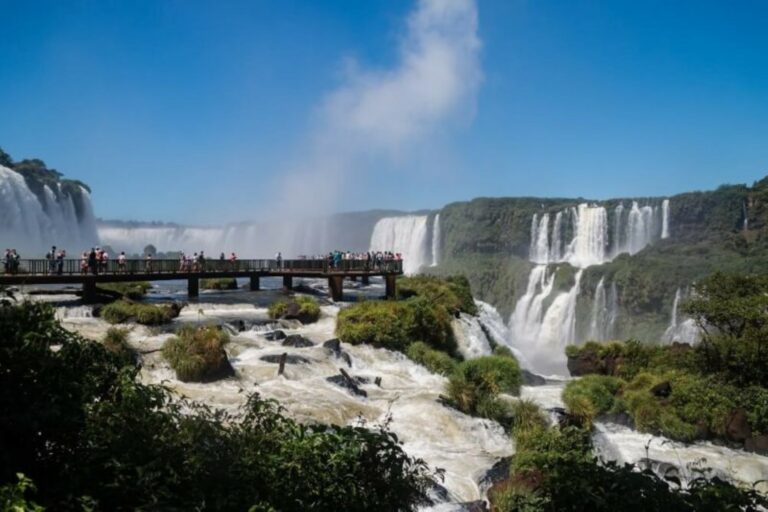
The final walkway approaches Devil’s Throat from the Brazilian side. It provides a more panoramic view than the Argentine platform but can also be extremely wet.

Prepare the camera before entering.

A useful sequence is:

  1. Photograph wide views from the drier approach.
  2. Mount the rain cover.
  3. Clean the front element.
  4. Enter with one selected lens.
  5. Capture essential compositions quickly.
  6. Protect the equipment before moving again.

Repeatedly removing the camera from a wet bag can introduce additional moisture.
★★★★★ (6 reviews - 5 ★)

3 Day Tour to Iguazu Falls From Buenos Aires

Experience the awe of Iguazu Falls on a 3-day tour from Buenos Aires. Book now for an unforgettable adventure!

  • Traditional

From Price: USD190

Porto Canoas Area

The elevated area near the final section offers a useful alternative perspective across the river and waterfalls.

It can work well for:

  • Broad environmental landscapes
  • River-and-forest compositions
  • Telephoto studies
  • Late-afternoon light
  • Final images of the shooting day

Photographers should scout the angle before committing to a tripod setup. Vegetation, visitor flow and temporary barriers can affect compositions.

Day Three: Wildlife, Rainforest and Adventure

A third day transforms the itinerary from a conventional sightseeing visit into a genuine photography tour.

It can be used for one of four purposes:

  1. Wildlife and rainforest photography
  2. Boat and action photography
  3. Returning to a park after unfavorable weather
  4. A guided image-review and editing session

Wildlife Photography

The Atlantic Forest is a central part of the Iguazu story.

Possible subjects include:

  • Toucans
  • Swifts
  • Butterflies
  • Coatis
  • Monkeys
  • Vultures
  • Lizards
  • Native plants
  • Forest insects

Technique

For birds and moving wildlife:

  • Shutter speed: 1/1000 second or faster
  • Aperture: as wide as needed
  • Auto ISO
  • Continuous autofocus
  • Animal or bird eye-detection
  • High-speed burst
  • Image stabilization
  • RAW format

Use a long lens and maintain a respectful distance.

Do not:

  • Feed animals
  • Use bait
  • Touch wildlife
  • leave the marked trail
  • Break vegetation
  • Play recorded bird calls without appropriate guidance
  • Use flash close to animals

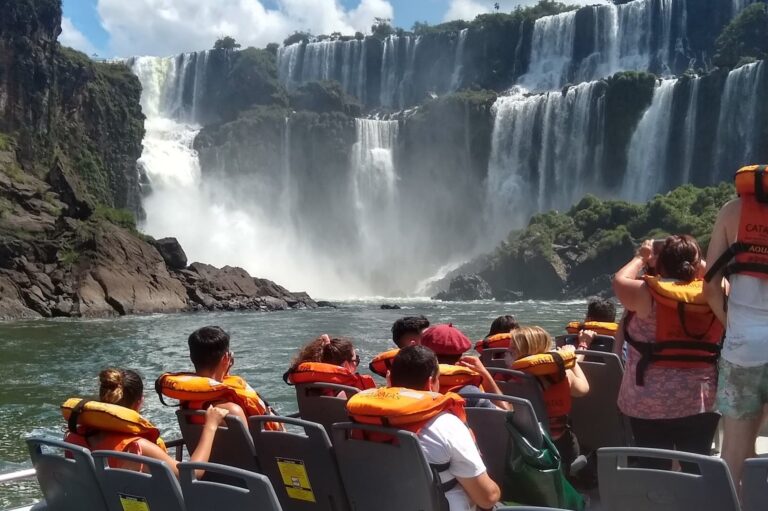
Boat Photography

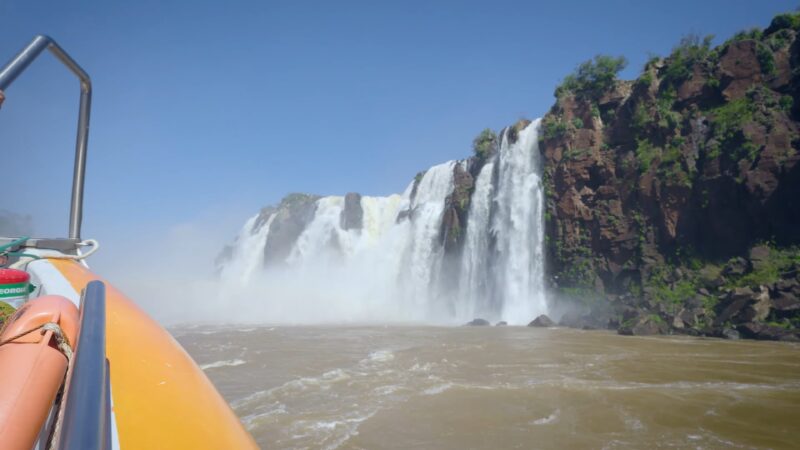
A boat excursion provides dynamic viewpoints but creates a serious risk to equipment.

For most participants, the best strategy is to divide the experience into three parts.

Before boarding

Photograph:

  • The boat and river
  • Safety preparation
  • Life jackets
  • The forest from river level
  • The falls from the landing area

During the approach

Use only properly protected equipment:

  • Waterproof action camera
  • Rugged waterproof compact camera
  • Camera inside a professional housing
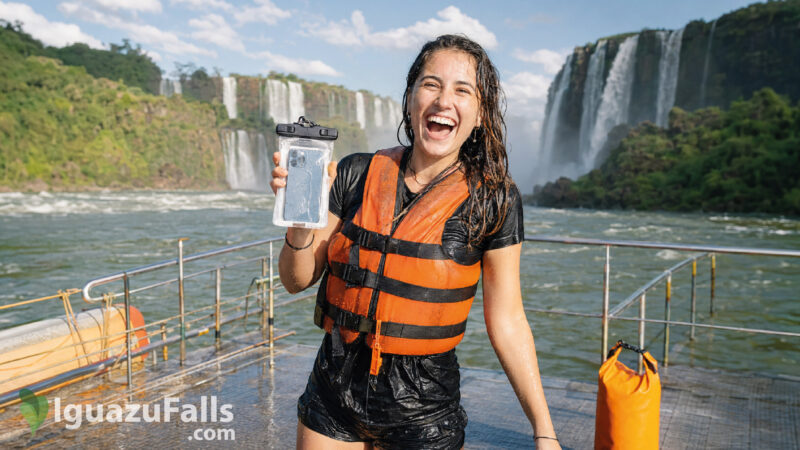
  • Securely tethered phone in a waterproof case

During the wettest section

Put sensitive equipment away.

Water pressure, spray and rapid movement make standard rain sleeves inadequate for the closest approaches.

After the ride

Capture:

  • Passenger reactions
  • Wet clothing
  • Water droplets
  • The boat returning
  • Candid storytelling images

The experience is often better communicated through people and reactions than through another technically perfect waterfall photograph.
Iguazu Falls for instagram lovers

The Best Light at Iguazu Falls

There is no universal “perfect hour.” The best light depends on the desired image.

Early Morning

Best for:

  • Lower visitor numbers
  • Wildlife
  • Softer contrast
  • Atmospheric mist
  • Potential rainbows
  • Comfortable temperatures
  • Clean landscape compositions

Midday

Most challenging for:

  • Harsh highlights
  • Dark forest shadows
  • Heat
  • Crowds
  • Reflections on wet surfaces

Still useful for:

  • Abstract water images
  • High-speed action
  • Backlit mist
  • Tight telephoto compositions
  • Details in shaded forest areas

Buenos Aires, Bariloche, Iguazu Falls

Visit Three Beautiful Destinations in 9 Nights

Late Afternoon

Potential advantages include:

  • Warmer light
  • Fewer tour groups
  • Better directional texture
  • More comfortable temperatures
  • Renewed wildlife activity

Remember that the parks close before sunset under regular admission schedules.

Overcast Conditions

Cloudy weather is excellent for:

  • Waterfall texture
  • Saturated forest colors
  • Long exposures
  • Portraits
  • Balanced dynamic range
  • Moody landscapes

Do not cancel a photography day because the sky is cloudy.

★★★★★ (6 reviews - 5 ★)

3 Day Tour to Iguazu Falls From Buenos Aires

Experience the awe of Iguazu Falls on a 3-day tour from Buenos Aires. Book now for an unforgettable adventure!

  • Traditional

From Price: USD190

Rain

Rain can produce:

  • Reflective walkways
  • Rich vegetation
  • Dramatic mist
  • Water droplets on leaves
  • Atmospheric portraits
  • More powerful rainforest storytelling

Protect the equipment and embrace the conditions.

Rainbows: How to Find and Photograph Them

A rainbow appears when sunlight reaches water droplets at the correct angle relative to the photographer.

To improve your chances:

  1. Keep the sun behind you.
  2. Face an area of illuminated mist.
  3. Move slightly along the viewpoint.
  4. Watch how the arc changes.
  5. Rotate a polarizing filter carefully.
  6. Underexpose slightly if the white water is clipping.

A polarizer can dramatically intensify a rainbow, but rotating it too far can make the rainbow disappear.

Use exposure bracketing because mist and white water create difficult dynamic range.

Evening Stargazing Tour at Iguazu Falls (Brazil Side)

Experience a breathtaking night under the stars at Iguazu Falls, in a peaceful and exclusive setting inside the Brazilian side of the national park.

From Price: USD265

Essential Camera Equipment

Recommended professional kit

  • Two weather-resistant camera bodies
  • 16–35mm wide-angle zoom
  • 24–70mm standard zoom
  • 70–200mm telephoto
  • Optional 100–400mm for wildlife
  • Optional macro lens
  • Circular polarizer
  • Three- and six-stop neutral-density filters
  • Compact tripod
  • Monopod
  • Camera rain covers
  • Waterproof backpack
  • Dry bag
  • Multiple microfiber cloths
  • Spare batteries
  • Several memory cards
  • Portable backup drive
  • Silica-gel packets
  • Lens-cleaning kit

Two camera bodies reduce the need to change lenses in humid or misty environments.

Lightweight kit

A practical minimal setup could include:

  • One weather-resistant body
  • 24–105mm zoom
  • Compact wide-angle lens
  • Polarizer
  • Rain cover
  • Microfiber cloth
  • Waterproof bag
  • Spare battery

Smartphone kit

  • Waterproof case
  • Secure wrist strap
  • Portable battery
  • Microfiber cloth
  • Small stabilizer where permitted
  • Offline storage space
  • Manual or RAW-capable camera application

Brazilian Side Iguazu Falls & Bird Park Full Day Tour

Explore the Brazilian side of Iguazu Falls and visit Parque das Aves in a single full-day experience.

From Price: USD95

Camera Settings for Different Results

Freezing the water

Use:

  • 1/500 to 1/2000 second
  • Continuous autofocus
  • f/5.6 to f/8
  • Auto ISO if necessary

This emphasizes power, individual droplets and movement.

Silky waterfall effect

Use:

  • Approximately 1/4 to 2 seconds
  • Low ISO
  • f/8 to f/11
  • Neutral-density filter
  • Stable tripod
  • Two-second timer or remote release

Do not automatically use extremely long exposures. Iguazu’s power can become an undefined white mass if the water is blurred too heavily.

General landscapes

A reliable starting point is:

  • ISO 100–200
  • f/8
  • Shutter speed determined by light
  • RAW format
  • Highlight alerts
  • Exposure bracketing when necessary

Environmental portraits

Try:

  • 35–70mm
  • f/4 to f/5.6
  • Fast enough shutter speed for spray and movement
  • Person positioned away from the center
  • Waterfalls retained as a recognizable background


6-Night Tour: Buenos Aires & Iguazu Falls with Grand Hotels

Experience Argentina’s Icons with Comfort and Style


Managing Dynamic Range

Iguazu often combines bright white water with dark forest shadows.

To preserve detail:

  • Shoot RAW.
  • Check the histogram.
  • Protect waterfall highlights.
  • Use exposure bracketing.
  • Avoid excessive underexposure.
  • Review images at full brightness.
  • Consider graduated local adjustments during editing.
  • Capture alternative compositions without bright sky.

A slightly dark forest can often be recovered. Completely clipped waterfall highlights cannot.
Humidity and Equipment Care

Humidity is a major concern.

Preventing condensation

When leaving an air-conditioned room:

  1. Keep the camera inside its closed bag.
  2. Allow the bag to warm gradually.
  3. Avoid exposing cold lenses immediately to humid air.
  4. Wait until temperatures begin to equalize.

At the end of the day

  • Dry the exterior of every camera.
  • Remove wet rain covers.
  • Leave compartments open in a dry room.
  • Replace saturated silica gel.
  • Clean lenses carefully.
  • Back up every memory card.
  • Recharge all batteries.
  • Do not store damp equipment in a sealed bag overnight.

Never use excessive heat to dry a camera.

★★★★★ (6 reviews - 5 ★)

3 Day Tour to Iguazu Falls From Buenos Aires

Experience the awe of Iguazu Falls on a 3-day tour from Buenos Aires. Book now for an unforgettable adventure!

  • Traditional

From Price: USD190

Organizing a Professional Photography Tour

A specialized photography tour differs from a conventional guided excursion.

Recommended group size

The ideal group is:

  • One photography leader
  • One licensed local guide
  • Two to six participants

A small group can move efficiently, occupy less platform space and adapt to changing light.

Essential services

A well-designed program should include:

  • Private transportation
  • Licensed park guide
  • Photography leader
  • Border assistance
  • Advance park tickets
  • Flexible meal schedule
  • Weather monitoring
  • Dry storage in the vehicle
  • Backup batteries or charging
  • Drinking water
  • Emergency contact procedure
  • Optional equipment assistant
  • Optional post-shoot review session

Licensed guides for the Argentine park can be arranged through the official access portal.

Pre-tour questionnaire

Ask each participant about:

  • Camera system
  • Available lenses
  • Tripod
  • Physical mobility
  • Photography level
  • Principal interests
  • Wildlife priorities
  • Boat participation
  • Dietary restrictions
  • Passport and visa status
  • Equipment insurance
  • Commercial or personal use of images

This allows the itinerary to be paced correctly.

Buenos Aires & Iguazu Falls

Unveiling the Wonders of Argentina: Explore Buenos Aires and Iguazu Falls on a 6-Night Journey

Sample Two-Day Professional Program

Day 1: Argentine Park

7:15 a.m. – Hotel pickup and equipment check
8:00 a.m. – Enter at opening
8:15 a.m. – Travel toward Devil’s Throat
8:45–10:15 a.m. – Devil’s Throat photography
10:30 a.m.–12:30 p.m. – Upper Circuit
12:30–1:15 p.m. – Lunch and equipment check
1:15–3:30 p.m. – Lower Circuit
3:30–4:30 p.m. – Forest details and wildlife
4:30–5:00 p.m. – Exit and transfer
Evening – Optional image review and backup session

Day 2: Brazilian Park

The starting time should reflect weekday or weekend opening.

Opening time – Enter on the first available admission slot
First 60 minutes – Initial panoramic viewpoints
Following 90 minutes – Mid-trail panoramas and telephoto work
Late morning – Devil’s Throat walkway
Lunch – Porto Canoas area
Afternoon – Elevated views, details or bird park extension
Late afternoon – Return to the hotel and equipment care
Evening – Editing, critique and image selection

Times should remain flexible. A cloud opening or rainbow can be more valuable than following the itinerary to the minute.

Buenos Aires & Iguazu with Loi Suites

Discover two of Argentina’s most iconic destinations in one exciting journey.

Special Access, Commercial Shoots and Drones

Standard admission does not automatically authorize:

  • Commercial productions
  • Large crews
  • Advertising shoots
  • Blocking platforms
  • Extensive lighting equipment
  • Models and wardrobe setups
  • Drone flights
  • Access before opening
  • Access after closing
  • Entering restricted areas

Professional productions should contact the appropriate park authority well in advance.

Do not launch a drone without explicit authorization from every relevant aviation, environmental and park authority. The border location, protected environment, wildlife and visitor safety make unauthorized drone operation particularly inappropriate.

Responsible Photography

The photograph should never be more important than the place.

Follow these principles:

  • Remain on designated trails.
  • Respect barriers.
  • Do not block walkways.
  • Allow other visitors to use viewpoints.
  • Never feed wildlife.
  • Avoid flash near animals.
  • Do not damage vegetation.
  • Keep noise low.
  • Follow guide and ranger instructions.
  • Carry all waste out.
  • Do not place tripods in accessible routes.
  • Never climb railings for a better angle.

A professional photographer should model responsible behavior.

Final Recommendations

The ideal Iguazu photography tour combines:

  • Two full park days
  • Early starts
  • One country per day
  • A flexible third day
  • Wide-angle and telephoto coverage
  • Strong waterproof protection
  • A small group
  • Licensed local guiding
  • Careful border planning
  • Weather flexibility
  • Respect for wildlife and park regulations

The Argentine side provides the intimacy and power: water beneath your feet, mist around the platform and individual cascades only a short distance away.

The Brazilian side provides the scale: the full canyon, multiple waterfall levels, forest islands and the classic panoramic view.

Together, they offer a complete visual story.

The secret is not simply to arrive with expensive equipment. It is to choose the right viewpoint, understand the light, protect the camera, wait patiently and allow Iguazu’s changing conditions to shape the photograph.

★★★★★ (7 reviews - 5 ★)

2 Day Trip to Iguazu Falls From Buenos Aires

Experience the wonder of Iguazu Falls on a private 2 day tour from Buenos Aires. Easily reserve accommodations and optional activities. Book now!

  • Traditional

From Price: USD150

★★★★★ (6 reviews - 5 ★)

3 Day Tour to Iguazu Falls From Buenos Aires

Experience the awe of Iguazu Falls on a 3-day tour from Buenos Aires. Book now for an unforgettable adventure!

  • Traditional

From Price: USD190

Picture of Ramiro Rodriguez

Ramiro Rodriguez

25 years working in the travel industry, as Sales & Marketing Manager at RipioTurismo. Marketing Manager at Nuevas Ideas Travel Consulting Group. Writer and travel lover.

Table of Contents