
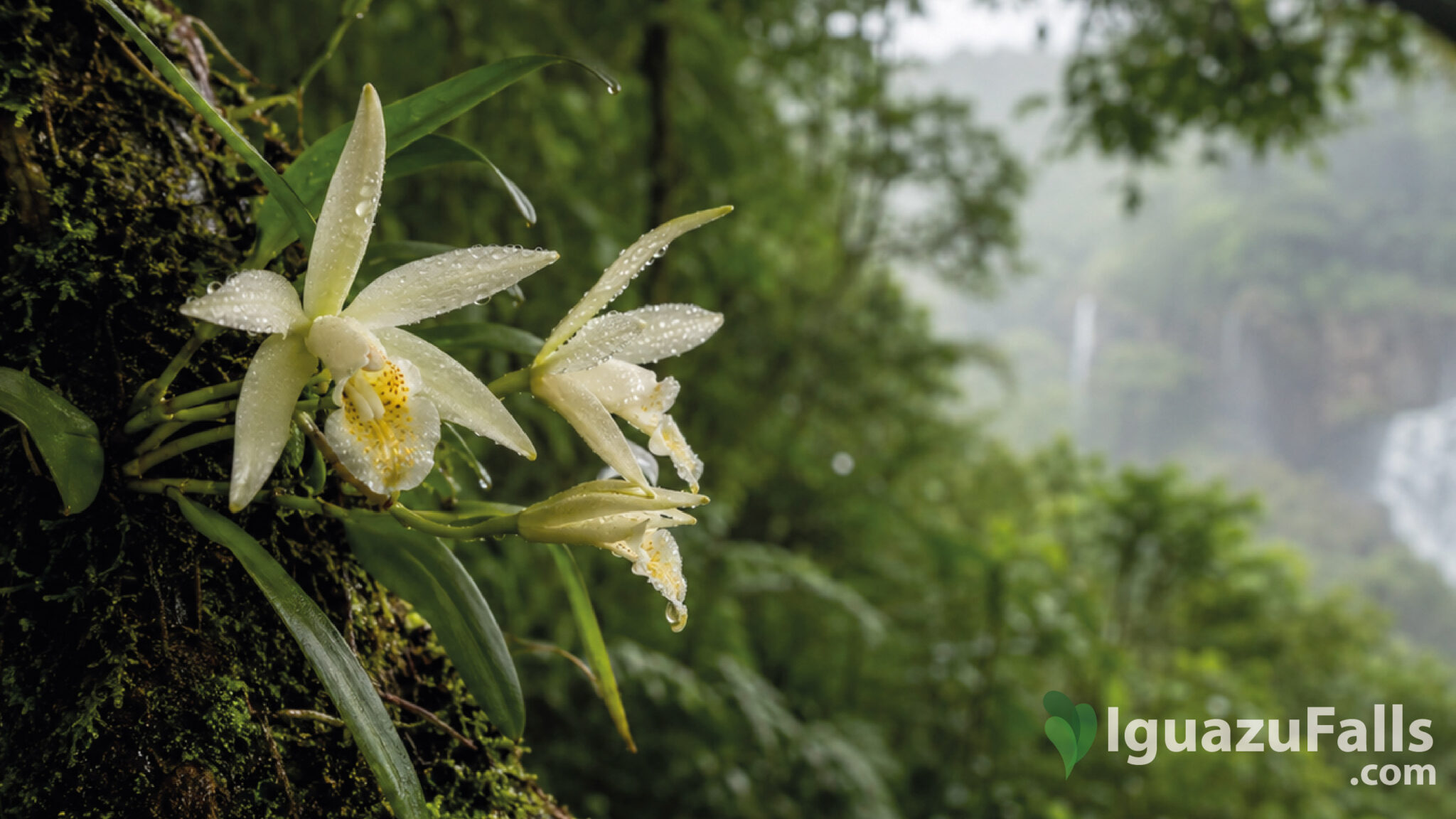
The rainforest surrounding Iguazu Falls is famous for its immense waterfalls, colourful butterflies, toucans and dense walls of subtropical vegetation. Hidden among the branches, however, is a more delicate botanical world: the native orchids of the Atlantic Forest.
Some grow high in the canopy, attached to the branches of ancient trees. Others appear on shaded trunks, moss-covered rocks or directly in the forest soil. Many are so small or well camouflaged that visitors can walk beneath them without realizing they are there.
Unlike the large hybrid orchids commonly sold in garden centres, Iguazu’s wild orchids are part of a complex natural system. Their survival depends on specific pollinators, microscopic fungi, stable humidity and the continued presence of mature native forest.
They are not merely beautiful flowers. They are evidence of an ecosystem functioning through countless relationships that remain largely invisible to the casual observer.
Yes. Native orchids occur throughout the Atlantic Forest of Argentina, Brazil and Paraguay, including the wider Iguazu region.
The humid forest provides many of the conditions orchids require:
Iguaçu National Park in Brazil protects more than 700 species of terrestrial plants and one of the country’s most important remnants of Seasonal Semideciduous Atlantic Forest. Orchids form part of this wider botanical diversity.
On the Argentine side, Iguazú National Park protects part of the Selva Misionera, the most biologically diverse forest environment in Argentina.
Orchids occur on almost every continent, but humid tropical and subtropical forests contain some of their greatest diversity.
The Atlantic Forest offers a wide range of miniature habitats within a relatively small area.
Moist air reduces water loss from orchids growing on exposed trunks and branches. Morning dew, rainfall and humid forest conditions provide water even when the plants are far above the ground.
The spray from the falls influences the immediate environment, although orchids are distributed throughout the forest rather than only beside the waterfalls.
The Iguazu forest includes emergent trees, a main canopy, understory vegetation and a shaded forest floor.
Each level has different conditions of:
This allows different orchid species to occupy highly specialized positions.

Experience the wonder of Iguazu Falls on a private 2 day tour from Buenos Aires. Easily reserve accommodations and optional activities. Book now!
From Price: USD150
Old trees offer broad branches, bark crevices, moss, decaying organic material and stable surfaces on which epiphytic orchids can become established.
A young plantation may contain trees, but it does not immediately reproduce the complexity of a mature native forest.
Iguazu is subtropical rather than equatorial. Temperatures and rainfall change during the year, and some orchids use these seasonal signals to initiate growth, dormancy or flowering.
One single amazing destination, three different countries!
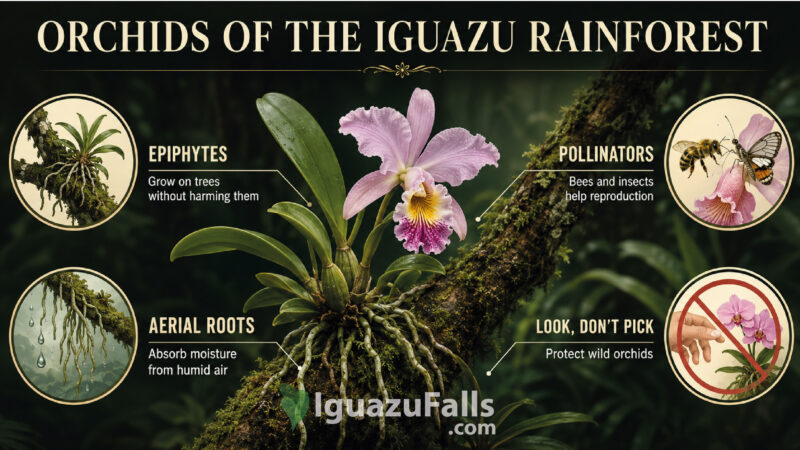
Many of Iguazu’s native orchids are epiphytes, meaning they grow on other plants without taking nourishment directly from them.
They use tree trunks and branches as physical support, allowing them to reach brighter areas above the dark forest floor.
No. An epiphytic orchid does not normally feed on the host tree or penetrate its living tissue to steal nutrients.
It obtains water and minerals from:
The tree provides a place to live, not a direct food supply.
Light is limited near the forest floor. Growing on a branch gives an orchid greater access to sunlight without investing energy in a large trunk of its own.
This strategy is highly efficient, but also creates challenges. An orchid in the canopy must tolerate irregular water supplies, wind and periods of stronger sunlight.
Experience the awe of Iguazu Falls on a 3-day tour from Buenos Aires. Book now for an unforgettable adventure!
From Price: USD150
Not all rainforest orchids grow in trees. Terrestrial species root directly in the soil, often in shaded areas with abundant leaf litter.
They may appear along forest edges, in clearings or in places where a temporary opening in the canopy allows more light to reach the ground.
Many terrestrial orchids are seasonal. Their visible leaves or flowers may emerge for only part of the year, while underground structures survive until suitable conditions return.
Genera such as Habenaria include terrestrial orchids found in different habitats of southern South America. Some prefer moist forest conditions, while others occur in grasslands, marshes or open environments.
Some species can grow on mossy or shaded rocks. These plants are described as lithophytic orchids.
Rock surfaces may appear inhospitable, but small cracks can accumulate:
Roots enter these spaces and anchor the plant. Conditions can change quickly, so lithophytic orchids often possess adaptations for storing water or tolerating temporary dryness.
Wild orchids have evolved remarkable ways to collect water and nutrients.
Many epiphytic orchids have pale aerial roots covered by a sponge-like tissue called velamen.
Velamen absorbs water rapidly when rain falls and helps protect the inner root during dry periods. It can also assist the root in attaching to bark.
The silvery roots often become green when wet because moisture makes the underlying photosynthetic tissue more visible.
Some orchids develop thickened stems called pseudobulbs. These store water and nutrients, helping the plant survive between rain events.
Pseudobulbs vary considerably in shape. They may be rounded, elongated, compressed or almost cane-like.
Species growing in brighter, more exposed positions often have thick or leathery leaves that reduce water loss.
Orchids living in shaded, humid places may have thinner foliage.
A plant’s precise location on a tree matters. The upper surface of a branch may provide more light, while the lower side offers greater protection from direct sun.
Some orchids prefer vertical trunks; others grow where branches divide and organic material accumulates.
Orchid seeds are among the smallest produced by flowering plants.
A single seed capsule may contain thousands of dust-like seeds that can be carried by air currents.
Most plant seeds contain stored nutrients that support the embryo during germination. Orchid seeds contain very little nutritional reserve, which makes them light enough to travel through the forest air.
This advantage creates a major difficulty: the seed cannot usually germinate alone.
In nature, an orchid seed generally needs to encounter a compatible mycorrhizal fungus.
The fungus enters the seed and supplies nutrients that allow the embryo to begin developing. Without this relationship, many orchid seeds will never germinate.
This means orchid conservation is more complicated than scattering seeds in the forest. The correct fungi, moisture, tree surfaces and microclimate must all be present.
DISCOVER A WONDERFUL PLACE TO ENJOY BIRDWATCHING. BE READY WITH YOUR BINOCULARS.

Orchid flowers are famous for their extraordinary structures. These shapes are not random decoration; they guide specific pollinators.
Depending on the species, pollination may involve:
One petal is modified into a structure called the labellum, or lip. It often acts as a landing platform or guide for the pollinator.
Colours, scents and markings direct the visitor towards the flower’s reproductive structures.
Rather than releasing loose pollen grains, many orchids package their pollen into masses called pollinia.
When an insect enters the flower, the pollinia may attach to a particular part of its body. If the animal visits another flower of the same species, the pollen is transferred with remarkable precision.
Some orchids offer nectar, oils, fragrance or other rewards. Others deceive pollinators by resembling a food source, shelter or potential mate.
These specialized relationships help orchids reproduce but also make them vulnerable. If a particular pollinator disappears, the orchid may produce flowers without successfully forming seeds.
The following orchids are associated with Misiones, Paraná or the wider Upper Paraná Atlantic Forest. Their presence and flowering vary by precise location, season and habitat, and visitors should not expect to see every species inside the principal waterfall circuits.
Botanical classifications also change as scientists use genetic evidence to revise orchid relationships. A plant may therefore appear under different scientific names in older books.
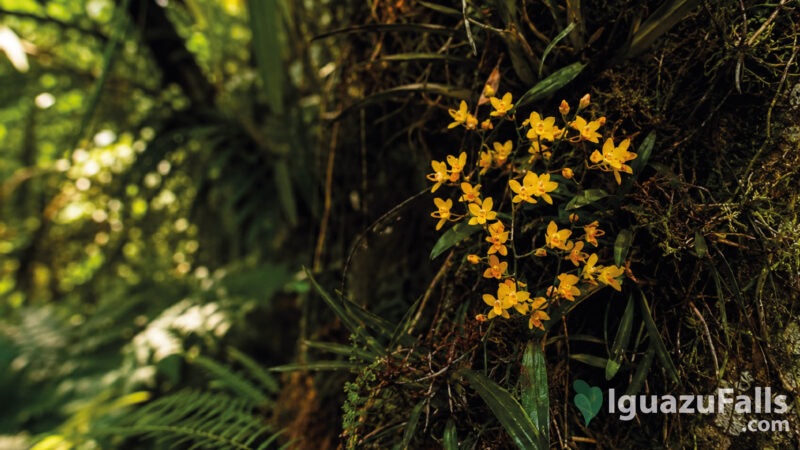
Orchids historically placed within Oncidium include several native species with yellow flowers marked in brown.
The flowers can resemble small figures moving in the air, which explains the common English name “dancing-lady orchid.”
One representative associated with southern Brazil and northeastern Argentina is commonly referred to as Gomesa bifolia, formerly known as Oncidium bifolium.
These orchids may produce branching flower stems holding numerous small yellow blossoms.
Species historically identified as Miltonia flavescens and now often classified as Gomesa flavescens occur in parts of southern South America.
They can produce sprays of pale yellow or cream flowers with contrasting markings.
The plants are epiphytic and may grow on tree branches where they receive filtered light and moving air.
Species of Brassavola are known for narrow petals, prominent white lips and fragrance that may become more noticeable at night.
The pale colour and nocturnal scent of some species are adaptations for moth pollination.
Brassavola tuberculata is associated with parts of southern and southeastern South America and can grow in bright, airy positions.
Epidendrum is a large and diverse orchid genus. Its species vary from small epiphytes to taller plants with cane-like stems.
Some produce clusters of colourful flowers, while others have more discreet blossoms.
Different Epidendrum species occupy forest, edge and open habitats, demonstrating the ecological range contained within a single orchid group.
Octomeria includes many small epiphytic orchids of the Atlantic Forest.
Their flowers may be tiny and easily overlooked. The plants can form clusters on trunks and branches, sometimes hidden among moss and other epiphytes.
These miniature orchids reward close observation rather than dramatic long-distance photography.
Orchids traditionally grouped within Maxillaria are highly diverse. Many produce individual flowers emerging close to the leaves or pseudobulbs.
Some are fragrant, and their scents may resemble fruit, spices or coconut. Others produce little fragrance detectable by humans but remain highly effective at attracting their natural pollinators.
Species of Campylocentrum can be small and inconspicuous. Some produce rows of miniature flowers along slender stems.
The genus also includes remarkable leafless orchids whose green roots perform much of the plant’s photosynthesis.
These plants demonstrate how far the orchid family has diversified from the familiar image of a broad-leaved decorative houseplant.
Habenaria orchids grow from the ground and often produce upright flower spikes.
Many have intricate green, white or pale flowers with narrow segments and nectar spurs. Their subtle colouring makes them easy to miss among surrounding vegetation.

Enjoy a city tour in Puerto Iguazu, to visit differnt areas and views of the river, and the famous triple frontier landmark
From Price: USD75
The rainforest may contain many orchids without presenting obvious masses of flowers.
Some plants live too far above the visitor to be identified without binoculars or a telephoto lens.
An orchid may remain visible only as leaves and roots during much of the year. The flowers may last days or weeks rather than months.
Not every orchid resembles the large Phalaenopsis sold in shops. Some native flowers are only a few millimetres across.
Roots, leaves and pseudobulbs may become almost indistinguishable from moss, bark, ferns and bromeliads.
Rainfall, temperature, light and storm damage influence flowering from one year to the next. A tree covered in flowers during one visit may show no blooms during another.
There is no single Iguazu orchid season because different species flower at different times.
In general, spring and summer provide increasing warmth, humidity and biological activity. However, certain orchids flower during cooler or drier periods.
Flowering may be triggered by:
Travellers visiting specifically for orchids should consult a local botanical guide shortly before arrival. Recent observations are more useful than a fixed annual calendar.
An amazing adventure program to enjoy Iguazu Falls with some extreme activities

Native orchids can occur throughout suitable forest, but protected-area rules must always be respected.
Look for clumps of leaves, pale aerial roots or pseudobulbs attached to textured bark.
Organic material accumulates where branches divide, creating favourable sites for orchid establishment.
After storms, an orchid growing high in the canopy may become visible on a fallen branch.
Do not remove or relocate it. Inform park staff if the plant lies within a visitor area.
Moss-covered trunks and areas near streams may support small epiphytes, although each species has different requirements.
Increased light can stimulate orchid flowering, but edge conditions may also be hotter and drier.
Trails through private reserves, jungle lodges and protected areas may offer observation opportunities, especially with a specialized guide.
Experience the awe of Iguazu Falls on a 3-day tour from Buenos Aires. Book now for an unforgettable adventure!
From Price: USD150
Possibly, but the principal waterfall circuits are not botanical gardens and the orchids are not arranged for easy viewing.
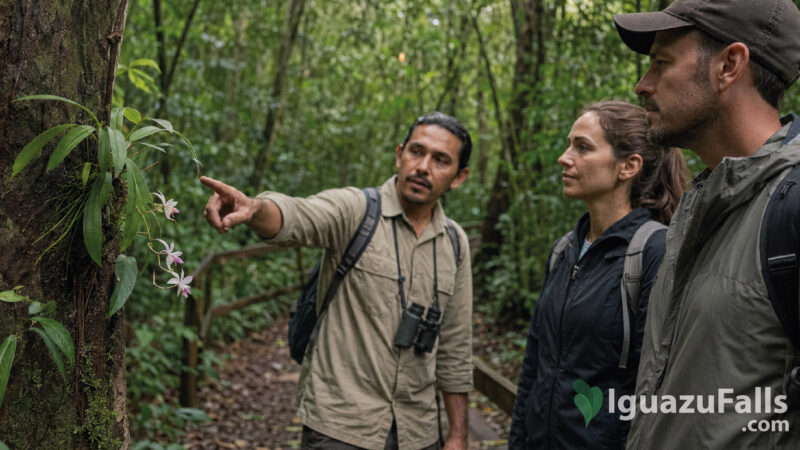
Visitors should search the surrounding trunks and branches rather than only looking towards the water. Binoculars can help locate plants in the canopy.
A guide familiar with local flora will notice details most visitors miss. Even when no orchid is flowering, the guide may identify leaves, roots and growth forms.
Epiphytic orchids depend strongly on the forest’s large trees.
A mature Palo Rosa, Cedar, Timbó or other canopy tree provides:
When an old tree is removed, the loss extends far beyond its trunk. Orchids, bromeliads, mosses, fungi and nesting animals may all lose their habitat.
A newly planted tree cannot immediately replace these relationships. It may require many years before its bark and branches become suitable for a diverse epiphyte community.
Visitors sometimes confuse orchids with bromeliads.
Both groups frequently grow on trees, but they have different structures.
Orchids commonly show:
Bromeliads often form a rosette of leaves. Some collect water in a central tank that becomes a miniature habitat for insects, frogs and microorganisms.
Ferns may also grow as epiphytes, while moss covers bark and retains moisture. Together, these organisms create small aerial gardens.

Explore the Brazilian side of Iguazu Falls and visit Parque das Aves in a single full-day experience.
From Price: USD95
Orchids are admired throughout the world for their beauty, complexity and rarity.
In South America, they are associated with:
However, admiration can become a threat when plants are removed illegally from nature.
The best way to appreciate a wild orchid is to leave it exactly where it grows.
Removing a single plant may seem insignificant, but the ecological cost can be substantial.
A wild orchid depends on specific humidity, light, airflow and host conditions. Moving it to a house or garden often results in its death.
A mature orchid may be one of relatively few flowering individuals in a local population. Removing it reduces opportunities for pollination and seed production.
The plant’s natural fungal relationships may not transfer successfully to a new environment.
Demand for unusual orchids can motivate repeated extraction from protected forests.
Plants, seeds, flowers, roots and fallen natural material must remain within the national parks unless removal forms part of an authorized scientific or conservation program.
From Bustling City to Majestic Natural Wonders: Buenos Aires, El Calafate & Iguazu Falls in 9 Nights

Cultivated orchids may be purchased from authorized nurseries, but travellers should verify that the plants were propagated legally rather than collected from the forest.
Ask for:
International transport of orchids may fall under CITES regulations and the agricultural controls of the destination country.
A plant legally purchased in Argentina or Brazil cannot necessarily be carried across an international border without documentation.
For most international visitors, photographs are a safer and more responsible souvenir.
When native forest is cleared, terrestrial orchids lose their soil environment while epiphytes lose the trees supporting them.
Even when the surrounding vegetation remains, removing large mature trees can eliminate entire communities of canopy orchids.
Rare, colourful or unusual orchids are particularly vulnerable to collectors.
Forest edges experience stronger sunlight, higher temperatures, lower humidity and greater wind exposure. Species adapted to stable interior conditions may decline.
Changes in rainfall and temperature can disrupt flowering, fungal relationships and pollinator activity.
An orchid may bloom before or after its normal pollinator is active, reducing reproductive success.
Pesticides, habitat loss and environmental changes affect bees, moths and other animals required for orchid reproduction.
Non-native plants can alter forest structure or compete with native terrestrial orchids.
DISCOVER A WONDERFUL PLACE TO ENJOY BIRDWATCHING. BE READY WITH YOUR BINOCULARS.
Conservation depends primarily on maintaining intact forest rather than protecting isolated flowers.
Important measures include:
Researchers and institutions in Misiones have studied the flowering cycles and in-vitro cultivation of native orchids, including plants rescued from authorized forest clearing. This work can contribute to conservation and reduce pressure on wild populations.
Because natural germination depends on fungi, orchid propagation requires specialized techniques.
Seeds are cultivated with a compatible fungal partner, recreating part of the natural relationship.
Seeds can also be grown in sterile containers containing a nutrient-rich medium. This supplies the resources normally provided by fungi.
Small sections of plant tissue may be used to produce additional individuals under laboratory conditions.
Returning propagated orchids to the wild is complex. The receiving habitat must be suitable, protected and capable of supporting the plants over the long term.
Reintroduction should be performed only as part of a scientifically designed conservation project.

Enjoy visiting Puerto Iguazu, the three frontier landmark, Guira Oga and the Aripuca in a wonderful half day trip
From Price: USD55
Orchids make exceptional photographic subjects, but their size and location create challenges.
A macro lens or close-focusing phone mode can reveal flower structures invisible to the naked eye.
Avoid pulling stems, cutting vegetation or rotating the plant to improve the composition.
Strong repeated flash may disturb pollinators and produce an unnatural image. Use natural light or a softly diffused flash when appropriate.
Do not step away from the trail to reach a flower. Terrestrial orchids and seedlings may be hidden beneath leaves.
Aerial roots can be easily broken, especially when dry.
A wider image showing the orchid on its host tree provides ecological context and communicates that the plant belongs to a larger forest system.
Sharing exact coordinates can expose vulnerable orchids to illegal collectors. General locations are sufficient for most photography and nature records.
Visitors interested in orchids should bring:
The most important tool is time. Walk slowly, inspect trunks and allow your eyes to adjust to the complexity of the vegetation.
The orchid family is an important part of Atlantic Forest diversity. However, many species are difficult to notice because they grow high in trees, remain small or flower only seasonally.
Some may grow in humid environments influenced by rivers or spray, but orchids occur throughout suitable forest habitats and are not limited to the immediate waterfall area.
No. The region contains epiphytic, terrestrial and occasionally rock-growing species.
Epiphytic orchids generally use trees for support and are not parasites.
No. Natural material should remain inside the protected area. Notify park staff if a fallen plant is in a place where it may be damaged.
Different species flower at different times. Spring and summer can be productive, but there is no single flowering season for every Iguazu orchid.
Orchids are not normally considered a major poisoning risk to visitors, but no wild plant should be eaten or handled unnecessarily.
Yes, but a botanically knowledgeable guide greatly increases the chance of locating and identifying them.
The two parks share the same wider Atlantic Forest ecosystem, so many plant groups occur on both sides. Precise species distribution and abundance vary according to habitat.
International movement may require phytosanitary and CITES documentation. Check the regulations of every country involved before purchasing or transporting a plant.
The orchids of Iguazu do not offer the immediate spectacle of Devil’s Throat. They reveal themselves slowly: a cluster of roots on an old trunk, a miniature flower among moss or a pale blossom suspended high above the trail.
Their beauty comes partly from their complexity. An orchid may depend simultaneously on a mature tree, a particular fungus, a specific pollinator and the humid microclimate created by the surrounding forest.
Remove any one of these elements and the plant may disappear.
For visitors willing to look beyond the waterfalls, orchids provide a different way to understand Iguazu—not simply as a scenic attraction, but as a living network of highly specialized relationships.
Wild orchids are among the most refined expressions of the Atlantic Forest’s biodiversity. They grow without ordinary soil, release seeds light enough to travel on the wind and form partnerships with fungi before producing their first leaves.
Some attract pollinators with fragrance and nectar. Others rely on elaborate forms of deception. Many spend most of the year hidden among bark, roots and foliage before briefly revealing their flowers.
When you walk through Iguazu National Park, remember to look up at the branches as well as towards the waterfalls. Somewhere within that enormous green architecture, an orchid may be flowering quietly above the trail—small, intricate and perfectly adapted to its place in the rainforest.
Experience the wonder of Iguazu Falls on a private 2 day tour from Buenos Aires. Easily reserve accommodations and optional activities. Book now!
From Price: USD150
Experience the awe of Iguazu Falls on a 3-day tour from Buenos Aires. Book now for an unforgettable adventure!
From Price: USD150
