

Long before Iguazu Falls appeared on maps, in travel books or on lists of the world’s natural wonders, Indigenous communities lived beside the rivers and forests of the region.
For them, the landscape was not simply a collection of rocks, trees and waterfalls. The natural world was alive with spirits, powerful beings and stories that explained the relationship between people, water and the forest.
The best-known traditional story associated with the creation of Iguazu Falls is the legend of Naipí and Tarobá: two young lovers who attempted to escape the will of M’Boi, a powerful serpent deity connected to the river.
Their escape ended in tragedy, but according to the legend, the lovers remain at the waterfalls forever—separated by M’Boi’s anger yet still able to see each other across the rushing water.
DISCOVER A WONDERFUL PLACE TO ENJOY BIRDWATCHING. BE READY WITH YOUR BINOCULARS.

The legend is frequently described in travel literature as a Guaraní story. However, several cultural and educational sources from the Brazilian state of Paraná attribute its best-known form to the Kaingang people, historically written in Portuguese as Caingangues.
The wider Iguazu region has been inhabited and travelled through by different Indigenous peoples, including Guaraní and Kaingang communities. Over generations, the legend has been retold, translated and adapted by schools, writers, artists and tourism organizations.
Consequently, there is no single definitive version.
Names, characters and details can change between retellings. M’Boi may be described as a god, a giant serpent, a guardian of the river or the son of Tupã. Naipí may be offered as a sacrifice or consecrated to serve the deity. Tarobá may become a tree, a palm or a rock overlooking the falls.
The story should therefore be approached as a living regional tradition rather than a fixed historical document.
A smart, great-value way to see Iguazu Falls in two nights. Stay at a confirmed 3-star hotel, join shared group tours to both the Brazilian and Argentine sides, and enjoy shared transfers from and to IGR or IGU.
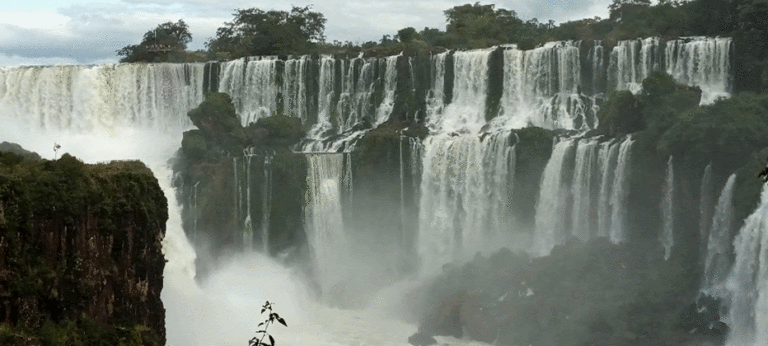
According to the legend, the Iguazu River once flowed peacefully through the forest. There was no enormous precipice, no Devil’s Throat and no vast system of waterfalls separating its banks.
The world was governed—or at least powerfully influenced—by M’Boi, a supernatural being who lived in the depths of the river.
M’Boi was described as an immense serpent deity. In some versions, he was the son of Tupã, a powerful spiritual figure associated with thunder and creation in several Indigenous traditions.
M’Boi controlled the waters and was both respected and feared. The river provided food, transportation and life, but its currents could also bring danger and destruction.
To maintain balance and secure M’Boi’s protection, the community held ceremonies in his honour. In the most dramatic versions of the legend, a beautiful young woman was periodically chosen to be offered or consecrated to the serpent deity.
That chosen woman was Naipí.

Enhance your visit to Iguaçu National Park in Brazil and experience a breathtaking sunset at Iguazu Falls with a delightful drink in hand.
From Price: USD139
Naipí was the daughter of the community’s chief, often named Igobi in Brazilian retellings.
Her beauty was said to be so extraordinary that the river stopped flowing whenever she looked at her reflection in the water. Birds paused their songs, and the forest seemed to grow silent in her presence.
Because of her exceptional beauty, Naipí was selected for M’Boi. Depending on the version, she was expected to dedicate her life to the deity or be sacrificed during an important ceremony.
Once chosen, she was forbidden from marrying or sharing her life with another person.
But Naipí was already loved by the young warrior Tarobá.

Tarobá was known for his courage, strength and skill as a warrior. When he saw Naipí, he fell deeply in love with her.
The feeling was mutual.
The two understood that their relationship could not be accepted. Naipí had been promised to M’Boi, and opposing the serpent god could place the entire community in danger.
Tarobá nevertheless refused to surrender the person he loved. As the day of Naipí’s consecration approached, the couple secretly prepared their escape.
A great celebration was organized in honour of M’Boi. Members of the community gathered beside the river to dance, sing and prepare offerings.
During the ceremony, Tarobá waited for an opportunity to reach Naipí. While the celebration continued, the two escaped to the river and entered a canoe.
Tarobá paddled with all his strength, carrying Naipí downstream through the darkness. For a moment, it seemed that they might leave M’Boi and their former lives behind.
But a deity of the river could not be escaped by travelling across his own waters.

Enjoy a city tour in Puerto Iguazu, to visit differnt areas and views of the river, and the famous triple frontier landmark
From Price: USD75
When M’Boi discovered that Naipí and Tarobá had fled, he became furious.
The great serpent moved beneath the river, twisting his immense body through the earth. The ground shook, the riverbed split open and a vast chasm appeared in front of the fleeing canoe.
Water that had once flowed peacefully began pouring into the newly formed abyss.
The canoe was pulled toward the edge. Despite Tarobá’s desperate efforts, the current carried the lovers over the precipice and into the enormous gorge.
According to the legend, this was the birth of Iguazu Falls.
The deepest and most violent part of the chasm became what visitors now call Devil’s Throat—Garganta del Diablo in Spanish and Garganta do Diabo in Portuguese.

Enjoy a wonderful full day activity to learn more about the jesuit ruins of San Ignacio, Loreto and Santa Ana.
From Price: USD229
M’Boi did not allow the lovers simply to disappear. He transformed them so that they would remain part of the landscape forever.
Naipí was turned into one of the great rocks at the centre of the waterfalls.
There she would be surrounded and struck eternally by the falling water, unable to leave the chasm created by M’Boi.
The rock symbolizes endurance. Although the river crashes around her, Naipí remains present and visible within the landscape.
Tarobá was transformed into a tree—or a palm in some versions—standing on the edge of the gorge.
From this position, he can look across the water toward Naipí but can never reach her.
The permanent distance between the rock and tree became M’Boi’s final punishment: the lovers would remain close enough to see one another but separated by the immense power of the waterfalls.
Some versions say that M’Boi continues to live beneath the river or inside Devil’s Throat, watching over the lovers and ensuring that they never reunite.
The violent currents and the deep shape of the gorge are sometimes imagined as movements of the enormous serpent’s body.
Discover two of Argentina’s most iconic destinations in one exciting journey.

A gentler version of the story introduces the rainbows that regularly appear above Iguazu Falls.
When sunlight passes through the millions of droplets suspended in the air, a rainbow may form between different sections of the waterfall system.
According to popular retellings, the rainbow creates a temporary bridge between Naipí and Tarobá. It represents a connection that even M’Boi cannot completely destroy.
This element gives the tragic story a sense of hope. Although the lovers were physically separated, their bond continues through the water, mist and light.
The story of Naipí and Tarobá can be interpreted in several ways.
At its centre, the legend is the story of two people who challenge a powerful authority to remain together.
Their love represents individual choice, while M’Boi embodies divine or social rules that cannot easily be resisted.
The legend also explains why the Iguazu River changes from calm water into one of the world’s most powerful waterfall systems.
M’Boi’s creation of the chasm expresses the idea that nature possesses forces greater than human strength. Tarobá may be a courageous warrior, but he cannot overcome the river itself.
Naipí and Tarobá do not vanish completely. They become rock and vegetation—two permanent elements of the Iguazu landscape.
Their transformation reflects a worldview in which people, animals, plants, rivers and spiritual beings are connected rather than entirely separate.
The river supports the community but also destroys the escaping canoe. It is simultaneously a path to freedom and the instrument of M’Boi’s punishment.
This dual nature remains visible at Iguazu today. Above the waterfalls, parts of the Upper Iguazu River can appear remarkably calm. Moments later, the same water plunges into Devil’s Throat with overwhelming force.
From Bustling City to Majestic Natural Wonders: Buenos Aires, El Calafate & Iguazu Falls in 9 Nights

The Naipí and Tarobá legend is a cultural explanation of the landscape, not a scientific account.
Geologists explain that Iguazu Falls developed through volcanic activity, layers of basalt and millions of years of erosion.
Around 130 million years ago, enormous lava flows covered parts of present-day southern Brazil, northeastern Argentina and neighbouring areas. When the lava cooled, it created extensive layers of basalt.
Later geological movement and erosion produced changes in the riverbed. Water gradually exploited cracks and differences between basalt layers, forming the cliffs and stepped structure visible today.
The waterfalls continue to change as water erodes the rock and slowly moves the edge upstream.
Science explains the physical process. The legend expresses the emotional and cultural meaning that people gave to the landscape.
The two perspectives answer different questions and can be appreciated without treating one as a replacement for the other.
From Bustling City to Majestic Natural Wonders: Buenos Aires, El Calafate & Iguazu Falls in 9 Nights
Oral traditions naturally evolve as they pass between generations, languages and communities.
The legend of Naipí and Tarobá has been narrated in Indigenous contexts, translated into Portuguese and Spanish, included in school materials and adapted for tourism, literature, theatre and dance.
Differences include:
These differences do not necessarily invalidate the story. They demonstrate that the legend is still being interpreted and retold.
However, visitors and publishers should avoid presenting a modern tourist adaptation as the only authentic Indigenous version.
Experience Argentina’s Icons with Comfort and Style

The story remains visible throughout the Iguazu region.
At the Marco das Três Fronteiras in Foz do Iguaçu, cultural performances frequently retell regional stories through music and dance.
The legend of Naipí and Tarobá has been transformed into a theatrical presentation connecting the waterfall story with the identity of the Triple Frontier.
Murals, sculptures and artistic installations in Foz do Iguaçu and nearby communities depict the two lovers, the serpent and the waterfalls.
These works often combine Indigenous-inspired imagery with contemporary regional art.
The legend appears in educational materials and illustrated books throughout Paraná and the wider region. It is commonly used to introduce children to local folklore and the cultural significance of Iguazu Falls.
Naipí and Tarobá have also inspired the names of streets, neighbourhoods, businesses, tourism services and cultural spaces.
Their presence in everyday language demonstrates how deeply the story has become connected with regional identity.
Enhance your visit to Iguaçu National Park in Brazil and experience a breathtaking sunset at Iguazu Falls with a delightful drink in hand.
From Price: USD139
There is no officially identified tree that can be definitively called Tarobá or one specific rock universally recognized as Naipí.
Different guides, artists and storytellers may point to particular natural formations as representations of the characters. These identifications are symbolic rather than geographical facts.
When standing before Devil’s Throat, visitors can nevertheless imagine the elements of the legend:
The story adds a human and spiritual dimension to a landscape that might otherwise be understood only through measurements and photographs.
Buenos Aires, Iguazu, & Rio de Janeiro: A Triad of South American Splendor

The legend is often presented as a romantic local story, but it originates within a region shaped by Indigenous history and living Indigenous communities.
Visitors should remember that Guaraní and Kaingang peoples are not characters who exist only in legends. Their communities, languages and cultural traditions continue in Argentina, Brazil and Paraguay.
Travellers interested in Indigenous culture should choose respectful experiences developed with or led by local communities. Cultural visits should not treat sacred beliefs as entertainment or reduce complex peoples to stereotypes.
The legend can serve as a starting point for learning more about the Indigenous history of the Atlantic Forest and Triple Frontier region.
An amazing adventure program to enjoy Iguazu Falls with some extreme activities

Naipí was a young woman chosen or consecrated for the serpent deity M’Boi. Tarobá was the warrior who loved her and attempted to help her escape by canoe.
M’Boi was a powerful supernatural serpent associated with the Iguazu River. Some versions describe him as a god and the son of Tupã.
According to the legend, M’Boi twisted his enormous body beneath the earth, splitting the riverbed and creating the chasm into which the lovers’ canoe fell.
Naipí was transformed into a rock in the centre of the waterfalls, surrounded by the river’s turbulent water.
Tarobá was transformed into a tree or palm standing beside the gorge, eternally looking toward Naipí.
The story is frequently called a Guaraní legend in international tourism, but several Brazilian cultural sources attribute its best-known version to the Kaingang people. Because the story has been transmitted and adapted across cultures, its attribution should be presented carefully.
It is a traditional story rather than a historical or geological record. The physical formation of Iguazu Falls is explained scientifically through basalt lava flows, geological fractures and erosion.
Particular rocks and trees may be symbolically identified with them, but there are no officially designated natural formations universally recognized as the two characters.
The legend of Naipí and Tarobá transforms Iguazu from a physical landscape into a story of love, rebellion, punishment and memory.
The falling water becomes M’Boi’s anger. A rock becomes Naipí. A tree becomes Tarobá. And every rainbow appearing through the mist offers the possibility that the two lovers remain connected.
Whether heard beside the river, read in a children’s book or performed through dance, the story continues to shape the cultural identity of Iguazu.
The waterfalls may have been created by geology, but in the regional imagination, their spirit belongs to Naipí and Tarobá.

Experience the wonder of Iguazu Falls on a private 2 day tour from Buenos Aires. Easily reserve accommodations and optional activities. Book now!
From Price: USD150
Experience the awe of Iguazu Falls on a 3-day tour from Buenos Aires. Book now for an unforgettable adventure!
From Price: USD150
