
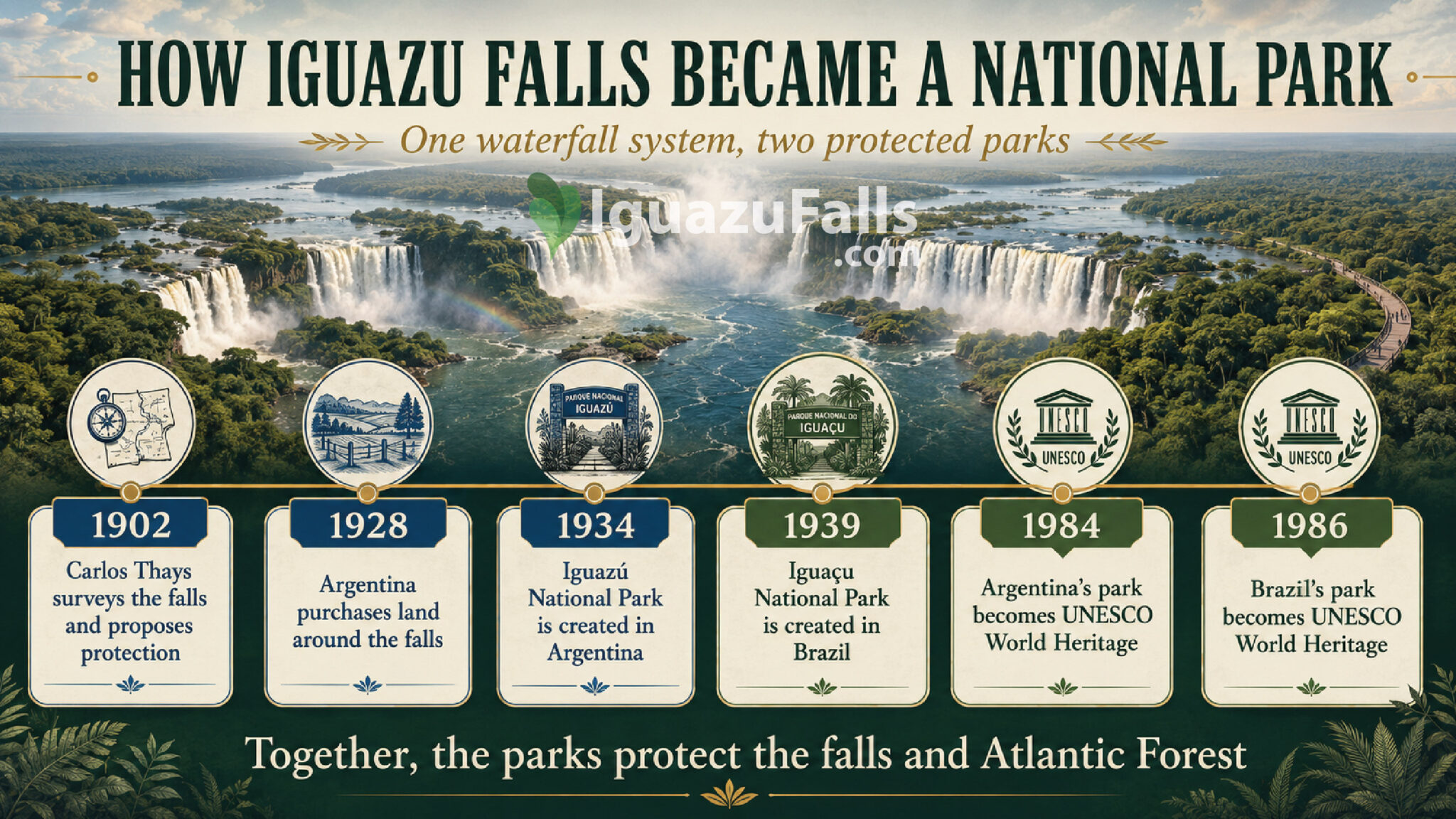
Iguazu Falls did not become a national park through a single decision. Its protection developed gradually on both sides of an international border, through scientific expeditions, early tourism, political advocacy, land purchases and a growing recognition that the surrounding rainforest was as important as the waterfalls themselves.
Today, two adjoining parks protect the landscape:
Together, they preserve the world-famous waterfall system and one of the most significant surviving areas of the Upper Paraná Atlantic Forest.
The two parks are managed separately and were added to the UNESCO World Heritage List in different years, but ecologically they form one continuous protected landscape divided by the Iguazu River.
The expression “Iguazu National Park” can create confusion because the waterfalls lie between two countries.
Argentina uses the Spanish spelling Iguazú, while Brazil uses the Portuguese spelling Iguaçu.
The Argentine park protects the southern and eastern side of the waterfall system in Misiones Province. It contains the extensive walkway network, ecological train and the principal approach to Devil’s Throat.
Created in 1934, it covers approximately 67,620 hectares of the Paraná rainforest.
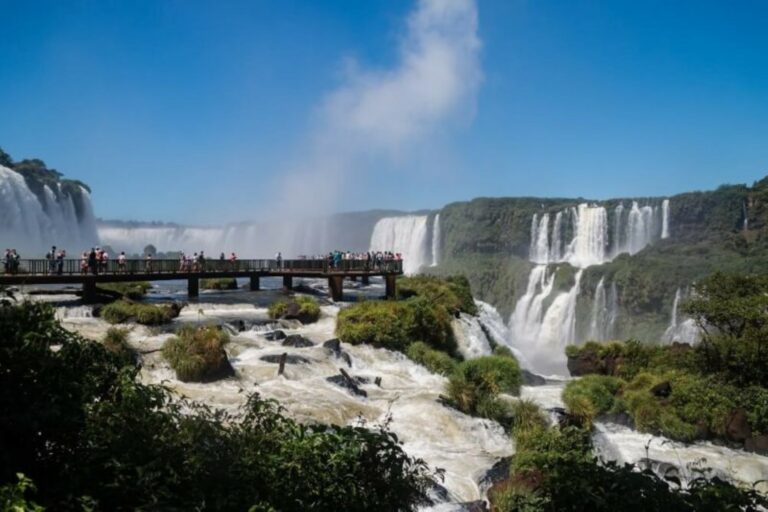
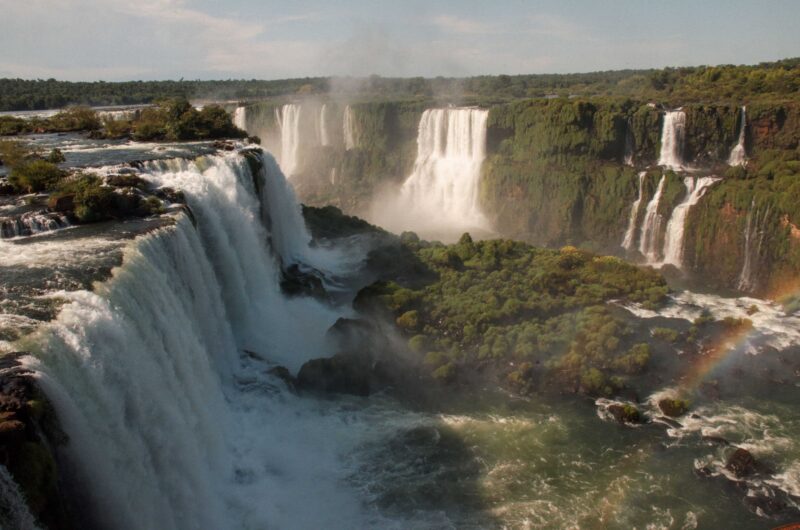
The Brazilian park occupies a much larger protected area in the state of Paraná. It provides the great panoramic view across many of the falls and protects an extensive forest corridor beyond the main visitor area.
It was established as a federal national park in 1939 and now protects approximately 185,000 hectares.
The river forms the international boundary, but wildlife, water, seeds and ecological processes do not recognize political borders.
Jaguars, tapirs, birds and other animals move through the broader forest landscape. Maintaining protected habitat on both sides is therefore essential.
DISCOVER A WONDERFUL PLACE TO ENJOY BIRDWATCHING. BE READY WITH YOUR BINOCULARS.

The history of Iguazu did not begin with explorers, tourism or government decrees.
Indigenous peoples inhabited and travelled through this region long before national borders existed. The waterfalls, rivers and forest formed part of an Indigenous cultural landscape.
The name Iguazu derives from Guaraní words commonly interpreted as:
The name therefore means “Great Water.”
The term describes not only the visual scale of the falls but also their importance within a landscape structured by rivers.
Mbyá Guaraní communities continue to live in the wider Iguazu region. Their relationship with the forest includes language, spirituality, food, medicinal plants and traditional crafts.
The official cultural information of Argentina’s park recognizes the presence of Mbyá Guaraní communities around the protected area and the importance of their orally transmitted history and customs.
Any history of the national parks should therefore distinguish between the legal creation of a protected area and the far older human history of the landscape.
Spanish explorer Álvar Núñez Cabeza de Vaca reached the falls in 1542 while travelling through the region. European accounts later presented this as the “discovery” of Iguazu Falls, although Indigenous communities already knew the area.
For centuries after European colonization began, the location remained remote from the major cities of South America.
Dense forest, rivers and limited infrastructure made access difficult. The falls were known to travellers, mapmakers and local communities, but mass tourism was still impossible.
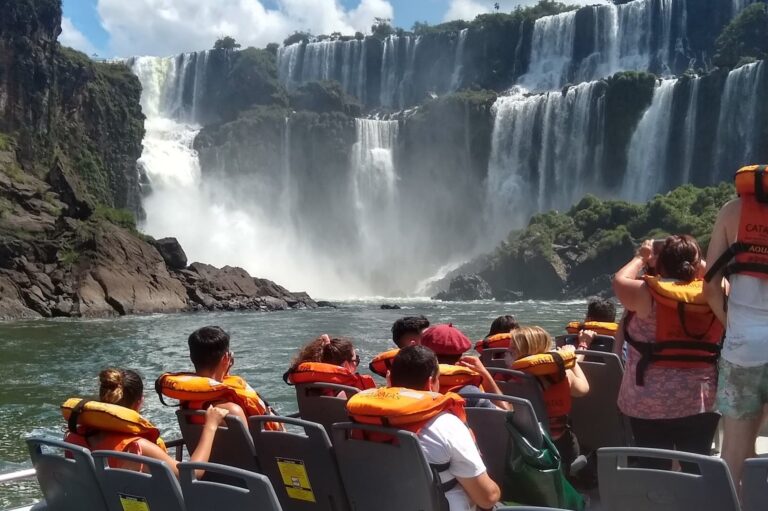
Experience the awe of Iguazu Falls on a 3-day tour from Buenos Aires. Book now for an unforgettable adventure!
From Price: USD190
By the late nineteenth and early twentieth centuries, interest in Iguazu was increasing.
Travellers had to navigate the Paraná and Iguazu river systems and continue through difficult terrain. There were few roads, limited accommodation and no modern visitor infrastructure.
One of the figures associated with the development of access to the Argentine falls was Victoria Aguirre, a member of a prominent Argentine family.
After experiencing the difficulty of reaching the site, she contributed financially to the construction of a road connecting the settlement area with the waterfalls.
Her role is remembered in Puerto Iguazú, where a principal avenue and the national park administration’s address bear her name.
This early road was important because conservation and tourism were closely linked from the beginning. Governments were more likely to protect the area if people could reach it, understand its value and generate economic activity through responsible visitation.

Experience the wonder of Iguazu Falls on a private 2 day tour from Buenos Aires. Easily reserve accommodations and optional activities. Book now!
From Price: USD150
The decisive early figure in the Argentine conservation story was Carlos Thays.
Born in France and later becoming one of Argentina’s most influential landscape architects, Thays designed parks, plazas and botanical spaces across the country. His interest extended beyond urban landscaping to the conservation of natural environments.
In 1902, the Argentine government sent Thays to study the Iguazu Falls area.
His mission involved mapping the waterfalls and considering how visitors could access and experience them.
Thays did not see the falls merely as an isolated scenic object. He understood that the surrounding forest was fundamental to the landscape.
Following his investigation, Thays designed a project for a national park of approximately 25,000 hectares.
The proposal combined:
This was a forward-looking idea at a time when Argentina did not yet possess a fully developed national park system.
The Argentine National Parks Administration identifies Thays’s 1902 study as one of the foundational moments in the country’s protected-area history.
Thays’s proposal did not immediately create a park, but it influenced later government decisions.
In 1909, Argentina reserved national lands surrounding the falls, following the recommendations made by Thays.
This was a crucial legal step. It reduced the possibility that the entire area would be transferred into private hands or developed without a conservation plan.
In 1912, Thays submitted another extensive report to the national government.
His continued advocacy demonstrates that the park was not created through a single expedition. More than three decades separated his original visit from the final national park law.
In 1928, the Argentine government purchased approximately 75,000 hectares intended for the creation of a national park around the falls and a military colony in northwestern Misiones.
By then, protection had moved beyond theoretical planning. The state was acquiring the territory needed to establish a permanent public reserve.
The legal creation of the Argentine national park finally took place in 1934.
On September 29, 1934, during the presidency of Agustín P. Justo, Argentina enacted Law No. 12,103.
The legislation created:
This law gave Argentina an organized national institution responsible for protected areas and tourism development.
The area combined several qualities considered essential to an early national park:
Iguazú and Nahuel Huapi represented two dramatically different versions of Argentina: the subtropical rainforest in the northeast and the Andean lakes and mountains of Patagonia.
The process had taken more than 30 years:
The park’s official history confirms its creation in 1934 and its current role in protecting Argentina’s most biodiverse national park landscape.
One single amazing destination, three different countries!
The creation of the park also influenced the development of the nearby settlement.
In 1939, architects and planners Ángel Guido, Alejandro Bustillo and other professionals associated with the national park era contributed to plans for what was then known as Puerto Aguirre.
The town was later renamed Puerto Iguazú.
Argentina’s early national park administration used architecture to express a national identity connected with landscape and tourism.
Administrative buildings, hotels, roads and public spaces were planned not only as services but as parts of a broader visitor experience.
The national park became an institution that shaped both the protected forest and the gateway town.
The early administration believed tourism could help justify and finance conservation.
The basic idea was that visitors who experienced the falls would understand why they deserved protection.
This relationship between tourism and conservation remains central today, although modern visitation must be managed carefully to prevent overcrowding, wildlife disturbance and damage to sensitive environments.
On the Brazilian side, the idea of protecting Iguaçu also emerged before the federal park was created.
In 1876, Brazilian engineer and abolitionist André Rebouças proposed creating national parks to protect Iguaçu Falls and Sete Quedas on the Paraná River.
This was an extraordinarily early conservation proposal. Yellowstone National Park in the United States had been established only four years earlier, in 1872.
Rebouças understood that exceptional landscapes should be preserved for public benefit rather than controlled entirely for private exploitation.
His proposal did not immediately lead to a national park, but it established an important intellectual precedent.

Enjoy a full day tour to the amazing Mocona Falls.
From Price: USD355
The most celebrated figure in the Brazilian park’s creation story is aviation pioneer Alberto Santos Dumont.
Santos Dumont visited Iguaçu Falls in 1916.
He was reportedly surprised to learn that the land providing access to the falls was privately owned. He believed such an extraordinary natural site should belong to the public and receive government protection.
After leaving the area, Santos Dumont promised to discuss the situation with the leadership of Paraná.
His national prestige helped bring political attention to the waterfalls.
Only a few months after his visit, the state of Paraná issued Decree No. 653 on July 28, 1916.
The decree declared the area to be of public utility so that a settlement and park could be established.
The Brazilian park’s official history directly connects Santos Dumont’s visit with this political development.
Not by himself.
André Rebouças had proposed protection decades earlier, and government institutions ultimately performed the legal and administrative work. Nevertheless, Santos Dumont’s public intervention became a decisive catalyst.
His role remains commemorated near the Brazilian visitor area.
State-level protection in 1916 did not immediately produce the large federal national park known today.
That occurred more than two decades later.
On January 10, 1939, Brazilian president Getúlio Vargas signed Federal Decree No. 1,035, formally creating Iguaçu National Park.
It became Brazil’s second national park, following Itatiaia National Park, created in 1937.
The park was established to protect:
The Brazilian park’s boundaries evolved after its initial creation.
Additional land was incorporated, creating a much larger conservation area extending far beyond the immediate waterfall viewpoints.
This broader protection was essential. Preserving only a narrow strip beside the falls would not have protected the watershed, wildlife populations or forest processes on which the landscape depends.
A smart, great-value way to see Iguazu Falls in two nights. Stay at a confirmed 3-star hotel, join shared group tours to both the Brazilian and Argentine sides, and enjoy shared transfers from and to IGR or IGU.
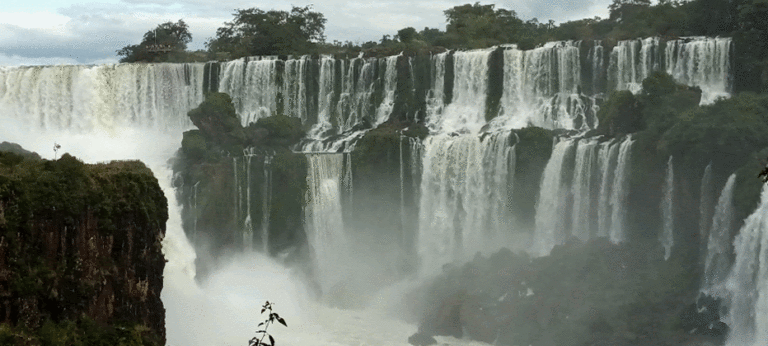
Early visitors were naturally focused on the waterfalls. Modern conservation science demonstrates that the surrounding forest is inseparable from them.
Forest vegetation slows runoff, protects soil and influences water quality. Clearing the land surrounding rivers increases erosion and sediment.
The park shelters animals requiring large territories, including jaguars, pumas, tapirs and peccaries.
A viewpoint-sized reserve could never support these species.
Birds, mammals and insects pollinate flowers and disperse seeds. Streams, soils and fungi support forest regeneration.
The falls are the most visible feature, but the park protects an entire ecological system.
Much of the original Upper Paraná Atlantic Forest outside protected areas was cleared or fragmented by:
As the surrounding landscape changed, the two parks became increasingly important as biological refuges.

Enhance your visit to Iguaçu National Park in Brazil and experience a breathtaking sunset at Iguazu Falls with a delightful drink in hand.
From Price: USD139
After their creation, both countries began constructing the infrastructure needed to manage visitors and protect the parks.
This included:
Early tourism infrastructure sometimes placed visitors closer to sensitive places than modern conservation standards would allow.
Over time, park planning increasingly emphasized:
Both parks now use regulated service providers for elements of visitor operations.
Private participation may include transportation, food services, retail, excursions and infrastructure investment, while the national authorities remain responsible for conservation policy and park management.
Book Your Shore Excursion Through a Local Operator at a Much Lower Rate Than on the Ship!

The parks received international recognition during the 1980s.
UNESCO inscribed Iguazú National Park in Argentina on the World Heritage List in 1984.
The organization recognized the park’s extraordinary scenery and biodiversity.
Iguaçu National Park in Brazil was added to the World Heritage List in 1986.
UNESCO noted its ecological continuity with the Argentine park and considered the possibility of viewing the two areas as a connected transboundary landscape.
The parks remain separately listed World Heritage properties, but UNESCO treats their conservation as closely related.
Together they protect one of the most significant surviving remnants of the Interior Atlantic Forest.
World Heritage recognition does not transfer ownership or management to UNESCO. Each country remains responsible for its park.
The designation does:
A World Heritage site is understood to possess value extending beyond national borders.

A wonderful adventure activity including kayak and trekking
From Price: USD69
Declaring an area a national park does not permanently solve every conservation problem.
Both parks continue to face pressures.
Illegal hunting can reduce populations of prey species and large mammals.
When animals such as peccaries decline, predators also suffer.
Valuable timber, orchids, bromeliads and Juçara palms may be targeted.
Roads fragment habitats and expose animals to vehicle traffic.
Urban growth, agriculture and tourism infrastructure can increase pressure along park boundaries.
Changes in river flow upstream can affect aquatic ecosystems and the visual character of the falls.
Non-native plants and animals can alter ecological relationships.
Changing rainfall, extreme floods, droughts and higher temperatures may affect both forest and river systems.
Tourism generates support and economic value but must be managed to prevent waste, congestion, trail damage and wildlife disturbance.
One of the Brazilian park’s most persistent conservation controversies has involved the former Colono Road, known as Estrada do Colono.
The road crossed the protected forest and created a connection between communities on opposite sides of the park.
An open road through the forest could:
The road was ultimately closed, although political proposals to reopen or redefine it have continued to generate debate.
The controversy demonstrates that national park boundaries do not end conflicts between local transportation needs and conservation.
Legal protection becomes meaningful only when people implement it.
Park rangers perform responsibilities that may include:
The enormous size and forested terrain of the parks make this work challenging.
One single amazing destination, three different countries!
The national parks provide protected environments where scientists can study long-term ecological processes.
Research topics include:
Without protected areas, long-term research would be disrupted by land-use changes and habitat loss.
Argentina and Brazil manage their parks through different institutions:
Despite separate legal systems, ecological cooperation is essential.
A jaguar may cross the international boundary without knowing it has entered another country.
Conservation therefore requires communication concerning:
The protected parks form an essential core, but long-term biodiversity conservation also depends on forest connections beyond their borders and across Paraguay.
Isolated parks can become ecological islands if animals and plants cannot move between forest areas.

Enjoy a city tour in Puerto Iguazu, to visit differnt areas and views of the river, and the famous triple frontier landmark
From Price: USD75
The creation of the parks transformed Iguazu from a remote scenic location into a protected international destination.
Land that might otherwise have been logged, subdivided or privately developed became subject to conservation rules.
Paths, roads and visitor services were planned under government supervision.
Puerto Iguazú and Foz do Iguaçu grew as tourism centres serving national and international visitors.
Researchers gained access to large protected forest areas.
Both Argentina and Brazil incorporated Iguazu into their national identities and international tourism images.
UNESCO recognition placed the parks within a global system of heritage monitoring.
Brazilian engineer André Rebouças proposed protecting Iguaçu Falls and Sete Quedas through national parks.
Argentina sent landscape architect Carlos Thays to survey the falls and develop a national park proposal.
Argentina legally reserved lands surrounding Iguazu Falls.
Carlos Thays submitted a further detailed report supporting the park project.
Santos Dumont visited the Brazilian falls and advocated public protection. Paraná declared the area of public utility for a settlement and park.
Argentina purchased approximately 75,000 hectares for a future national park and military colony.
Argentina created Iguazú National Park through Law No. 12,103.
Brazil created Iguaçu National Park through Federal Decree No. 1,035.
UNESCO inscribed Argentina’s Iguazú National Park on the World Heritage List.
UNESCO inscribed Brazil’s Iguaçu National Park on the World Heritage List.
A wonderful 5-night program to visit Iguazu Falls and spend three nights in El Soberbio Lodge, to visit the amazing Mocona Falls
Argentina created Iguazú National Park in 1934. Brazil created Iguaçu National Park in 1939.
No single person created it. Carlos Thays played a central role in Argentina, while André Rebouças and Santos Dumont were important advocates in Brazil. The parks were legally created by their respective national governments.
No. He visited the area in 1916 and was surprised that access was located on private property. He used his influence to advocate public protection.
In 1902, Thays surveyed the Argentine falls and designed an early national park project that combined conservation and public visitation.
Argentina’s park was created first, in 1934. Brazil followed in 1939.
They are two separately inscribed World Heritage properties. Argentina’s park was listed in 1984 and Brazil’s in 1986, but UNESCO recognizes their ecological continuity.
The Brazilian park extends across a large forest landscape beyond the public waterfall area. Its boundaries were developed to protect an extensive Atlantic Forest ecosystem.
Yes. Mbyá Guaraní communities live in the broader Iguazu region, maintaining cultural traditions connected with the forest.
Yes. Legal status provides essential protection, but enforcement, research, funding and cooperation remain necessary.
Iguazu Falls became a national park because generations of people gradually understood that a landscape of such scale should not be treated as an ordinary piece of land.
In Argentina, Carlos Thays transformed an early government survey into a vision for conservation and public tourism. Land reservations and purchases eventually led to the creation of Iguazú National Park in 1934.
In Brazil, André Rebouças proposed protection as early as 1876, while Santos Dumont’s influential visit in 1916 accelerated the political process that ultimately produced Iguaçu National Park in 1939.
The story did not end when the decrees were signed. The parks had to be built, staffed, expanded and defended. Tourism infrastructure evolved, scientific research grew and UNESCO recognized both sides as part of the world’s natural heritage.
Most importantly, the meaning of protection expanded. The parks were not created only to preserve a beautiful view. They now protect rivers, giant trees, orchids, jaguars, birds, Indigenous cultural connections and one of the last great remnants of the Upper Paraná Atlantic Forest.
The waterfalls inspired the parks—but the forest is what made their protection complete.
Experience the wonder of Iguazu Falls on a private 2 day tour from Buenos Aires. Easily reserve accommodations and optional activities. Book now!
From Price: USD150
Experience the awe of Iguazu Falls on a 3-day tour from Buenos Aires. Book now for an unforgettable adventure!
From Price: USD190
