
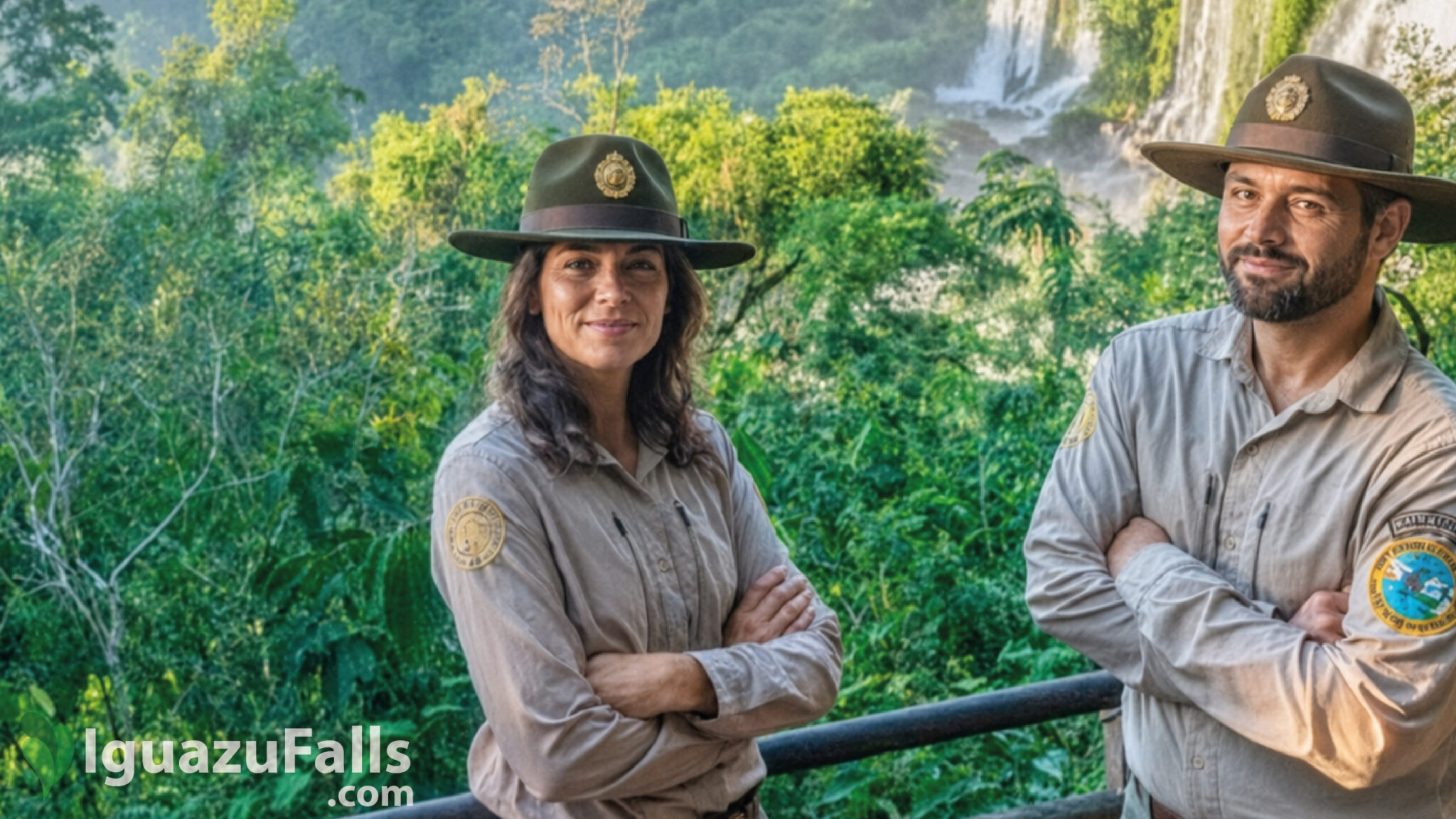
Protecting Iguazu Falls involves much more than caring for the famous waterfalls. The falls are surrounded by two vast national parks containing rivers, forest, wetlands and hundreds of animal species.
On the Argentine side, Iguazú National Park is managed by Argentina’s National Parks Administration. Across the river, Iguaçu National Park is managed by Brazil’s Chico Mendes Institute for Biodiversity Conservation, commonly known as ICMBio.
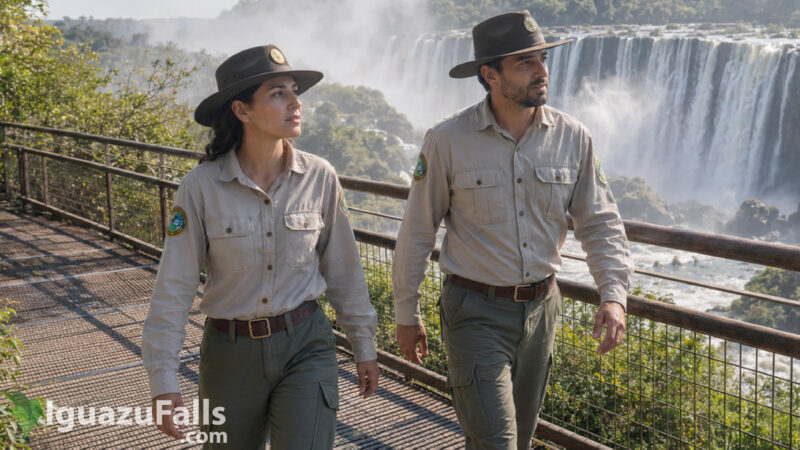
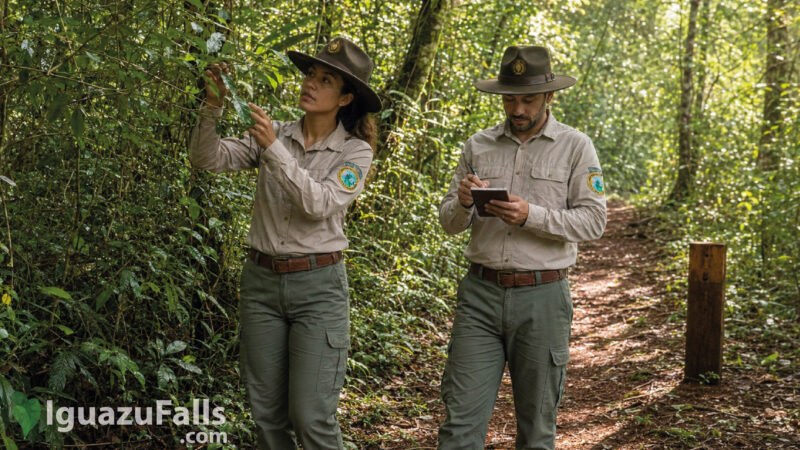
Park rangers and specialized conservation teams patrol these protected areas, monitor wildlife, prevent illegal activities, respond to fires, assist researchers and keep visitors safe. Much of this work takes place far beyond the public walkways, in remote parts of the Atlantic Forest rarely seen by tourists.
Iguazu Falls is protected by two neighboring national parks:
Although the waterfalls form one continuous natural system, each country manages its own park under national legislation.
Argentina’s park rangers are known as guardaparques nacionales. They are trained conservation officers working for the Administración de Parques Nacionales.
Their official responsibilities include surveillance, environmental protection, visitor assistance, collaboration with local communities, support for scientific research, environmental education and wildfire prevention.
Experience Argentina’s Icons with Comfort and Style

Brazil’s Iguaçu National Park is administered by ICMBio, a federal institution responsible for managing protected areas and conserving biodiversity.
Protection work involves environmental officers, park managers, researchers, firefighters, educators and technical personnel. Some tourism services are operated by authorized concessionaires, but conservation policy and protected-area management remain under government supervision.
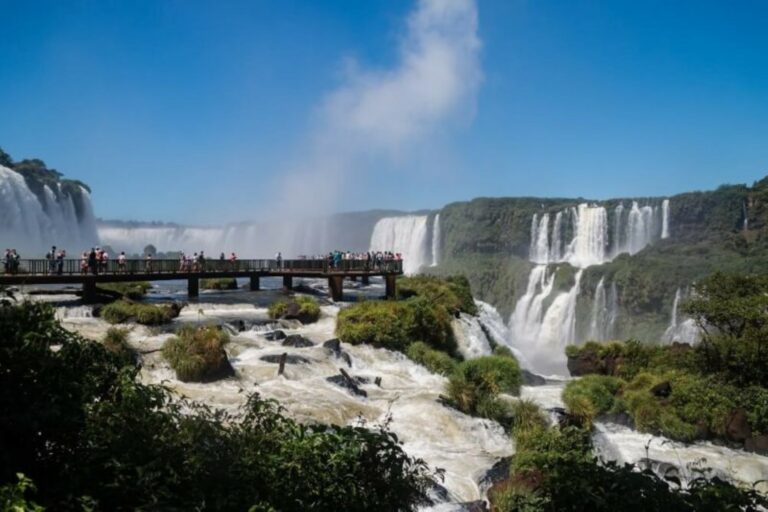
Most visitors experience only a small portion of the national parks. They see observation platforms, trains, buses, restaurants and marked trails near the cascades.
The protected forest extends far beyond those public areas.
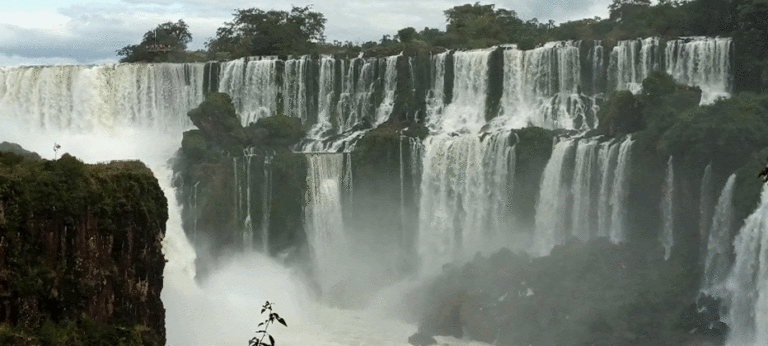
The forest surrounding Iguazu Falls belongs to the Upper Paraná Atlantic Forest, one of the most biologically diverse and threatened ecosystems in South America.
It provides habitat for animals such as:
Rangers help protect not only individual animals but also the ecological relationships that allow the entire forest to survive.

Experience the wonder of Iguazu Falls on a private 2 day tour from Buenos Aires. Easily reserve accommodations and optional activities. Book now!
From Price: USD150
Regular patrols are among the most important elements of ranger work.
Teams travel along roads, forest tracks, rivers and remote boundaries to detect illegal activities and environmental damage.
Patrol teams may search for evidence of:
Patrols may be conducted on foot, in vehicles or by boat, depending on the location and terrain.
Large sections of the parks are difficult to access. Dense vegetation, muddy tracks, high temperatures and heavy rain can make patrol work physically demanding.
Internal service roads and trails must be maintained so rangers can reach sensitive areas quickly. Argentina’s National Parks Administration has explained that internal roads are essential for surveillance, anti-poaching work and scientific research.
Poaching can have serious consequences even when only a limited number of animals are killed.
Large mammals reproduce slowly. Removing a jaguar, tapir or other important species can affect the ecological balance of a wide area.
Rangers look for tracks, camps, cartridges, traps, recently cut vegetation and unauthorized trails. They may also use information from local communities, camera traps and other government agencies.
When illegal activity is discovered, park authorities can document evidence, confiscate prohibited equipment and involve environmental police or judicial authorities.
Many conservation threats begin outside the park.
Agriculture, roads, settlements and other land uses surround parts of the protected forest. Rangers therefore monitor not only the interior but also boundary zones and ecological corridors.
On the Brazilian side, satellite images have been used in cooperation with the Federal Police and environmental authorities to identify possible forest clearing near Iguaçu National Park. These images help teams decide where field inspections are required.
One single amazing destination, three different countries!
The jaguar is one of the most important symbols of Iguazu conservation. As the forest’s largest native predator, it requires extensive territory and healthy populations of prey.
Protecting jaguars consequently helps protect many other species sharing the same habitat.
Camera traps are automatic cameras activated by movement. Teams position them along animal trails and in other strategic locations.
The cameras allow conservationists to:
On the Brazilian side, the Onças do Iguaçu project combines periodic population surveys with continuous camera-trap monitoring.
Argentina has also used camera traps inside Iguazú National Park to document mammals and understand how animals use different parts of the protected area. One survey involving 15 cameras produced more than 430 wildlife records.
DISCOVER A WONDERFUL PLACE TO ENJOY BIRDWATCHING. BE READY WITH YOUR BINOCULARS.

The pattern of spots on a jaguar is unique, much like a human fingerprint. Researchers can compare photographs and recognize individual animals.
This makes it possible to determine whether a jaguar is new to the area, returning to a familiar territory or moving between Argentina and Brazil.
If a jaguar appears near a visitor area, road or community, rangers and wildlife specialists assess the situation.
Their objective is to protect both the animal and the public. Responses may include:
A jaguar sighting does not automatically mean that the animal is aggressive. Jaguars generally avoid people, but every encounter must be managed carefully.
The Iguazu region receives abundant rainfall, but the Atlantic Forest can still experience dangerous fires during dry periods.
Drought, high temperatures, lightning, agricultural burning and human negligence can all increase fire risk.
Before a fire occurs, protection teams may:
Brazil’s ICMBio has trained specialized firefighters to work in fire prevention and suppression inside Iguaçu National Park. Training includes both theoretical instruction and practical field exercises.
When smoke or flames are detected, teams must evaluate:
Not every fire can be approached directly. Safety, terrain and weather determine the appropriate strategy.

Enhance your visit to Iguaçu National Park in Brazil and experience a breathtaking sunset at Iguazu Falls with a delightful drink in hand.
From Price: USD139
Rangers also play an important role in public safety.
Iguazu Falls is a powerful and constantly changing natural environment. River levels can rise rapidly following heavy rain across the watershed, even when conditions beside the falls initially appear normal.
Park authorities monitor water levels, weather reports and the condition of walkways.
When river flow becomes dangerous, they may:
Temporary closures can be disappointing, but they protect visitors and allow infrastructure to be evaluated safely.
Rangers and maintenance teams check visitor infrastructure for problems such as:
The walkways place visitors remarkably close to an enormous volume of moving water. Continuous inspection is therefore essential.
Rangers may assist with:
Not every emergency is handled by a ranger alone. Responses may involve firefighters, medical personnel, police, guides and park concession employees.
From Bustling City to Majestic Natural Wonders: Buenos Aires, El Calafate & Iguazu Falls in 9 Nights

The animals most frequently seen by visitors are not necessarily the largest or rarest. Coatis and capuchin monkeys often attract attention because they can appear near busy areas.
When tourists feed wild animals, the animals may begin associating people with food.
This can cause them to:
Rangers enforce rules against feeding and disturbing wildlife. They also explain why apparently harmless interactions can produce long-term damage.
If animals repeatedly appear near restaurants, bins or walkways, park teams may improve waste containers, change barriers, monitor the animals or temporarily control access.
The goal is not to remove every visible animal. It is to maintain a safe relationship between wildlife and visitors.
A smart, great-value way to see Iguazu Falls in two nights. Stay at a confirmed 3-star hotel, join shared group tours to both the Brazilian and Argentine sides, and enjoy shared transfers from and to IGR or IGU.
Rangers possess detailed knowledge of the landscape. They often know where animals travel, which areas flood, when certain plants flower and where illegal activity has previously occurred.
This local knowledge is extremely valuable to researchers.
Rangers may:
Scientists then use this information to study wildlife populations, vegetation, water quality, invasive species and the effects of climate change.
A single wildlife observation offers limited information. Repeated surveys over many years can reveal whether populations are growing, declining or moving into different areas.
Long-term monitoring helps park managers decide where patrols, habitat restoration and visitor restrictions are most necessary.
Not every plant or animal found in the region belongs naturally to the Atlantic Forest.
Invasive species can spread rapidly and compete with native wildlife. They may alter vegetation, damage soil or introduce diseases.
Rangers and technical teams help detect invasive organisms before they become impossible to control.
Their work can include:
Conservation depends on more than enforcement. Visitors and local communities must understand why the parks exist and how their actions affect the forest.
Rangers answer questions, interpret natural features and explain park regulations.
They help visitors understand why they should:
Environmental education programs introduce children to native wildlife, forest ecology, water conservation and the role of protected areas.
These activities can create a lasting connection between local communities and the national parks. Children who understand the importance of the forest are more likely to support its protection as adults.
One single amazing destination, three different countries!
National parks do not exist separately from the people living around them.
Rangers and park managers interact with local residents, tourism workers, farmers and Indigenous communities. These relationships can help identify environmental threats and develop conservation practices that also consider local knowledge and needs.
Community collaboration may involve:
Successful protection depends on trust as well as enforcement.

Enjoy a full day tour to the amazing Mocona Falls.
From Price: USD355
The Iguazu River forms an international border, but wildlife moves naturally between both countries.
A jaguar may be photographed in Brazil and later appear in Argentina. Birds fly across the river, fish move through connected waterways and fires or pollution can affect more than one jurisdiction.
Cooperation may include:
The IUCN’s World Heritage assessment has recognized cross-border patrols and ecological monitoring as important elements of conservation in the Iguazu region. IUCN World Heritage Outlook
The Argentine and Brazilian parks have separate administrations, laws and visitor systems. Ecologically, however, they protect the same forest and river landscape.
Cooperation is therefore essential for managing species that require territories extending beyond political borders.
Modern conservation increasingly combines traditional fieldwork with technology.
Tools may include:
Technology does not replace rangers. It helps them decide where to focus limited time and resources.
A satellite image may identify suspicious forest clearing, but trained personnel must interpret the information, inspect the location and document what happened.
Unveiling the Wonders of Argentina: Explore Buenos Aires and Iguazu Falls on a 6-Night Journey

Protecting Iguazu is complicated because the parks must accommodate conservation, tourism and neighboring human activity.
Major challenges include:
Most of the forest cannot be constantly observed. Rangers must prioritize sensitive boundaries, wildlife corridors and locations with a history of illegal activity.
Large numbers of visitors create pressure on trails, transportation, waste systems and wildlife behavior.
Changes in rainfall, temperature and extreme weather can influence fires, floods, vegetation and animal movements.
Outside the parks, agriculture, roads and urban development can isolate wildlife populations and reduce ecological corridors.
Jaguars and other predators sometimes move near farms or communities, creating concern about livestock and public safety.
Conservation teams must distribute personnel, vehicles, equipment and budgets across large and complex areas.
Every visitor can contribute to conservation.
Respect trail closures, warning signs and ranger directions, even when the reason is not immediately visible.
Feeding coatis, monkeys or birds creates serious behavioral and safety problems.
Leaving authorized routes can damage vegetation, disturb wildlife and place visitors in dangerous areas.
Use designated bins and avoid leaving food residue that could attract animals.
Inform park staff if you see:
Do not attempt to intervene personally in a dangerous situation.
Use authorized guides and operators that follow national park regulations.

Enjoy a city tour in Puerto Iguazu, to visit differnt areas and views of the river, and the famous triple frontier landmark
From Price: USD75
Yes. Argentina and Brazil have their own park authorities and conservation personnel.
Some authorized officers involved in law enforcement and anti-poaching operations may carry appropriate equipment according to national regulations. However, many ranger duties involve education, visitor assistance, monitoring and research support.
They may assist with wildlife emergencies, but specialized veterinarians and biologists are often involved. The best response depends on the species and situation.
Park authorities can restrict or close circuits when floods, storms, structural damage or other risks make access unsafe.
Yes. Feeding and disturbing wildlife violates park regulations and can endanger both animals and visitors.
Conservation teams use camera traps, field signs, scientific surveys and the unique spot patterns of individual jaguars to estimate populations.
The parks have separate administrations, but cross-border communication, ecological monitoring and conservation cooperation are important because both sides belong to the same ecosystem.
Without rangers and the wider conservation teams supporting them, Iguazu Falls would still be visually spectacular—but the surrounding ecosystem could gradually lose the wildlife, forest and ecological balance that make the destination truly extraordinary.
Their work prevents poaching, reduces fire risk, protects visitors, supports science and teaches future generations why the Atlantic Forest matters.
Much of that work happens quietly and far from the viewpoints photographed by tourists. Every safe trail, protected jaguar, restored habitat and responsible wildlife encounter is part of a much larger effort.
The waterfalls may be the most visible symbol of Iguazu, but the rangers protect the complete living landscape around them.
Enjoy a full day tour to the amazing Mocona Falls.
From Price: USD355
Experience the awe of Iguazu Falls on a 3-day tour from Buenos Aires. Book now for an unforgettable adventure!
From Price: USD150
