
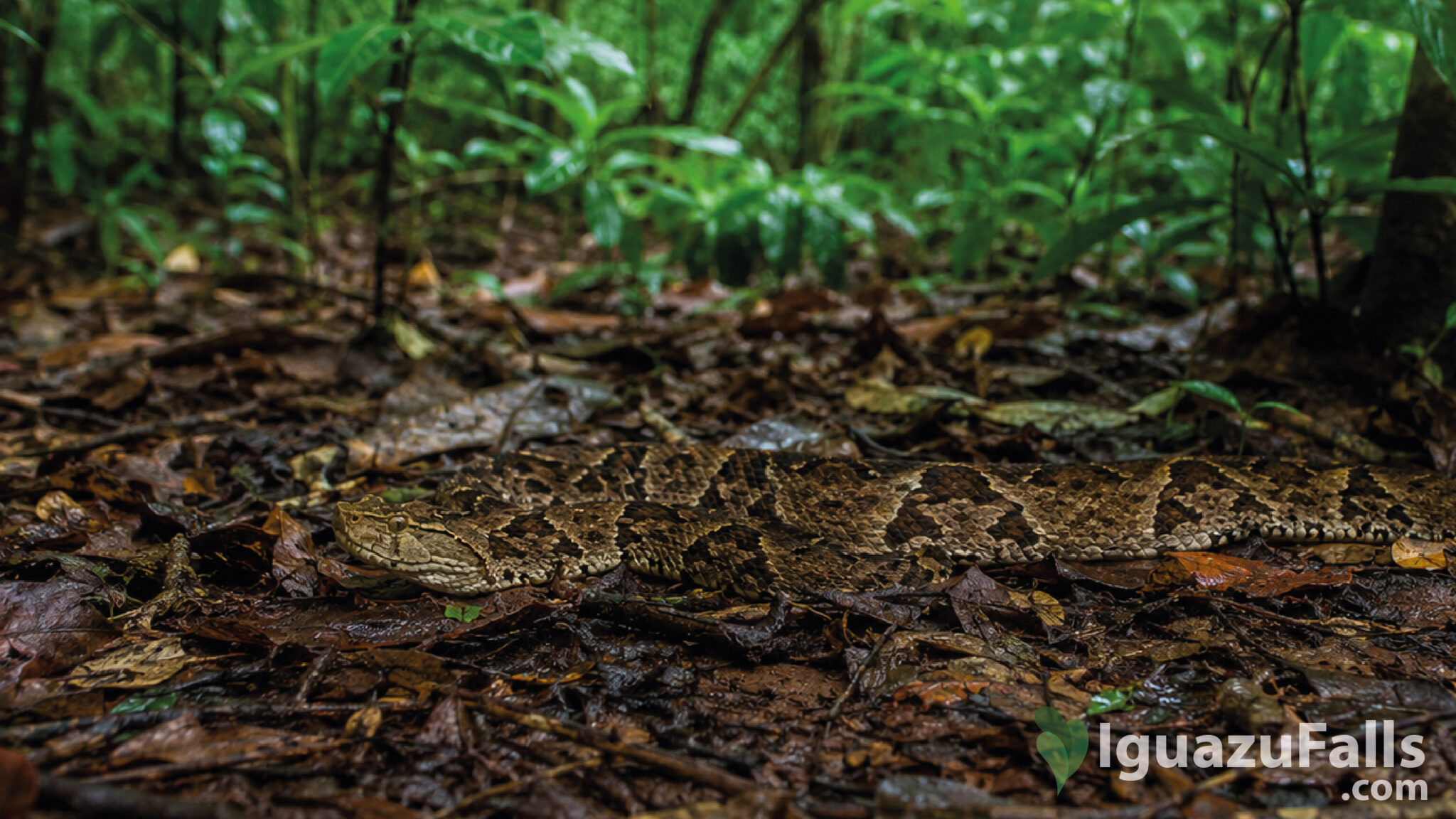
The rainforest surrounding Iguazu Falls is one of the most biologically diverse environments in South America. Alongside toucans, coatis, monkeys and butterflies, it supports an impressive variety of reptiles—including many species of snakes.
For some visitors, this is fascinating. For others, simply knowing that snakes live in the forest can create anxiety. The reassuring fact is that encounters along the main tourist circuits are uncommon, and bites involving visitors are extremely rare.
Most snakes avoid humans and move away when they detect footsteps or activity. They are an important part of the Atlantic Forest ecosystem and should be observed calmly, from a safe distance and without interference.
Yes. Snakes live throughout the Atlantic Forest on both the Argentine and Brazilian sides of Iguazu Falls.
The subtropical environment provides the conditions they need: warm temperatures, abundant vegetation, rivers, streams and a varied supply of prey. Different species occupy the forest floor, tree branches, wet areas and underground shelters.
However, the presence of snakes in the rainforest does not mean visitors commonly encounter them.
The principal circuits in Iguazú National Park and Iguaçu National Park are busy, maintained and used by thousands of people. Noise, movement and vibration generally encourage snakes to remain away from heavily visited areas.
Visitors who stay on the official walkways may spend an entire day in the park without seeing a single snake.
Experience Argentina’s Icons with Comfort and Style

The broader Atlantic Forest and Paraná River region has exceptional reptile diversity. A 2025 scientific survey of western Paraná, the Brazilian region that includes Foz do Iguaçu, recorded 47 snake species. The study reported 33 reptile species within the municipality of Foz do Iguaçu itself, although this number includes reptiles other than snakes and does not mean all are found beside the tourist walkways.
On the Argentine side, Misiones contains the country’s greatest concentration of snake diversity. According to researchers from Argentina’s CONICET, the Misiones rainforest supports dozens of snake species, most of which are harmless to humans or unable to inject medically significant venom.
The exact number attributed specifically to the visitor area can vary according to taxonomy, survey methods and geographical boundaries.
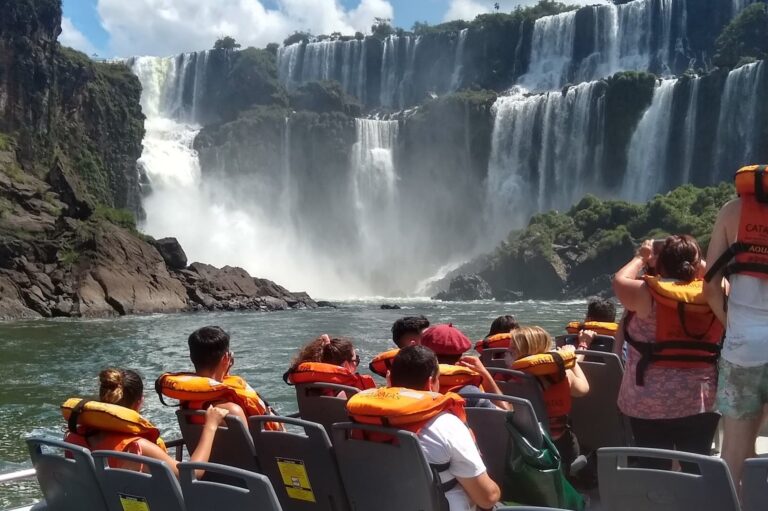
Experience the awe of Iguazu Falls on a 3-day tour from Buenos Aires. Book now for an unforgettable adventure!
From Price: USD150
The Iguazu rainforest contains terrestrial, arboreal, aquatic and underground species. Some are active during the day, while others emerge primarily at night.
Many are small, secretive and rarely noticed by visitors.
The name yarará is used in Argentina for several snakes belonging to the genus Bothrops. In Brazil, related species are generally known as jararacas.
These are venomous snakes and are responsible for many medically significant snakebites in South America. Species of the group occur in the forest environments of Misiones and Paraná.
Depending on the species and age of the individual, a yarará may display brown, grey or olive colouring with darker geometric or triangular markings. This pattern provides excellent camouflage among leaves and branches on the forest floor.
Yararás do not hunt people. Most defensive bites occur when a snake is stepped on, touched, cornered or handled.
The jararacussu is a large, heavy-bodied member of the Bothrops group associated with humid forests in southeastern South America.
Its pattern consists of dark shapes over a lighter background, helping it disappear among fallen leaves. The species has medically important venom and should never be approached.
Despite its intimidating appearance, the jararacussu usually remains motionless or attempts to escape when given enough space.
True coral snakes belong to the genus Micrurus. They are recognized for their contrasting rings, typically combining red, black and pale colours.
These venomous snakes have powerful neurotoxic venom, but they are generally secretive, spend considerable time beneath leaves or underground and are not aggressive towards people. Encounters are unusual, and bites are rare.
Colour patterns should never be used by an untrained visitor to decide whether a coral snake is dangerous. South America has several true and false coral species with patterns that can be difficult to distinguish.
The popular colour rhymes used in North America are unreliable for South American snakes.
Several harmless or less medically significant species imitate the colours of true coral snakes. This resemblance may discourage predators.
False coral snakes demonstrate why visitors should never attempt to identify or handle a snake based on appearance alone. Even specialists sometimes require close examination and detailed knowledge to distinguish similar species.
The safest response to any red, black and pale-banded snake is simply to keep a generous distance.
Experience the awe of Iguazu Falls on a 3-day tour from Buenos Aires. Book now for an unforgettable adventure!
From Price: USD150
The mussurana is a mainly dark-coloured snake known for preying on other snakes, including venomous species.
Although some mussuranas possess rear fangs and venom adapted to subduing prey, they are not generally considered a major danger to humans. They are secretive and play a valuable role in regulating other snake populations.
Known locally by names such as caninana, the tiger rat snake is a large, slender and active species. Its dramatic black and yellow pattern can make it appear threatening, but it is not considered dangerously venomous to humans.
Caninanas are excellent climbers and may be found on the ground or in trees. They feed on rodents, birds and other small animals.
When threatened, they may raise the front of the body or move quickly, but their normal preference is to escape.
The false water cobra is a large South American snake usually associated with wetlands and river environments. When threatened, it can flatten its neck in a way that resembles a cobra, although it is not a true cobra.
It has rear-positioned fangs and venom used to capture prey. Human bites require medical evaluation, but the species does not normally seek confrontation.
Visitors should never attempt to touch or move one.
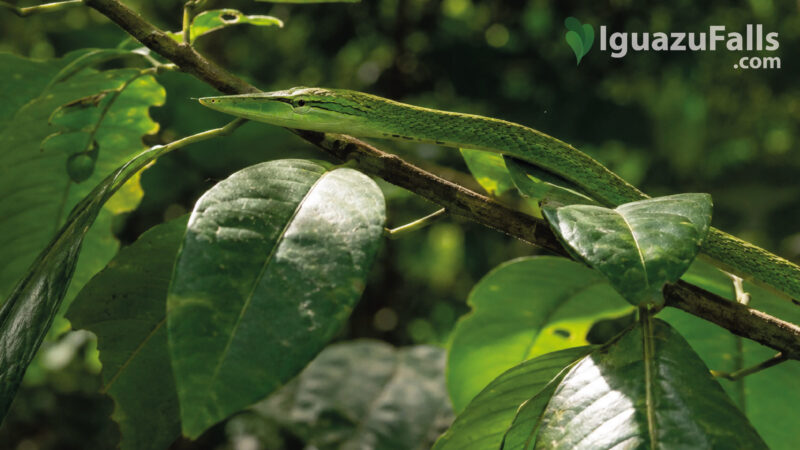
The Iguazu forest is also home to slender species that live or hunt in vegetation. Their green or brown colouring makes them exceptionally difficult to detect among branches and leaves.
These snakes feed primarily on frogs, lizards and small animals. Most present little or no danger to visitors when left undisturbed.
The Iguazu and Paraná river systems, along with smaller streams and wetlands, support snakes adapted to aquatic or semi-aquatic habitats.
They may feed on fish, amphibians and other animals found near water. Visitors should avoid entering unauthorized riverbanks or dense vegetation, not only because of snakes but also because of unstable ground, currents and other wildlife.
Visit Three Beautiful Destinations in 9 Nights

The word anaconda often appears in stories about South American rainforests, but visitors should not imagine enormous green anacondas waiting beside the park walkways.
Green anacondas are primarily associated with major tropical wetlands and river basins farther north. The Iguazu region is a different ecosystem from the Amazon and Pantanal.
Yellow anacondas have a broader distribution in southern South America and may occur in suitable wetland environments within the wider region. However, they are not a normal feature of the main waterfall circuits, and a visitor is extremely unlikely to see one during a standard national park visit.
Boa species occur in different parts of South America, including regions of Argentina and Brazil. Their precise local distribution depends on habitat and species.
Boas are nonvenomous constrictors. They kill prey by wrapping around it rather than injecting venom.
Even a nonvenomous snake should not be approached or handled. Large individuals are powerful wild animals and may bite defensively if cornered.
A small proportion of the region’s snakes possess venom of medical importance. That makes awareness appropriate, but fear unnecessary.
The majority of snakes are harmless or pose little danger when left alone. Even venomous species generally bite only as a defensive response.
The risk to a tourist on an official park circuit is very low because:
Risk increases when people leave marked trails, walk through tall grass, place their hands into holes or vegetation, attempt to capture wildlife or hike in uncontrolled areas at night.

Go biking to the amazing Iguazu Falls National Park Brazilian Side ,enjoying the nature, the animals, the flora.
From Price: USD35
Snake activity depends on species, temperature, humidity, rainfall and prey availability.
As reptiles, snakes rely on external heat to regulate body temperature. Activity generally increases during warmer periods, although extreme midday heat may cause them to seek shelter.
Rain can stimulate movement among frogs, insects and other prey. Snakes may also move after heavy rainfall if their normal shelters become flooded.
This does not mean that every rainy day produces snake encounters, only that environmental conditions influence their behaviour.
Many forest snakes are crepuscular or nocturnal. They may become more active when temperatures are comfortable and human activity decreases.
Visitors participating in authorized night activities should remain with their guide and use designated paths.
There is no simple “snake season” when encounters are guaranteed. Iguazu remains warm enough for reptile activity throughout much of the year, although activity usually decreases during cooler periods.

Experience a breathtaking night under the stars at Iguazu Falls, in a peaceful and exclusive setting inside the Brazilian side of the national park.
From Price: USD265
If a visitor does encounter a snake, it may be:
A snake on a warm surface may be regulating its body temperature. Do not force it to move.
Park staff should be notified if the animal is close to a busy visitor area.
The correct response is simple: stop, remain calm and give the animal space.
Do not move closer for a photograph. A zoom lens provides a better and safer image.
The appropriate distance depends on the situation, but several metres is a sensible minimum. Increase that distance if the snake changes posture or appears alert.
Do not block the direction in which the snake is moving. Most snakes will leave if they have a clear route.
Tell nearby people that a snake is present without shouting or causing panic. Keep children close and prevent anyone from approaching.
Notify a ranger, guide or other staff member, especially if the snake is on a walkway or near a station.
Staff can secure the area and decide whether professional intervention is necessary.
Do not use a stick, umbrella, branch or clothing to push the snake. Do not throw objects or spray it with water.
Many bites occur when someone attempts to capture, kill or manipulate an animal that would otherwise have moved away.
Experience the awe of Iguazu Falls on a 3-day tour from Buenos Aires. Book now for an unforgettable adventure!
From Price: USD150
Standard visitors do not need specialized snake equipment. A few sensible habits are sufficient.
Official trails exist for visitor safety and environmental protection. Do not enter tall grass, dense vegetation or closed areas.
Look ahead, particularly after rain or in quieter sections of a path. Avoid stepping directly over a log or rock when you cannot see the other side.
Do not place your hands under logs, inside tree hollows, between rocks or into dense plants.
Closed walking shoes provide better protection than flip-flops and improve stability on wet surfaces.
Special snake boots are unnecessary for the standard tourist circuits.
At accommodation surrounded by forest, illuminate paths before walking outdoors after dark. Do not walk barefoot around gardens, lodges or cabins.
Guests staying at jungle lodges should keep doors and screens closed. Shake out shoes or clothing left outdoors before using them.
On specialized forest walks, stay behind the guide and do not separate from the group.

A wonderful full day trip to visit the Iguazu Falls Brazilian Side, starting early in the morning with early entrance to see the sunrise!
From Price: USD139
Every snakebite should be treated as a medical emergency. Do not wait for symptoms to appear, even if the animal seems harmless.
Argentina’s official medical guidance explains that most snake species are nonvenomous but emphasizes that medically important species can cause serious poisoning. Early professional assessment is essential.
Prevent a second bite. Do not attempt to capture or kill the animal.
A photograph taken from a safe distance may help professionals, but it is not worth delaying medical attention or risking another injury.
Movement can accelerate the distribution of venom. Have the person rest and keep the affected limb as still as reasonably possible.
Remove rings, watches, bracelets or tight clothing before swelling develops.
Alert park staff immediately and arrange rapid transportation to an appropriate medical facility.
Antivenom must be administered by trained healthcare professionals when clinically indicated.
Do not:
Traditional snakebite remedies can worsen the injury and delay effective treatment.
Travel from Asunción to the Brazilian side of Iguazu Falls for an unforgettable full day experience.
From Price: USD425
No single visible characteristic reliably identifies every venomous snake.
The common idea that venomous snakes always have triangular heads is misleading. Some harmless species flatten their heads when threatened, while coral snakes do not have the broad head usually associated with vipers.
Other unreliable identification methods include:
Visitors should treat every unknown snake with caution and allow trained specialists to identify it.
Snakes are predators and prey, making them essential links in the forest food web.
Many species consume rats and mice. By controlling rodents, snakes indirectly protect vegetation and reduce animals that may carry diseases.
Aquatic and arboreal species help maintain balance among amphibians, lizards, fish and small birds.
Snakes form part of the diet of birds of prey, mammals and other snakes.
A diverse snake population reflects a forest containing multiple habitats, healthy prey populations and functioning ecological relationships.
The Iguazu rainforest would be less balanced without them.
Snakes are often killed because of fear or mistaken identification. This is a serious conservation problem because many harmless species resemble venomous ones.
Other threats include:
Protected areas such as the Argentine and Brazilian national parks provide essential habitat for snakes and thousands of other species.
A smart, great-value way to see Iguazu Falls in two nights. Stay at a confirmed 3-star hotel, join shared group tours to both the Brazilian and Argentine sides, and enjoy shared transfers from and to IGR or IGU.
Seeing a snake can be an exceptional wildlife experience, but the animal’s welfare and visitor safety must come first.
For responsible photography:
A natural photograph taken from a respectful distance is more valuable than a close-up created by disturbing the animal.
A smart, great-value way to see Iguazu Falls in two nights. Stay at a confirmed 3-star hotel, join shared group tours to both the Brazilian and Argentine sides, and enjoy shared transfers from and to IGR or IGU.
No. Although many species inhabit the rainforest, most visitors do not see one during a standard visit to the waterfalls.
Yes. The region includes medically important groups such as Bothrops lanceheads and true coral snakes. Encounters and bites involving tourists are nevertheless very uncommon.
It is possible in properties surrounded by forest, but well-maintained lodges use screens, sealed rooms and vegetation management to reduce the risk. Keep doors closed and notify staff if an animal is found.
Some species are excellent climbers, while others live mainly on the ground or near water. Visitors should avoid touching branches or dense vegetation unnecessarily.
The forest supports some relatively large species, but sensational stories about enormous snakes beside the visitor walkways are unrealistic. Anacondas are not a normal attraction of the waterfall circuits.
No. Commercial snake repellents are generally unnecessary and should not be applied inside a protected natural area. Staying on marked routes and following park rules are the most effective precautions.
Yes. Keep children on the official paths, close to accompanying adults and away from vegetation and wildlife.
No. Authorized excursions with professional guides are designed to manage normal environmental risks. Follow the guide’s instructions and wear the recommended clothing.
No. Visitors should respect snakes, but there is no reason to fear a normal trip to Iguazu Falls.
The rainforest is their habitat, yet the busiest tourist areas represent only a small and carefully managed part of that environment. Snakes generally avoid crowds, noise and vibration, and most remain hidden deep within the forest.
By staying on official walkways, wearing suitable footwear and resisting the temptation to approach wildlife, visitors reduce an already low risk even further.
DISCOVER A WONDERFUL PLACE TO ENJOY BIRDWATCHING. BE READY WITH YOUR BINOCULARS.

Snakes are among the most misunderstood inhabitants of Iguazu. Their secretive behaviour means they are rarely seen, but their presence demonstrates the remarkable biological richness of the Atlantic Forest.
A visitor who encounters one has witnessed something unusual, not necessarily something dangerous. The correct reaction is to remain calm, step back and allow the animal to continue on its way.
Iguazu is a wild environment, and that is part of what makes it extraordinary. Respecting its snakes—along with its mammals, birds, insects and plants—is essential to preserving the rainforest for the for the future.
Experience the awe of Iguazu Falls on a 3-day tour from Buenos Aires. Book now for an unforgettable adventure!
From Price: USD150

Experience the wonder of Iguazu Falls on a private 2 day tour from Buenos Aires. Easily reserve accommodations and optional activities. Book now!
From Price: USD150
