
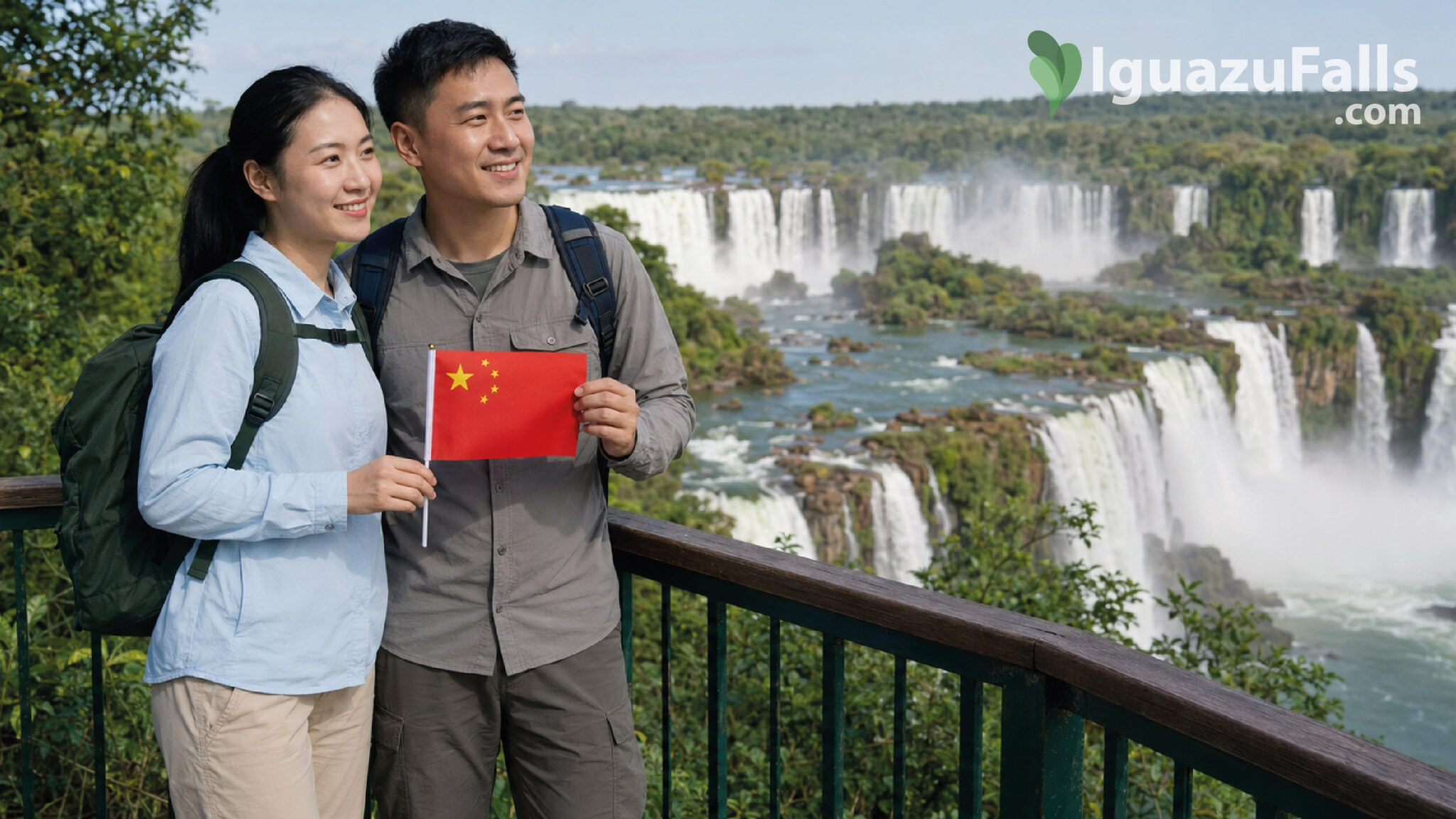
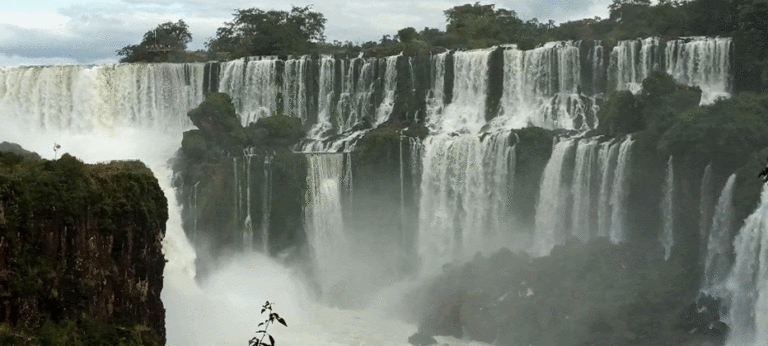
Known in Chinese as 伊瓜苏瀑布 (Yīguāsū Pùbù), Iguazu Falls is one of South America’s most spectacular natural attractions. Located between Argentina and Brazil, the waterfall system is surrounded by protected Atlantic Forest and can be experienced from two national parks with completely different perspectives.
For Chinese travellers, Iguazu represents a dramatic contrast to South America’s major cities. After the architecture, restaurants and cultural attractions of Buenos Aires, Rio de Janeiro or São Paulo, Iguazu offers rainforest, wildlife and the immense sound of water falling across hundreds of individual cascades.
Planning the journey requires more than choosing a hotel and purchasing a park ticket. Visiting both sides involves two countries, separate immigration requirements, different currencies, Portuguese and Spanish languages and payment systems that may not work in the same way as WeChat Pay or Alipay.
This guide addresses the questions Chinese travellers most frequently ask when preparing an Iguazu Falls itinerary.
Iguazu is one of the great natural landmarks of the world and an ideal addition to a first journey through South America.
In Chinese, the expression 不虚此行 (bù xū cǐ xíng) means that a journey was truly worthwhile. Few places represent that idea as convincingly as Iguazu Falls.
The destination appeals to Chinese visitors for several reasons:
For travellers flying such a long distance from China, visiting both Argentina and Brazil generally makes the journey more rewarding.
Experience Argentina’s Icons with Comfort and Style

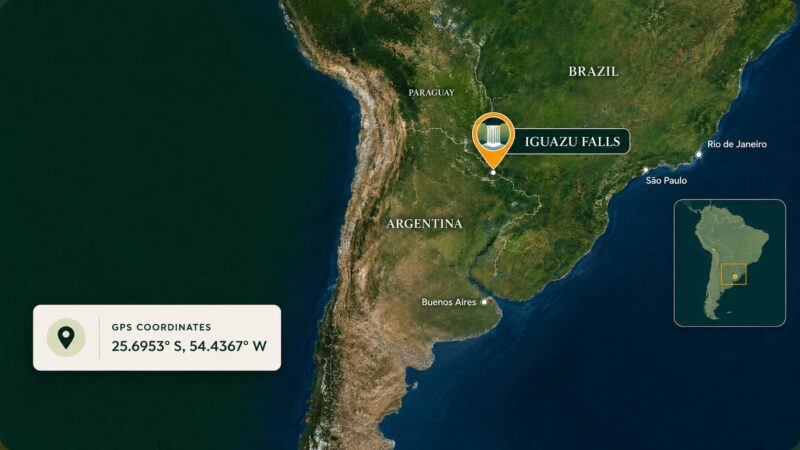
Iguazu Falls is located on the Iguazu River, which forms part of the international boundary between Argentina and Brazil.
The destination includes two gateway cities:
Ciudad del Este in Paraguay forms the third point of the Triple Frontier region, although the waterfalls themselves are not located in Paraguay.
In Simplified Chinese:
The Argentine and Brazilian national parks are separate attractions with different entrances, tickets and immigration requirements.
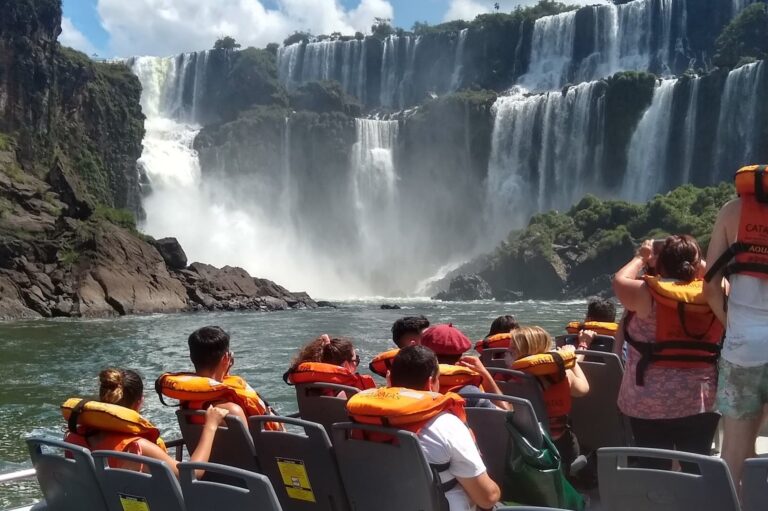
Experience the awe of Iguazu Falls on a 3-day tour from Buenos Aires. Book now for an unforgettable adventure!
From Price: USD190
The two sides should not be treated as interchangeable. They offer complementary experiences.
The Argentine park provides an extensive system of forest paths, elevated walkways and viewpoints. Visitors spend more time moving through the landscape and seeing individual waterfalls from different elevations.
The main experience is close, powerful and immersive. On some walkways, water, mist and forest seem to surround the visitor.
The Argentine side is usually allocated a full day.
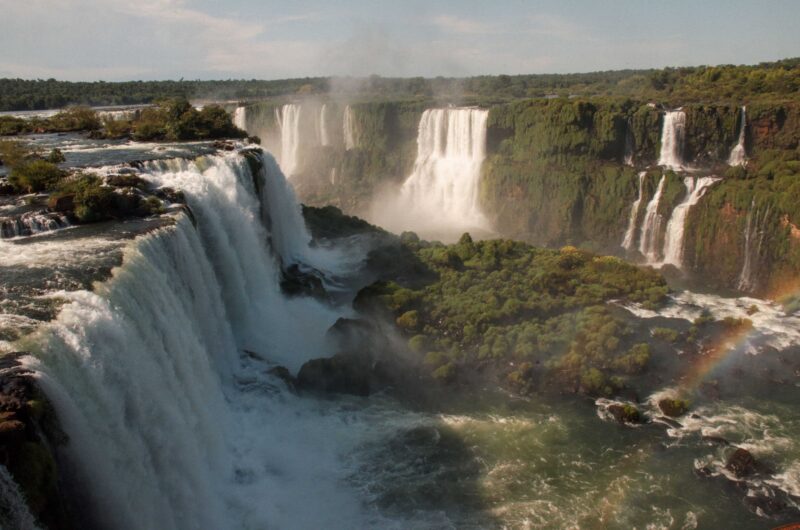
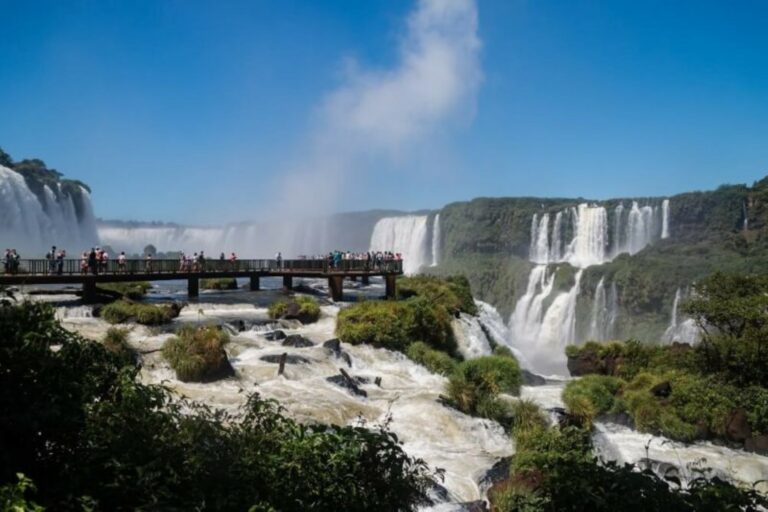
The Brazilian side faces a large portion of the waterfall system, providing the broad panoramic images frequently used in international travel campaigns.
Its principal visitor route is shorter than the Argentine circuits, but the scale of the view is extraordinary. This is often the preferred side for wide photographs, video and landscape composition.
The Brazilian park can generally be visited in approximately half a day, although transportation and border formalities must also be considered.
For broad panoramas, the Brazilian side usually has the advantage. For close details, varied angles, rainforest compositions and the sensation of being surrounded by waterfalls, the Argentine side provides more opportunities.
The best answer is 两边都值得去 (liǎng biān dōu zhíde qù): both sides are worth visiting.
Experience the awe of Iguazu Falls on a 3-day tour from Buenos Aires. Book now for an unforgettable adventure!
From Price: USD190
Chinese citizens must check the immigration rules for Argentina and Brazil separately. A short day trip across the border still counts as formal entry into another country.
Regulations can change, so always verify current requirements through official consular sources before purchasing nonrefundable travel services.
Argentina has special immigration provisions for citizens of the People’s Republic of China.
Since July 2025, Chinese tourists holding a valid and current United States entry visa may, subject to the applicable conditions, enter Argentina without obtaining a separate Argentine visa or Electronic Travel Authorization. The official Argentine announcement states that this facility applies when the qualifying U.S. visa is valid. Check the current Argentine regulation.
Travellers who do not meet the exemption conditions may need to obtain the appropriate authorization or visa before departure.
Because the rules contain specific eligibility conditions, Chinese visitors should confirm their situation with an Argentine consulate or Argentina’s immigration authority.
As of May 2026, Brazil introduced a temporary visa exemption for Chinese citizens holding ordinary passports for eligible visits of up to 30 days, according to official Brazilian consular information. The permitted stay is indicated as non-extendable and applies under the published conditions. Consult Brazil’s current visitor requirements.
Chinese travellers should verify that the exemption remains in force for their travel dates and confirm its precise scope before departure.
If you plan to cross into Ciudad del Este, check Paraguay’s entry requirements separately. Permission to enter Argentina or Brazil does not provide automatic admission to Paraguay.
Chinese travellers should carry:
Screenshots are useful as backups, but they do not replace original travel documents.
Experience Argentina’s Icons with Comfort and Style
There are no nonstop flights between mainland China and Iguazu. Travellers generally connect through a major international city and then take a domestic or regional flight.
A common route is:
China → international connection → Buenos Aires → Puerto Iguazú
Flights from Buenos Aires to Iguazu may depart from:
Pay close attention to the airport shown on each ticket. An itinerary arriving internationally at Ezeiza and continuing from Aeroparque requires a transfer across Buenos Aires.
Allow generous time between flights. Traffic conditions, immigration and baggage collection can make a tight airport change risky.
Another common route is:
China → international connection → São Paulo or Rio de Janeiro → Foz do Iguaçu
São Paulo is Brazil’s principal international aviation hub and offers domestic connections to Foz do Iguaçu.
For a longer South American journey, an open-jaw arrangement can reduce unnecessary travel.
For example:
China → Buenos Aires → Puerto Iguazú → Foz do Iguaçu → Rio de Janeiro or São Paulo → China
This route allows the traveller to visit the Argentine park, cross into Brazil and continue without returning to Argentina.
However, the international border must be crossed with all luggage, and the itinerary requires valid entry permission for both countries.
Three nights is the most comfortable choice for a first visit.
A two-night stay can work if arrival and departure times are convenient:
This schedule offers little flexibility for weather, delayed flights or long border queues.
A more balanced plan is:
This itinerary allows visitors to enjoy each park without excessive rushing.
Four nights suit travellers who prefer a slower rhythm, families with children, senior travellers or photography enthusiasts.
The additional day can include:
A common Chinese expression is 慢慢来 (mànmàn lái), meaning to take things gradually. Iguazu rewards precisely this approach.

Experience a breathtaking night under the stars at Iguazu Falls, in a peaceful and exclusive setting inside the Brazilian side of the national park.
From Price: USD265
Both cities offer good accommodation, but the experiences differ.
Puerto Iguazú is smaller, quieter and closely connected with the Argentine side. Its central area has restaurants, cafés, shops and access to local transportation.
It suits travellers who want:
Foz do Iguaçu is a larger Brazilian city with more urban infrastructure, shopping, restaurants and hotel options.
It suits travellers who want:
Changing hotels can be useful if the journey continues into Brazil. Travellers can visit Argentina first, cross the border with their luggage and spend the final night in Foz.
For a short round trip from Buenos Aires, remaining in Puerto Iguazú and visiting Brazil on a day excursion is simpler.
DISCOVER A WONDERFUL PLACE TO ENJOY BIRDWATCHING. BE READY WITH YOUR BINOCULARS.

Chinese guests may have preferences that are not standard at every South American hotel. It is worth contacting the property before booking.
Ask about:
Many Chinese travellers prefer warm or hot water, 热水 (rèshuǐ), throughout the day. Electric kettles are not universal in Argentine and Brazilian hotel rooms.
Ask the hotel to confirm whether a kettle is available. A compact dual-voltage travel kettle may be helpful, but it must be compatible with local electrical standards.
A “double room” in South America may mean one large bed rather than two separate beds. Request a twin room explicitly if individual beds are required.
Confirm the arrangement in writing, particularly for friends, colleagues or multigenerational families.

Enjoy visiting Puerto Iguazu, the three frontier landmark, Guira Oga and the Aripuca in a wonderful half day trip
From Price: USD55
Argentina uses the Argentine peso, while Brazil uses the Brazilian real.
WeChat Pay and Alipay are central to daily life in China, but visitors should not assume they will be accepted in Iguazu.
A limited number of businesses serving international or Chinese clients may support them, but they are not standard payment methods in most local hotels, restaurants, taxis or park services.
Carry alternative payment methods.
UnionPay acceptance varies. Some terminals and ATMs may support it, while others may not.
Travellers should bring at least one internationally enabled Visa or Mastercard as a backup. Contact the issuing bank before departure and make sure overseas transactions are activated.
Carry a moderate amount of local currency for:
Avoid carrying excessive cash or exchanging money with unknown individuals.
When the card terminal offers a choice, paying in the local currency is generally preferable to accepting an automatic conversion into Chinese yuan. The conversion offered by the terminal may include an unfavourable exchange rate.
If the itinerary includes Paraguay, there may be three currencies:
U.S. dollars may be accepted in some tourism contexts, but the exchange rate offered by individual businesses can vary.
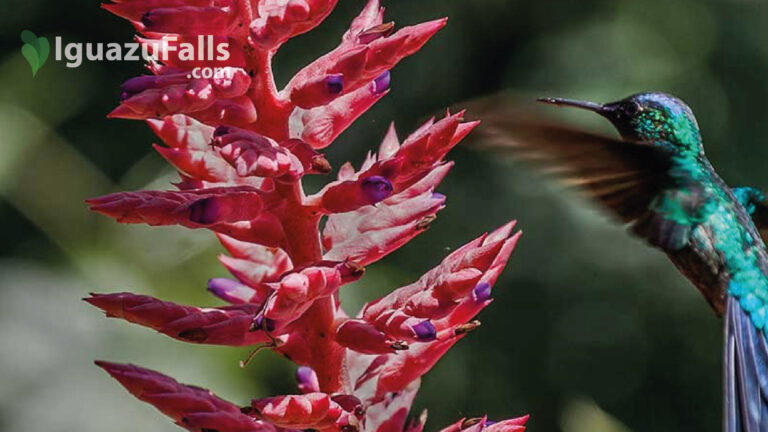
Enjoy a unique 3-night birdwatching tour in rainforest lodge
Wi-Fi is available in many Iguazu hotels, but speed and stability differ. Mobile coverage is generally stronger in the cities than deep inside the rainforest.
WeChat should remain an important communication tool for Chinese travellers abroad. Sina Weibo, Xiaohongshu and other Chinese platforms may also be used, subject to the traveller’s device, roaming service and account settings.
Download essential applications and confirm account access before leaving China.
Outside China, many local tourism companies communicate through WhatsApp. Chinese visitors who do not normally use it may find it helpful for contacting hotels, drivers and guides.
Google Maps and Google Translate are also widely useful outside mainland China. Travellers should install and test any necessary applications before departure.
The options include:
A SIM valid in Argentina may not include Brazilian data. Because the cities are close to the border, a phone can connect to a network in another country and generate roaming charges.
Turn off automatic roaming if your plan does not cover both countries.

Explore the Brazilian side of Iguazu Falls and visit Parque das Aves in a single full-day experience.
From Price: USD95
Before leaving the hotel, download:
Mobile service can be weaker in forested areas.
Spanish is spoken in Puerto Iguazú, while Portuguese is spoken in Foz do Iguaçu.
English is used by many tourism professionals, but fluency is not universal. Chinese-speaking guides are much less common and should be requested well in advance.
For a family group or a traveller unfamiliar with Spanish and Portuguese, a private guide can greatly simplify the experience.
| English | Chinese | Spanish | Portuguese |
|---|---|---|---|
| Hello | 你好 (nǐ hǎo) | Hola | Olá |
| Thank you | 谢谢 (xièxie) | Gracias | Obrigado/Obrigada |
| Please | 请 (qǐng) | Por favor | Por favor |
| How much is it? | 多少钱?(duōshao qián?) | ¿Cuánto cuesta? | Quanto custa? |
| Where is the entrance? | 入口在哪里?(rùkǒu zài nǎlǐ?) | ¿Dónde está la entrada? | Onde fica a entrada? |
| I need help | 我需要帮助 (wǒ xūyào bāngzhù) | Necesito ayuda | Preciso de ajuda |
| No spicy food | 不要辣 (bú yào là) | Sin picante | Sem pimenta |
| Hot water | 热水 (rèshuǐ) | Agua caliente | Água quente |
| Rice | 米饭 (mǐfàn) | Arroz | Arroz |
| Hospital | 医院 (yīyuàn) | Hospital | Hospital |
| Passport | 护照 (hùzhào) | Pasaporte | Passaporte |
Save the name and address of the hotel in Spanish or Portuguese, not only in Chinese.
The local dining scene is based primarily on Argentine, Brazilian and regional cuisine.
Visitors will find beef, chicken, fish, rice, cassava, salads, pasta, empanadas and grilled dishes. Foz do Iguaçu generally offers greater international and Asian food variety because it is a larger and highly multicultural city.
Chinese and Asian-style restaurants may be available in the broader region, especially in Foz do Iguaçu, but travellers should not expect the same range or flavours found in Beijing, Shanghai, Guangzhou, Chengdu or other Chinese cities.
Groups that require Chinese meals should arrange them in advance through an experienced operator.
Hotel breakfast in Argentina and Brazil may include:
Congee, steamed buns, noodles and warm vegetables are not standard everywhere.
Travellers with strong breakfast preferences can ask whether the hotel can provide:
Dinner in Argentina often begins later than in China. Some restaurants become busiest after 8:00 or 9:00 p.m.
Chinese families preferring an earlier meal should check opening hours and reserve in advance.
Useful phrases include:
Explain serious allergies clearly and carry a written translation.
One single amazing destination, three different countries!
Tea, 茶 (chá), occupies an important place in Chinese daily life. Local hotels commonly provide black tea or herbal infusions, but Chinese green, oolong or pu’er tea may not be readily available.
Travellers can bring their preferred tea in commercially packaged form, subject to customs regulations. Avoid carrying loose plant material without checking import restrictions.
A thermal bottle is particularly useful during transfers, but restrictions may apply to liquids at airport security.
Iguazu has a humid subtropical climate. Rain can occur throughout the year, and the forest remains green in every season.
Summer is hot and humid. Temperatures can feel intense during long walks, and thunderstorms are possible.
The advantage is an energetic tropical atmosphere and lush vegetation.
Autumn often provides warm conditions with less extreme heat. It is one of the most comfortable periods for walking.
Winter is usually milder, but mornings and evenings can be cool. Occasional cold periods are possible.
Chinese visitors should not assume that all of Brazil and northern Argentina remain hot every day of the year.
Spring becomes progressively warmer and is an attractive time for wildlife, vegetation and photography.
The Lunar New Year period, 春节 (Chūnjié), falls during the South American summer. Visitors should prepare for heat, humidity and possible rain.
Book flights and hotels early, especially when combining Iguazu with Rio de Janeiro or destinations affected by Carnival demand.
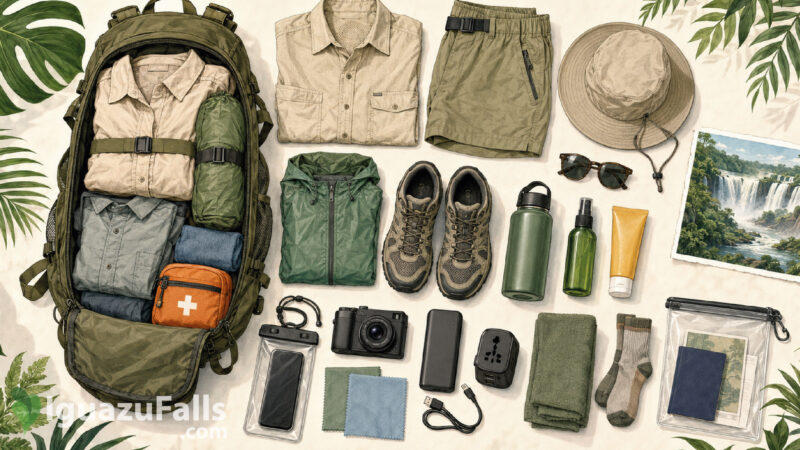
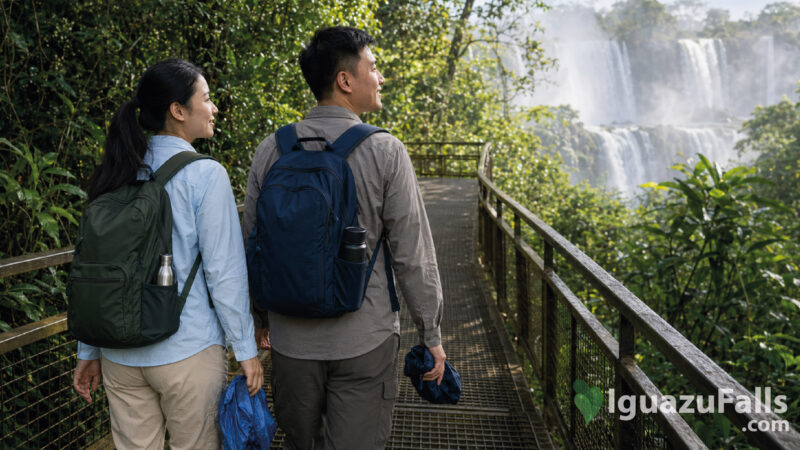
Choose clothing for humidity, water spray and walking rather than for formal sightseeing.
Bring:
Heavy denim can remain wet for a long time. Quick-drying fabrics are more comfortable.
Visitors who prefer stronger sun protection can wear lightweight long sleeves and long trousers.
Argentina and Brazil use different plug types, and voltage can vary.
Chinese travellers should carry a high-quality universal travel adapter compatible with their electronics. Check each device for an input rating such as 100–240V.
Do not assume that a plug adapter changes voltage. An adapter only changes the physical connection.
A portable battery is essential for long park days, particularly when using the phone for photography, translation and tickets.
Power banks must normally be transported in carry-on luggage rather than checked baggage. Confirm the airline’s capacity limits before departure.
Experience the awe of Iguazu Falls on a 3-day tour from Buenos Aires. Book now for an unforgettable adventure!
From Price: USD190
Iguazu is highly photogenic and well suited to content for Xiaohongshu, WeChat Moments, Douyin and Weibo.
The Brazilian park provides the classic broad view across the waterfall system. Wide-angle lenses work particularly well.
The Argentine park offers more walking routes, close waterfalls, forest scenes, butterflies, ecological trains and changing perspectives.
Water spray can reach the viewpoints even when it is not raining.
Bring:
Do not change camera lenses in heavy spray.
Do not assume recreational drones are permitted. National parks protect wildlife and control aerial operations. Flying without authorization may violate park and aviation regulations.
Leave the drone at the hotel unless all required permissions have been obtained.
Ask before photographing local residents, Indigenous people, staff or other visitors.
A useful phrase is:
Platforms such as Xiaohongshu frequently feature practical questions about transportation, photography, clothing and whether both parks are necessary.
It may be technically possible under favourable conditions, but it is not recommended. Border delays and park distances can turn the day into a rushed transfer.
Allow one day for Argentina and at least half a day for Brazil.
At some viewpoints, spray can be strong. On a boat excursion, visitors should expect to become thoroughly wet.
A poncho helps with light spray but may not keep clothing dry during a boat adventure.
A large suitcase is inconvenient and may be restricted in visitor transport. Leave main luggage at the hotel or use confirmed storage facilities.
Yes. Many areas have organized transportation and accessible walkways. However, walking distances, humidity and some changes in elevation must be considered.
A private transfer and guide can make the day more comfortable.
Yes. Families should supervise children around wildlife, keep them on designated paths and build rest periods into the day.
Mosquitoes and other insects are part of the subtropical environment. Apply repellent and follow current health recommendations.
No. Paraguay is part of the Triple Frontier region, but the Iguazu Falls visitor areas are in Argentina and Brazil.
Not necessarily, but basic phrases and translation applications are extremely helpful. A Chinese-speaking or English-speaking guide is recommended for travellers who want detailed interpretation.
For Chinese families, senior travellers and groups with limited language confidence, a private tour can be valuable. It provides assistance with transport, timing, tickets and border procedures.
An amazing 8-night program to enjoy the best of the nature and wonders of the Argentinian Northeast

Multigenerational travel is particularly important in the Chinese market. Iguazu can be enjoyed by older travellers, but the itinerary should be adjusted.
Avoid combining both national parks in one day. Start early, include seated breaks and avoid adding too many optional attractions.
Private transportation reduces waiting, walking between stops and uncertainty at the border.
Confirm:
The heat and humidity may affect people with cardiac, respiratory or mobility limitations. Travellers should discuss concerns with their doctor before departure.
Carry medication in hand luggage with translated prescriptions when appropriate.
A smart, great-value way to see Iguazu Falls in two nights. Stay at a confirmed 3-star hotel, join shared group tours to both the Brazilian and Argentine sides, and enjoy shared transfers from and to IGR or IGU.
Iguazu can provide an educational family experience combining geography, ecology and wildlife.
Children often enjoy:
Parents should ensure that children:
Food should never be offered to coatis. They are wild animals and may bite or scratch.
The forest contains monkeys, coatis, birds, reptiles and insects.
The principle 保持距离 (bǎochí jùlí)—keep your distance—is essential.
Visitors should never:
Coatis can open bags and take food. Keep backpacks closed.
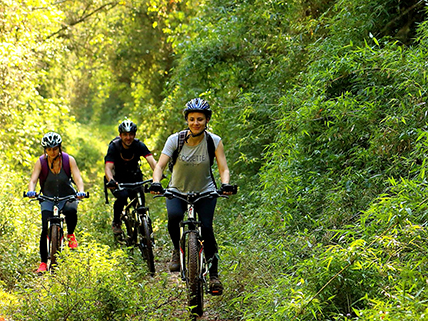
Enjoy a wonderful 4-hour biking tour in the jungle
From Price: USD185
Comprehensive travel insurance is strongly recommended for visitors travelling from China.
A suitable policy should cover:
Confirm whether boat excursions and other adventure activities are covered.
Bring sufficient medication for the complete trip. Keep it in original packaging and carry a prescription or medical certificate when necessary.
Do not place essential medication only in checked baggage.
Use repellent and follow current travel-health guidance concerning mosquito-borne illnesses and recommended vaccinations.
Health requirements can change, so consult official medical and consular information before departure.
Experience a breathtaking night under the stars at Iguazu Falls, in a peaceful and exclusive setting inside the Brazilian side of the national park.
From Price: USD265
The international crossing connects Puerto Iguazú and Foz do Iguaçu through the Tancredo Neves Bridge.
Waiting periods depend on traffic, season, holidays and immigration procedures. Do not schedule a flight immediately after a cross-border park visit.
A photograph of the passport or a copy on WeChat is not sufficient for immigration.
Make sure the correct immigration procedure is completed. Do not assume it is optional because local passengers appear to cross differently.
A prearranged transfer or guided service simplifies the process, particularly for travellers who do not speak Spanish or Portuguese.
Confirm whether the driver waits during immigration and whether the quoted price includes border assistance.
The national park visitor areas are structured and generally comfortable for international tourists. Normal precautions remain important in the surrounding cities and during transportation.
Chinese-speaking emergency assistance may not be immediately available. Travelling with translated medical and contact information can be very helpful.
Argentine and Brazilian communication may feel more expressive and informal than interaction in China.
Handshakes are common in formal introductions. Friends may greet one another with a cheek kiss, but international visitors are not expected to imitate this if uncomfortable.
Tourism services operate according to schedules, but restaurant and social culture can feel more relaxed.
Arrive punctually for transfers and excursions.
Tipping practices differ from China, where tipping is traditionally less common.
In restaurants, a tip may not be included in the bill. Guides and drivers also commonly receive tips when service is good. Ask the tour operator for current local guidance.
Local people may speak energetically or stand closer during conversation than some Chinese visitors expect. This is usually a sign of warmth rather than confrontation.
Residents may ask where a traveller is from or express interest in China. A friendly answer can lead to enjoyable conversations.
Popular Iguazu souvenirs include:
Check Chinese customs regulations before carrying food, seeds, plants, wood or animal-derived products home.
Avoid purchasing wildlife products or anything that may have been made from protected species.
Ciudad del Este is a major commercial centre, but travellers should compare prices, verify warranties and understand customs allowances.
Purchase electronics only from established businesses and request a receipt. A lower price is not necessarily good value if the product lacks an international warranty or compatible voltage.
One single amazing destination, three different countries!
Arrive at the Argentine airport and transfer to the hotel.
Use the afternoon to rest after the journey or visit Hito Tres Fronteras near sunset. Enjoy an early dinner and prepare for the park visit.
Spend the full day exploring the Argentine national park with a guide.
Depending on current operations and access, the day may include the principal circuits, ecological train and Devil’s Throat area.
Return to the hotel and enjoy a relaxed dinner.
Cross into Brazil with the required documentation.
Visit the Brazilian national park for panoramic views, followed by Parque das Aves. Return to Argentina or stay overnight in Foz do Iguaçu if continuing through Brazil.
Transfer to the appropriate airport and continue towards Buenos Aires, Rio de Janeiro, São Paulo or another destination.
For a less rushed itinerary, add a fourth night and use the extra day for Itaipu, a cultural activity or rest.
| Chinese | Pinyin | English |
|---|---|---|
| 伊瓜苏瀑布 | Yīguāsū Pùbù | Iguazu Falls |
| 阿根廷 | Āgēntíng | Argentina |
| 巴西 | Bāxī | Brazil |
| 国家公园 | Guójiā Gōngyuán | National park |
| 护照 | Hùzhào | Passport |
| 签证 | Qiānzhèng | Visa |
| 酒店 | Jiǔdiàn | Hotel |
| 机场 | Jīchǎng | Airport |
| 门票 | Ménpiào | Entrance ticket |
| 导游 | Dǎoyóu | Tour guide |
| 热水 | Rèshuǐ | Hot water |
| 洗手间 | Xǐshǒujiān | Restroom |
| 药店 | Yàodiàn | Pharmacy |
| 医院 | Yīyuàn | Hospital |
| 紧急情况 | Jǐnjí qíngkuàng | Emergency |
| 无线网络 | Wúxiàn wǎngluò | Wi-Fi |
| 出口 | Chūkǒu | Exit |
| 入口 | Rùkǒu | Entrance |
| 谢谢 | Xièxie | Thank you |
| 请帮帮我 | Qǐng bāngbang wǒ | Please help me |
Iguazu Falls is commonly written as 伊瓜苏瀑布 and pronounced Yīguāsū Pùbù.
Argentina applies specific rules to Chinese passport holders. Eligible travellers holding a valid U.S. visa may qualify for visa-free entry under current conditions. Other travellers may require advance authorization. Verify the latest requirements through official Argentine sources.
Brazilian official information currently describes a short-stay visa exemption for eligible Chinese ordinary-passport holders introduced in May 2026. Confirm that it applies to your dates and circumstances.
Alipay and WeChat Pay should not be relied upon as primary payment methods. Bring internationally enabled bank cards and some local currency.
They may be available through specialized operators, but supply is limited. Request one as early as possible.
Foz do Iguaçu has the broader multicultural dining scene. Chinese-style meals may be available, but groups with specific requirements should arrange them in advance.
Yes, with appropriate pacing, transportation and attention to heat, walking distances and health conditions.
Most hotels offer Wi-Fi, but connectivity can be weaker inside the national parks. Save tickets and essential documents offline.
One single amazing destination, three different countries!
Without question, 非常值得 (fēicháng zhíde)—it is absolutely worth it.
Iguazu Falls combines the scale of a world-famous natural wonder with the excitement of visiting Argentina and Brazil in a single journey. It offers powerful landscapes, extraordinary photography and a memorable introduction to the Atlantic Forest.
For Chinese travellers, the most important preparation involves visas, payment alternatives, border logistics, language support and hotel preferences such as twin beds, hot water and suitable meals.
Once these details are organized, the experience itself is wonderfully simple: walk through the forest, listen to the rising roar of the water and approach one of the most remarkable landscapes on Earth.
As the Chinese expression says, 读万卷书,行万里路 (dú wàn juàn shū, xíng wàn lǐ lù)—read ten thousand books and travel ten thousand miles. Iguazu Falls is precisely the kind of place that makes the long journey worthwhile.

Experience the wonder of Iguazu Falls on a private 2 day tour from Buenos Aires. Easily reserve accommodations and optional activities. Book now!
From Price: USD150
Experience the awe of Iguazu Falls on a 3-day tour from Buenos Aires. Book now for an unforgettable adventure!
From Price: USD190
